
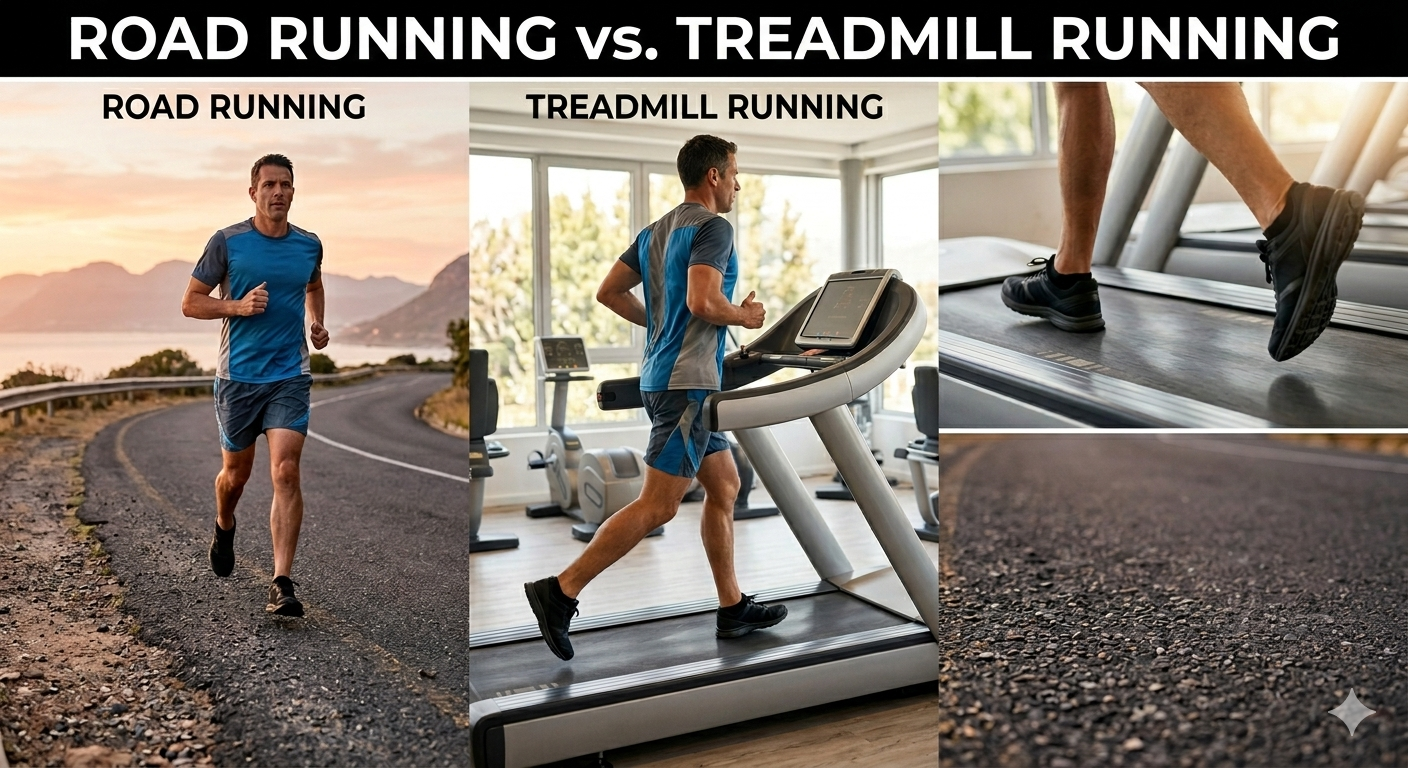
- Introduction: The Great Debate for Many Runners
- Are these two running options different from one another?
- The Treadmill Running: A Precision Laboratory for Form and Recovery
- The Great Outdoors: Embracing Natural Terrain and Sensory Richness
- Deciphering the Outdoor Running Surface: Which Terrain is Right for You?
- The Verdict: Crafting Your Running Blueprint for Longevity After 40
- Bottomline:
- For – Brands | Businesses | Coaches
Introduction: The Great Debate for Many Runners
Many runners debate the choice between open road running and treadmill running. Let’s break it down for midlife runners navigating their second chapter of fitness, the choice is no longer just about convenience – it’s about sustained preference, injury prevention and longevity.
Every runner develops a signature style and has a set of preferences, but as we cross the 40-year milestone, the “surface” we choose dictates the metabolic and mechanical stress placed on our aging architecture. While both these running modalities are exceptional tools for cardiovascular conditioning and caloric expenditure, they interact with your physiology in fundamentally different ways.
Maintaining peak fitness after 40 requires a shift from “just running” to intentional movement and kinetic chain engagement. Whether you are drawn to the sensory richness of an outdoor trail or the data-driven precision of a treadmill, each environment offers unique “plus and minus” points that can either accelerate your recovery or contribute to wear and tear.
In this guide, we break down the biomechanical nuances of both options to help you decide which tool deserves more space in your weekly training block. Drawing from over 17 years of daily running discipline and a deep dive into science-backed biomechanics, I’ve found that the “best” choice often lies in a strategic hybrid approach.
By understanding how terrain affects everything from your neural “Body GPS” (proprioception) to the rotational stability of your hips, you can transform a simple run into a powerful tool for physical preservation. Let’s look at the data to see which running option you should pick to thrive in your next decade of miles.
Are these two running options different from one another?
The primary difference between treadmill and outdoor running lies in the environmental settings, but both offer cardio health benefits. Biomechanical differences are minor, with evidence indicating more similarities. Outdoors may be more physically demanding due to weather and terrain. Treadmills allow you to run in a more controlled environment.
The Treadmill Running: A Precision Laboratory for Form and Recovery
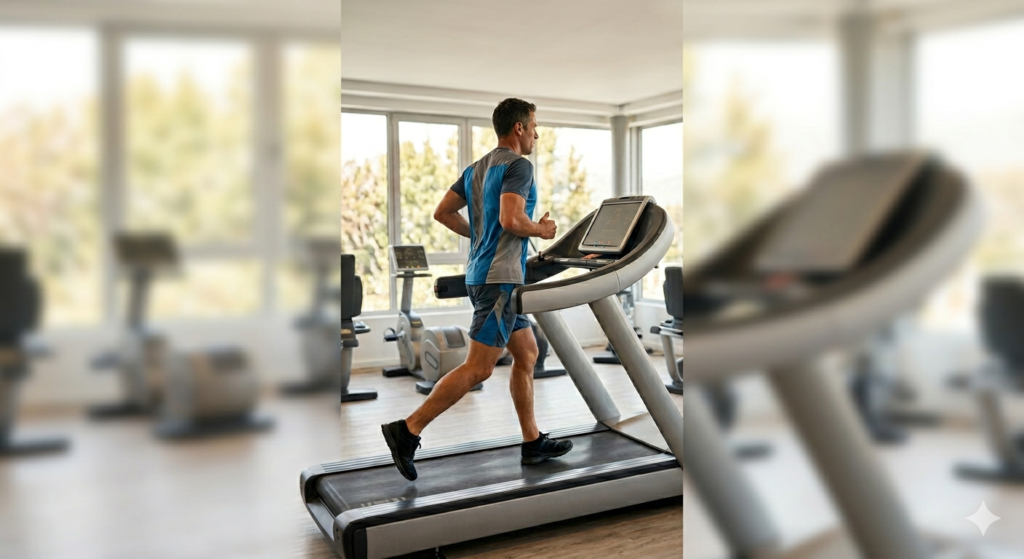
When viewed through the lens of biomechanics, the treadmill is more than just a backup for running during bad weather. It is a controlled environment where you can isolate and refine the mechanics of your gait. For the runner over 40, this precision is a massive asset for injury prevention. When you remove the “noise” of wind resistance and uneven terrain, you can focus entirely on the kinetic chain.
The Advantages (Pros):
- A “Body GPS” Recalibration Tool: The flat, predictable surface of the treadmill is an excellent way to improve proprioception, which is your brain’s ability to sense your body’s position in space. After an injury, the “noise” of uneven outdoor terrain can be overwhelming for a runner. Here the treadmill allows you to “re-map” your neural pathways in a safe, stable setting. After a layoff or a minor injury, this predictable surface allows your nervous system to re-map efficient movement patterns without the risk of tripping on unexpected curbs or stones.
- Precision Stride and Hip Correction: Because the belt moves at a constant velocity under your center of mass, it naturally discourages overstriding (landing too far in front of the body). This setting allows you to focus specifically on hip rotational stability, ensuring your pelvis remains level and your knees don’t collapse inward – a common mechanical flaw that contributes to injury as we age.
- Reduced Impact on Aging Architecture: Modern treadmill decks are engineered with shock absorption that is significantly more forgiving than asphalt or concrete. It reduces the peak impact forces on your knees and lower back, facilitating a “joint-friendly” workout that aids long-term longevity.
- Convenience and Metric Tracking: You have total control over your “environmental variables,” such as incline and speed, allowing for a data-driven workout regardless of the weather outside.
The Challenges (Cons):
- The “Boredom” Barrier: Without the sensory variety of the outdoors, treadmill running can feel monotonous, which may impact long-term motivation.
- Altered Muscle Activation: Because the belt pulls the ground away from you, your hamstrings and glutes may not work as hard to “propel” you forward as they would on solid ground.
- Malfunction Risks: While rare, mechanical issues or incorrect belt tension can lead to unexpected accidents if the equipment isn’t maintained well.
The Great Outdoors: Embracing Natural Terrain and Sensory Richness
For many runners, the allure of the outdoors is undeniable. Stepping outside offers a direct connection to nature and a constant state of sensory exploration. While treadmills provide a controlled setting, the open road or trail introduces a dynamic environment that challenges both the body and the mind in distinct ways.

The Natural Advantages (Pros):
- Diverse Terrain for Functional Strength: Outdoor running paths, whether a winding road, a grassy park, or a rugged trail, are never perfectly uniform. Every step requires subtle adjustments as your feet navigate uneven surfaces, gentle slopes, and varying textures. This constant variation naturally engages and strengthens your important stabilizer muscles in the hips and ankles, which are often less active on a treadmill.
- Variable Muscle Engagement: Unlike the predictable, flat belt of a treadmill, running outside frequently involves navigating natural elevations and changes in direction. Uphill sections build powerful glutes and hamstrings, while downhill running puts unique eccentric demands on your quadriceps, aiding in joint robustness. Each turn and obstacle encourages a wider range of motion and helps prevent overuse injuries by distributing impact forces more broadly.
- A “Sensory Rich” Experience: Running outdoors is a feast for the senses, providing fresh air, natural sunlight (essential for Vitamin D production), and ever-changing scenery. This immersion in nature can significantly boost your mental well-being, reduce stress, and enhance running motivation long-term, making your workouts feel less like a chore.
- Functional Movement and Agility: The simple acts of stepping over roots, dodging puddles, or navigating around others require quick decision-making and precise foot placement. These actions sharpen your general coordination and agility, translating into better everyday movement and reduced risk of falls, especially valuable for midlife runners.
The Environmental Trade-offs (Cons):
- Weather Vulnerability: Rain, snow, extreme temperatures, and wet leaves can transform a pleasant run into a risky endeavor. Slippery surfaces significantly increase the chance of accidental running injuries from falls or strains.
- Navigational Safety Hazards: Sharing your running space with traffic, cyclists, and aggressive pets introduces a continuous element of risk. Navigating sidewalks and crosswalks demands constant vigilance, which can distract from purely enjoying your run.
- Surface Consistency and Impact: Not all outdoor surfaces are created equal. Running consistently on concrete sidewalks can deliver higher peak impact forces to aging joints than a cushioned treadmill deck or a soft dirt trail, requiring thoughtful route planning to maintain joint longevity.
Deciphering the Outdoor Running Surface: Which Terrain is Right for You?
Not all outdoor miles are the same. The surface you choose dictates the level of proprioceptive feedback, lateral joint stability, and cumulative impact your body receives. As midlife runners, selecting the right outdoor terrain is crucial for balancing training stimulus with joint preservation.

Here is how different outdoor surfaces impact your mechanics:
Trail Running: The Ultimate Stabilizer Workout
Trails (dirt, gravel, rocky paths) offer the lowest impact but the highest complex demand. The uneven, unpredictable terrain forces your nervous system to stay alert, significantly enhancing proprioception. Every step requires micro-adjustments in the ankles and hips, which builds tremendous reflexive, functional strength that you cannot replicate on a treadmill.
- Best For: Active recovery, building ankle stability, and mental escape.
- Caution: Requires focus to avoid acute injuries like sprained ankles.
Road (Asphalt) Running: The Predictable Grind
Asphalt is the default setting for most runners, offering consistency for speed and pacing. While more forgiving than concrete sidewalks, it is still a hard surface that delivers a repetitive impact force to the joints. Its uniformity allows for predictable hip and knee tracking, but it lacks the lateral stability challenges of trails.
- Best For: Marathon training, tempo runs, and consistency.
- Caution: High repetitive mechanical load requires careful mileage management for sustainable running after 40.
Track Running: Precision and Safety
Synthetic tracks offer the “perfect” intermediate surface. They provide some soft comfort (unlike asphalt), are perfectly flat, and are traffic-free, making them an excellent outdoor equivalent to the treadmill for precision interval training.
- Best For: Speed workouts, interval training, and recovering from injury (while still being outdoors).
- Caution: Running too many loops in one direction can cause imbalances; always switch directions.
Soft Surfaces: Barefoot Beach & Cross-Country Grass
- Cross-Country/Grass: The softest common natural surface, grass offers significant cushioning and excellent lateral stabilization work. It requires high hip rotational stability to maintain form.
- Barefoot Beach Running: Running on soft or slightly harder wet sand forces the small muscles of the feet and ankles to work intensely. It provides incredible proprioceptive feedback, essentially functioning as a natural “foot strengthener.”
- Caution: These surfaces are deceptively demanding. Wet sand, while stable, can be slanted, placing uneven stress on the Achilles tendons. Always introduce soft surface work (especially barefoot running) very gradually to avoid tendonitis.
The Verdict: Crafting Your Running Blueprint for Longevity After 40
It is a common habit for many runners to prefer the freedom of the outdoors, but rely on treadmills as a fallback during harsh weather conditions. While this approach keeps you consistent, it misses a powerful opportunity to maximize your longevity and resilience.
It is true that the most crucial factor for achieving peak fitness after 40 is consistent effort. However, to thrive in the coming decades, you must move beyond forced binary choices. A longevity mindset doesn’t view the treadmill as a punishment; it views it as a tactical diagnostic tool.
The NadyFitness Hybrid Strategy: The “1 in 10” Blueprint
Drawing from 17 years of daily discipline, I have found that a hybrid strategy is the gold standard for maintaining the delicate balance between high-volume training and joint preservation. I recommend a deliberate hybrid structure, regardless of whether you primarily love the road or the machine.
The Blueprint for the Primary Outdoor Runner
If you are an outdoor runner, your primary training landscape should already be a mix of varying terrains like asphalt, light trails, flat segments, and challenging uphill routes. This natural variability builds the essential lateral hip stability and functional, unpredictable movement required for a robust kinetic chain.
However, I recommend dedicating 1 out of every 10 sessions to the treadmill. The predictable environment helps you strip away the “noise” of terrain and identify errors in form you may have picked up outdoors, helping you fix them safely. Use this “1 in 10” session not for intense cardio, but as a dedicated form and proprioception review.
If possible, run in front of a mirror. Intentionally monitor your landing to correct overstriding and strictly observe your pelvis to ensure you are maintaining hip rotational stability as you fatigue.
The Blueprint for the Primary Treadmill Enthusiast
If you are a regular treadmill runner, you have an incredible tool at your disposal for consistent metric-driven workouts and shock absorption. However, many machine users make the critical mistake of running with too much uniformity. To maximize your longevity on the treadmill, you must mix up your daily sessions with deliberate machine settings like variable incline (simulating hills), interval training, and varied speed.
To complete your longevity blueprint, I also recommend that you take at least 1 in every 10 running sessions outdoors. This outdoor session is not about speed; it is your “functional test.” It helps you evaluate your actual lateral hip stability, balance, and real-world kinetic chain engagement – elements that are less assisted by a motorized belt. Most importantly, it trains your nervous system to respond to the unpredictable movement dynamics of an outdoor setting.
Bottomline:
I admit “Treadmill Running vs. Outdoor Running” is not a good title for this post, because it is not really about a forced choice. The focus should be on how treadmill and outdoor running build longevity and resilience. It does not matter what surface you run on, as long as you are consistent in your efforts. Kudos to you for moving toward the small percentage of fit people out there. Just try to use variation to supplement the inherent drawbacks of your favorite running surface.
For – Brands | Businesses | Coaches
If your brand or website needs top-quality blog content or end-to-end blog management, chat with me today. I create content with the same clarity, science-backed storytelling, and motivational rhythm you just read.
I offer blog management and content writing services across diverse sectors, whether your niche is fitness and health (my favorite), technology, lifestyle, or business – I specialize in turning topic ideas into engaging, SEO-optimized blog posts that your readers will trust and love.
Let’s build your business authority online with content that delivers both value and results.
 Chat With Nady on WhatsApp
✍️ Explore Our Blog Writing Services
Chat With Nady on WhatsApp
✍️ Explore Our Blog Writing Services