

After more than 17 years of running 6 days a week, I’ve learned that a single stumble can be life-altering. As we age, we often focus on lung capacity or muscle mass, but there is a silent system governing our safety that declines in the background without warning. If you’ve ever felt a ‘neural lag’ or a heavy ‘thud’ in your steps instead of fluid strides, it’s time to talk about your ‘Body GPS.’ Discover how to master proprioception after 40, prevent injury, and strengthen the mind-muscle connection for lifelong stability.”
The Body Skill You Are Silently Losing
We live in an age where almost everything about our bodies can be measured, graphed, and optimized. The data on biomechanics and vitals are endless, and for many of us, it is oddly comforting when the numbers are in the "safe zones." It gives the illusion that if we track enough, we control enough.
But beneath all that precision, there is a system we rarely think about - until it fails us. It erodes silently over time, never sending a warning signal. Yet, it is the exact system that determines whether you can move confidently at 65, or recover from a trip at 55 instead of falling.
This system operates below our conscious awareness: the vestibular system and proprioception. Together, they form your internal navigation network - your brain’s constant, silent understanding of where your body is in space, how it is moving, and how to keep you from falling.
The Uncomfortable Truth of "Neural Lag"
Here is the reality of proprioception after 40: as we age, our nerve conduction velocity begins to decline. It isn’t dramatic; it won’t interrupt your morning walk or your weekend routine. Instead, it shows up as something subtle and easy to miss - what I call "neural lag." Most people simply aren't trained to read the signs.
At 25, you might misstep and recover instantly, almost effortlessly. At 51, that same misstep lingers just a fraction longer. It’s not enough for you to notice consciously, but it is enough to matter.
That fraction of a second? That is where injuries live.
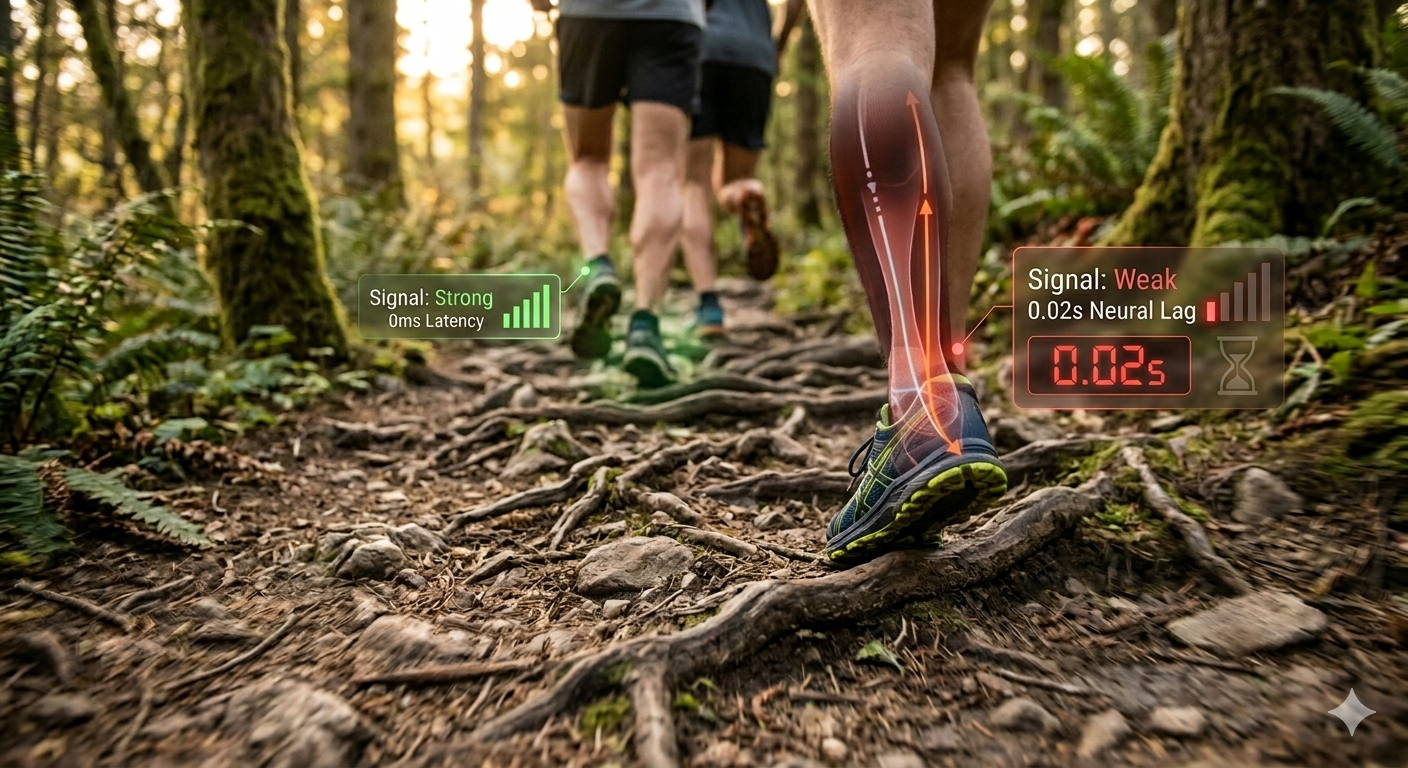 The Anatomy of a Stumble: When your "Body GPS" signal delays by just 0.02 seconds, a split-second delay of simple micro-adjustment becomes a fall. Mastering proprioception after 40 is about restoring this internal signaling system - training your brain to react before impact control is lost.
The Anatomy of a Stumble
A stumble is not just clumsiness. It is a breakdown in timing.
This loop is designed to be immediate. Automatic. Seamless.
But with age, the signal slows. Proprioception after 40 begins to decline, and the involuntary correction of your biomechanics arrives a touch too late. The ankle rolls further than it should. What could have been a simple micro-adjustment in your younger days now becomes a full stumble - or worse, a fall.
Strength vs. Timing
We often assume we lose strength first - that weakening muscles are the primary problem. But more often, we lose timing. This shift in physiology changes the entire approach toward your fitness mission after 40.
It is no longer just about getting stronger or faster. It is about sharpening the system that keeps you stable in the first place: reducing neural lag, restoring responsiveness, and training your body to react just a little quicker when it matters most.
The Science of Proprioception After 40: Neuroplasticity in Motion
Let’s clear up a common misconception: running is not just about lungs, heart rate, or calories burned. When done properly and regularly, it is deeply neurological.
Every step you take is more than just physical output; it is a massive stream of neural input, sensory feedback, and rapid-fire processing. Your brain is constantly negotiating with muscles and stabilizers to maintain posture and propulsion.
The moment you introduce complexity - uneven trails, loose gravel, or shifting surfaces – your running transforms. It stops being repetitive motion and becomes adaptive training. This is where neuroplasticity kicks in, and movement becomes one of the most powerful ways to train the brain.
BDNF: The Brain’s Fertilizer
Complex movement stimulates Brain-Derived Neurotrophic Factor (BDNF). You can think of BDNF as fertilizer for the brain:
A flat treadmill run is undoubtedly excellent for your cardiovascular health, but it is neurologically "quiet." Compare that to navigating a technical downhill trail where your brain "lights up" to adapt in real-time. That isn't just exercise; it is full-spectrum neural engagement.
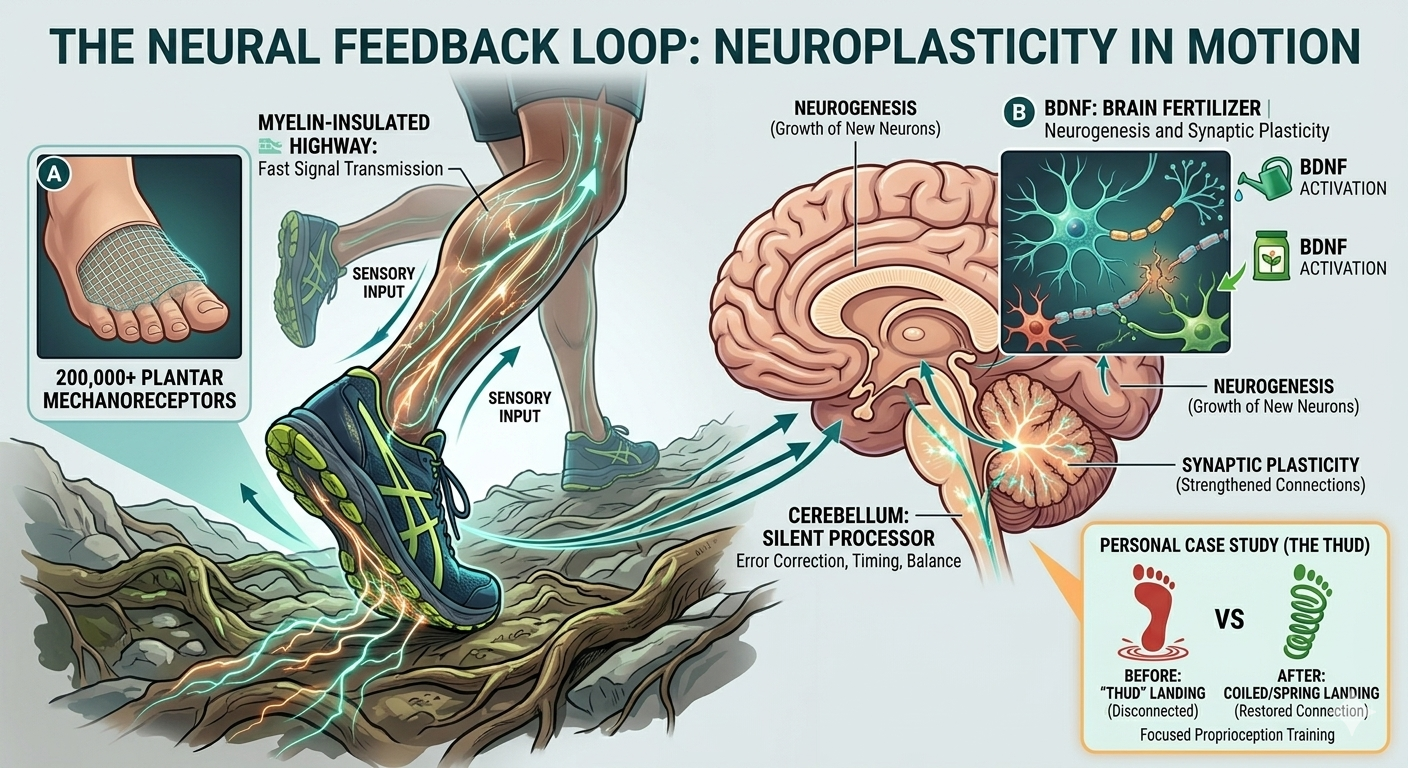 The Neural Feedback Loop: How complex movement triggers neuroplasticity and restores the "spring" in your stride.
The Cerebellum: Your Silent Processor
Tucked at the base of your brain, the cerebellum works behind the scenes, constantly refining movement. It governs timing, rhythm, error correction, and balance.
When you run on uneven ground, your cerebellum works overtime. Every wobble you recover from feeds data into this system, building neural efficiency under unpredictable conditions.
Mechanoreceptors: Your Feet as Sensors
Your feet are far more than shock absorbers; they are sophisticated sensory organs. Each sole contains over 200,000 nerve endings - plantar mechanoreceptors - that detect changes in pressure, texture, and vibration.
When this system is dulled by overly cushioned footwear or uniform surfaces, the brain receives less information. It is like turning down the resolution on a high-definition camera, resulting in a weaker proprioceptive feedback loop.
Myelination: Rebuilding Neural Speed
The encouraging part? The nervous system is plastic. When you consistently train balance, your neural pathways become more efficient through myelination. This is where nerve fibers are insulated to transmit signals faster and more reliably.
You aren't just preserving what you have; you are actively upgrading the speed, precision, and resilience of your nervous system - one stride at a time.
Beyond the Tear: Restoring the "Lost Connection"
Most people believe that once a ligament like the ACL or a pelvic stabilizer is surgically repaired or healed, the job is done. But a ligament is more than a structural cable; it is a high-speed data transmitter.
When a ligament tears, you don't just lose stability - you lose the mechanoreceptors embedded within it. This is why many athletes feel "disconnected" from their knee, ankle, or hip long after the physical wound has healed. The strength is back, but the timing is gone.
Without dedicated proprioceptive training, the brain struggles to "trust" the joint again. A complete rehabilitation cycle must include "retraining the sensors," not just building the muscle. It is about teaching the brain to listen to the surrounding stabilizers and the remaining receptors to fill the data gap.
The "Thud" of Disconnection: A Personal Case Study
I experienced this firsthand after a ligament tear in my posterior pelvic girdle. It happened because of a mistake I usually advocate against: aggressive dynamic stretching following a football game. I got carried away watching others who hadn't played the match, and I paid the price for that lapse in discipline.
While the pain subsided within a couple of months and my muscle strength returned, something was fundamentally "off." I lost the proper sensation in my left heel for a significant period.
My footstrike changed; it became a heavy "thud" rather than a coordinated, spring-like landing. Because running has been my lifestyle for over 17 years, I was sensitive enough to "read" these signals of inefficiency.
Through consistent balance training and focusing on the mind-muscle connection, I’ve been able to restore that sensation. The "thud" is gone, my footstrike has normalized, and my running efficiency has improved. This wasn't achieved through more strength training, but through better processing of neural data.
The "Brain Game" Workouts
This is where theory becomes practice. The goal isn't necessarily to add more mileage; it is to add intelligence to how you move.
The Statue Drill (Proprioceptive Reset)
Try this: stand on one leg while brushing your teeth, waiting for the kettle, or watching the news. It sounds almost too simple to matter, but biologically, it is powerful.
Trail Running as Real-Time Processing
A treadmill is predictable and safe, but neurologically, it is "quiet." Trail running is the opposite - it is a fast-moving puzzle. Every step forces your brain to process terrain height, surface firmness, and side-to-side instability within milliseconds.
This is proprioception after 40 in action. You aren’t just logging miles; you are solving movement problems in real-time.
The Soft-Surface Challenge
Surfaces like grass, sand, and uneven dirt introduce uncertainty, which is exactly why they are valuable. When the ground becomes less predictable, your nervous system becomes more alert.
The Footwear Factor: Highly cushioned shoes are comfortable, but they can act like noise-canceling headphones for your feet, reducing sensory input and dulling responsiveness. Occasionally exposing yourself to softer, less stable surfaces helps restore that critical communication between your feet and brain.
Cognitive Dual-Tasking
To take it a step further, try a cognitive challenge while running: count backward by sevens or recite every alternate letter of the alphabet.
By training this way, you improve the mind-muscle connection for running through integration, not isolation. You are teaching your body to stay responsive even when life gets a little messy.
The Core-to-Floor Connection
Most runners assume balance is strictly an ankle issue. It isn’t. The real story begins much deeper, at the very center of the body.
The Real Stabilizers
True stability originates from the pelvic floor and the transverse abdominis—your internal support system. These muscles don’t just sit there; they are active participants that:
When these stabilizers are inactive or slow to respond, the rest of the body compensates. Those compensations at the hips, knees, or ankles are almost always inefficient and injury-prone.
Pre-Activation: The Hidden Reflex
Here is a physiological reality most people never consider: Before your foot even hits the ground, your brain has already prepared your body. This is called pre-activation. It is the millisecond-timing that keeps you upright.
Your core muscles engage automatically before impact, bracing the entire system for the coming load. It is subtle, automatic, and essential. However, when this timing is off:
Why This Matters for Longevity
Let’s zoom out for a moment. This is not about shaving a few seconds off your 10K time or chasing another personal best. It is about something far more important: extending your healthspan - the number of years you remain strong, capable, and independent.
Fall Prevention Starts Now
A fall at 70 is rarely about that one "unlucky" step. A hip fracture doesn't come out of nowhere; it is often the end result of decades of gradually declining proprioception, slower reflexes, and reduced neural efficiency.
We don’t suddenly become fragile overnight. The decline is more subtle: we lose the ability to correct movements quickly and effectively. That small delay - that missed micro-adjustment - is where the real risk builds.
"Training coordination today is biological insurance for the future. You are investing in your ability to react, recover, and stay upright when it matters most."
Cognitive Sharpness: The Executive Function of Movement
Running, especially on varied and unpredictable terrain, is high-level cognitive work. It demands constant prediction, adaptation to changing surfaces, and rapid, real-time decision-making.
The Battle-Hardened Mind
There is also a deeper psychological layer. When you navigate uneven trails, recover from slips, and adjust to the unexpected, you are doing more than training muscles or reflexes. You are building resilience at a fundamental level.
This isn't the kind of resilience that lives in loud slogans; it is the kind that is felt in your body. It is the confidence that comes from solving problems under pressure. That is real intelligence.
Frequently Asked Questions
Conclusion: Training Proprioception After 40
We began by looking at the anatomy of a stumble—the split-second breakdown in timing that separates a "micro-adjustment" from a life-altering fall. We’ve seen that as we age, the mission changes. It is no longer just about the calories burned or the miles logged; it is about restoring the resolution of your internal GPS.
Whether it’s the "thud" of a disconnected footstrike after a ligament tear or the "neural lag" that naturally accumulates, the solution is the same: Integration, not isolation. Whether you are running or walking, it is not the movement of just a few muscles. The energy flows through the entire kinetic chain of your body, guided by neural inputs and proprioception.
Want professional content writing services to turn your ideas into engaging blog posts that your readers love?
 Chat with Nady on WhatsApp
Let’s build your authority in the fitness and health niche together.