

You told me you cannot run because your body and mind are not prepared, and you don’t see results with regular walking? I hear you. I’ve put together this critical 40+ fitness hack as the perfect middle-ground to change the results for you – Nady
If you’re over 40, you’ve probably heard that walking 10,000 steps a day is the “gold standard” for health. You lace up your shoes, hit the pavement or treadmill, and watch the pedometer climb – but the numbers on your scale don’t shift, your energy feels flat, and your blood pressure may still edge into the “warning” zone. Well, you’re likely missing a critical 40+ fitness hack that can change the results for you.
Here’s the reality: for robust metabolism in the 40s, sheer workout volume isn’t enough. Intensity matters too. Standard steady state walking supports general health, but it often falls short of delivering the “metabolic spark” needed to counter age‑related changes—such as the gradual 1% annual decline in muscle mass (sarcopenia), slower mitochondrial function, reduced bone density, and other physiological shifts.
That’s where the ultimate 40+ fitness hack, Japanese Interval Walking Training (IWT), comes in. Developed through nearly two decades of research at Shinshu University in Japan, this method is simple, joint‑friendly, and doesn’t require a gym or expensive gear. Researchers have shown that alternating brisk and slow walking can improve aerobic fitness, bone mineral density, and help reduce risks of lifestyle‑related diseases.
The structure is straightforward: alternate three minutes of brisk walking with three minutes of slower recovery. Studies published in Mayo Clinic Proceedings and research from Shinshu University have documented benefits including 15–20% improvements in aerobic capacity, reductions in blood pressure, and better muscle function.
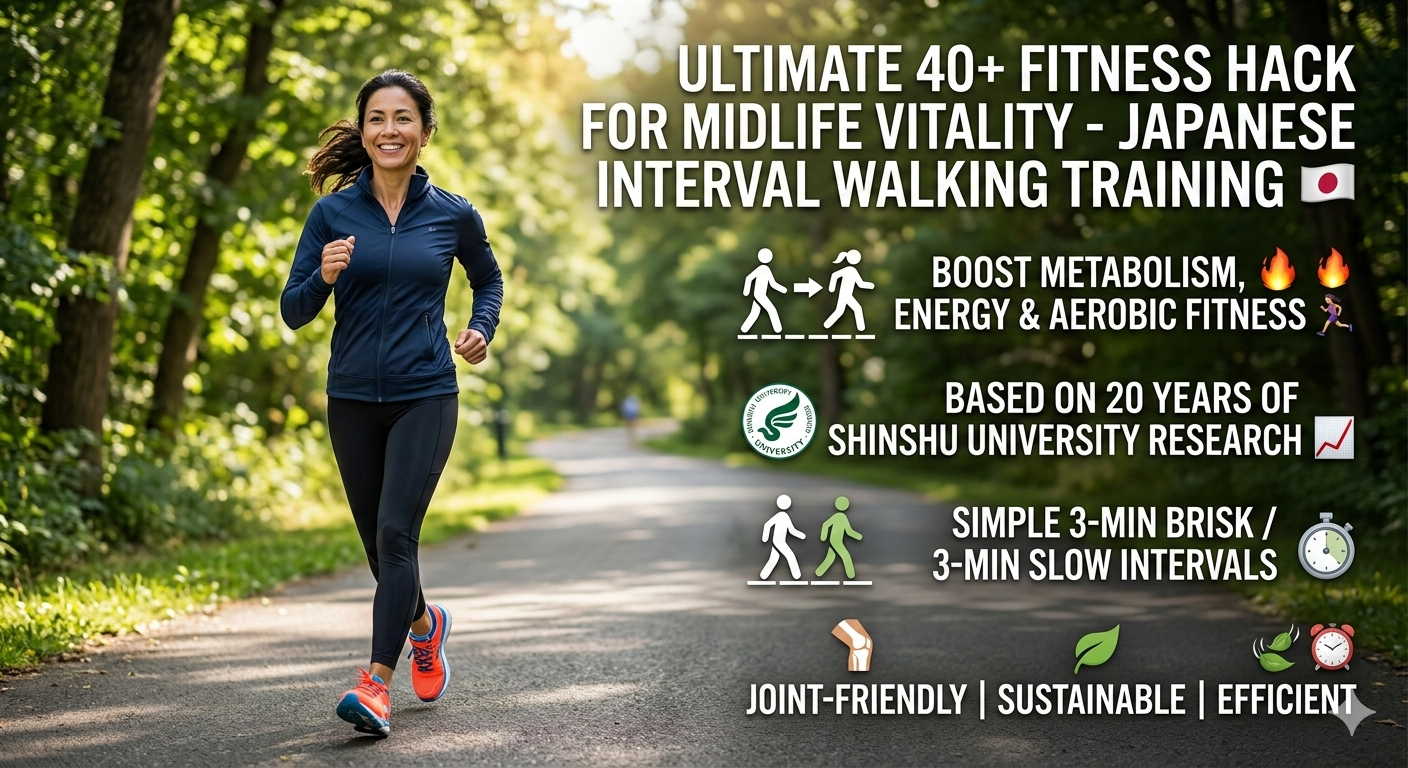
In this article, we’ll cut through fitness myths and explore the science behind IWT, showing why it’s one of the most efficient and sustainable ways for adults over 40 to reclaim vitality and long‑term fitness.
Meet Mark: 48, Desk-Bound, and “Pre-Hypertensive”
Clinical data from universities is one thing, but seeing how these protocols translate into the chaotic schedule of a modern professional is another. Many of us find ourselves in a similar position to Mark: the “invincibility” of our 20s has faded, replaced by the reality of long hours at a desk and a body that doesn’t bounce back as quickly as it used to.
At 48, Mark felt “fine,” but his numbers told a different story. His latest physical recorded a systolic blood pressure (SBP) of 135 mmHg—placing him in the Stage 1 Hypertension range. Like many professionals, Mark was pressed for time. He tried jogging, but his knees ached for days afterward. He switched to a nightly 40-minute stroll, yet his blood pressure remained unchanged.
Mark’s plateau is a common one. He was doing the work, but he wasn’t providing the specific stimulus his cardiovascular system needed to adapt. Following the Japanese IWT protocol, he committed to 30 minutes of interval walking, four days a week.
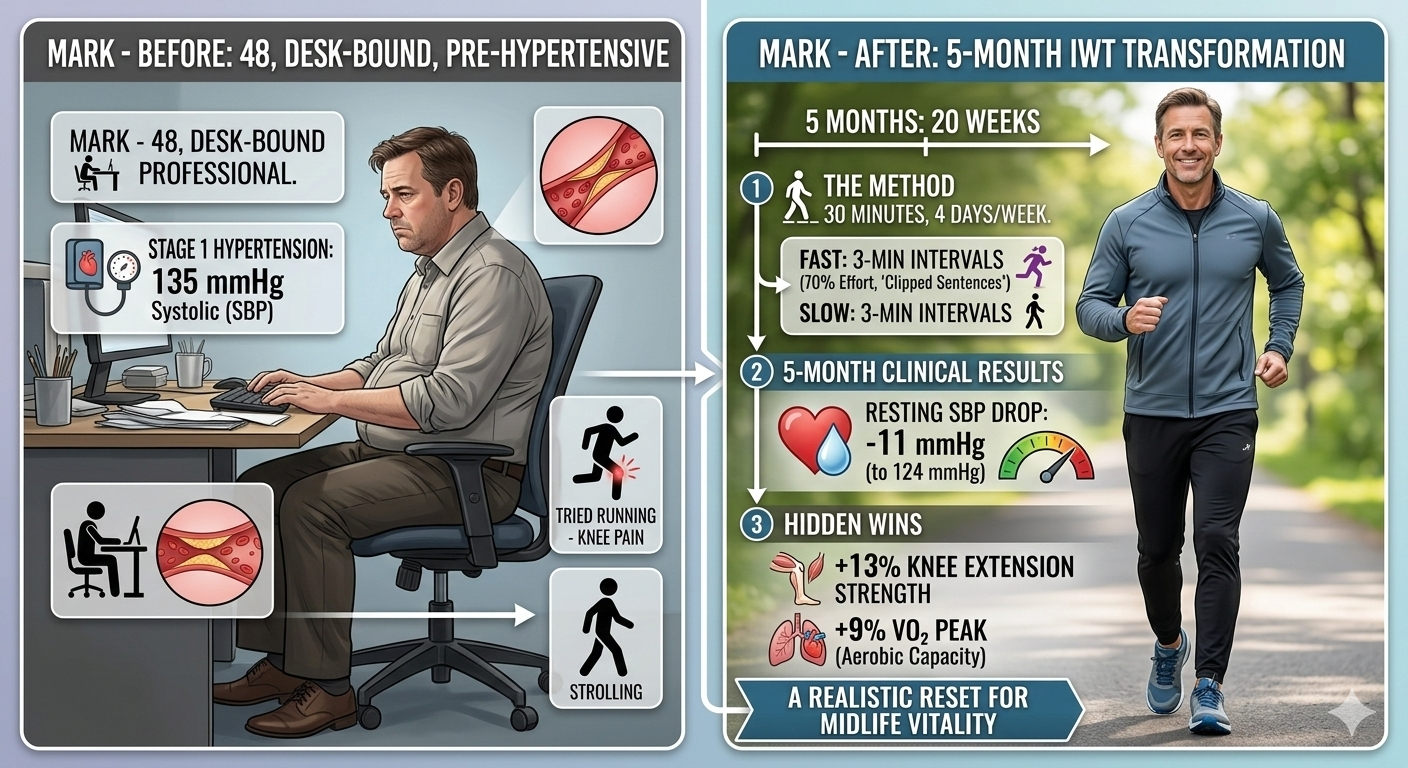
Mark’s story shows how a simple, structured walking plan can deliver measurable improvements in just five months—without the strain of running or the monotony of endless steady walking. His journey illustrates the potential of IWT as a realistic reset for midlife vitality.
Deep Dive Research: The Feasible 40+ Fitness Hack
I meet many people over 40 who aren’t physically or mentally prepared to take on the impact of running, yet find that steady walking doesn’t deliver the results they hope for. For women, the transition into perimenopause adds another layer of complexity—hormonal changes can affect energy, joints, and motivation, sometimes discouraging even the most determined.
I began searching for a middle ground: a method that could deliver meaningful results without the rigors of running. That’s when I discovered Japanese Interval Walking Training (IWT). Backed by years of research at Shinshu University, it offers hope for those who want more than steady walking but need a joint-friendly, sustainable approach.
What Is Japanese Interval Walking Training (IWT)?
The Intensity Check: During the brisk phase, you should not be able to speak comfortably—it’s the “push” stage. The fast walk (Borg Scale 6–7/10) should feel like walking quickly when you’re late for a flight. The slow walk (Borg Scale 3/10) should feel like a comfortable recovery stroll.
Japanese IWT is more than just a walking routine—the 3-3-3 Protocol is a structured system designed to spark metabolic change, preserve muscle, and protect joints. For adults over 40, it represents a practical bridge between the safety of walking and the benefits of higher-intensity training.
The “Medical Clearance” Guide for this 40+ Fitness Hack
When you’re over 40, “listening to your body” is only half the battle; you also need to listen to your physician. Because IWT can push your heart rate into the 70-85% “high‑intensity” zone, a proactive conversation with your doctor is essential.
How to Talk to Your Doctor About Japanese IWT
Starting IWT without knowing your resting blood pressure, heart rate, or joint health can make progress hard to measure. A quick baseline check with your physician ensures you can track improvements, adjust intensity safely, and build confidence that your journey is medically supported.
Why This 40+ Fitness Hack is a “Cheat Code” for Midlife Health
Japanese Interval Walking Training (IWT) isn’t just another workout trend – it’s a metabolic “cheat code” for adults over 40. By alternating three minutes of brisk walking with three minutes of recovery, it activates systems that steady walking simply doesn’t reach, while avoiding the orthopedic toll of running.

Muscle Preservation (Sarcopenia)
After 40, muscle mass declines by about 1% annually, especially in fast‑twitch fibers. The “push” phase of Japanese IWT recruits these fibers in the legs and glutes, stimulating growth and strength that casual walking ignores. Shinshu University’s 2025 findings confirmed increases in knee extension strength, helping counter age‑related sarcopenia.
The Estrogen/Testosterone Factor
Hormonal shifts in midlife – declining estrogen in women and gradual testosterone drops in men—can amplify cortisol spikes, leading to fatigue and belly fat. High‑intensity intervals help blunt these surges by improving insulin sensitivity and boosting growth hormone release, stabilizing energy and recovery during hormonal transitions.
Joint Longevity
Running loads the knees and hips with forces equal to 3-4 times body weight. Japanese Interval Walking Training reduces that impact to about 1.5 times, delivering cardio benefits without the “orthopedic tax.” For adults managing arthritis or knee pain, this makes IWT a sustainable alternative.
Aerobic Gains & Cardiovascular Health
Research shows consistent IWT improves aerobic capacity (VO₂ peak) by 15–20%. Trials also documented reductions of 8–11 mmHg in systolic blood pressure—a meaningful improvement for those at risk of hypertension. (Read more on how to slow down VO2 Max decline after 40).
Blood Sugar Control
Studies published in Mayo Clinic Proceedings demonstrated IWT’s superior effect on glycemic control compared to continuous walking, making it a powerful tool against midlife diabetes risk.
Bone Health
Beyond muscles and metabolism, IWT has been shown to improve bone mineral density, protecting against osteoporosis—a critical concern for adults over 40, especially women in perimenopause.
Bottom line: For the 40+ demographic, IWT is more than exercise – it’s a strategic intervention that preserves muscle, balances hormones, protects joints, and improves cardiovascular and metabolic health, all in a joint‑friendly, time‑efficient format.
How IWT Compares: Finding the Sweet Spot
🏃 Running
- Impact: 3–4× body weight per stride
- Aerobic Gains: High, but joint stress is significant
- Accessibility: Requires a strong physical baseline
🚶 Steady Walking
- Impact: ~1× body weight
- Aerobic Gains: Modest; limited VO₂ peak improvement
- Accessibility: Easy, but often insufficient for 40+ goals
🔄 Interval Walking (IWT)
- Impact: ~1.5× body weight (Safe)
- Aerobic Gains: 15–20% VO₂ peak improvement
- Blood Pressure: 8–11 mmHg reduction documented
- Accessibility: Joint-friendly; no gym required
For the 40+ demographic, IWT provides the metabolic intensity of running with the orthopedic safety of walking.
The 2026 Modernized Protocol for this 40+ Fitness Hack
Fitness experts now recommend adapting Japanese IWT for busy professionals:
Risks & Considerations
- • Medical Clearance: Adults over 40 should consult a physician before starting, especially if hypertensive or on heart medications.
- • Individual Variation: Results vary depending on baseline fitness, adherence, and health markers.
- • Consistency: Benefits are documented after 20 weeks of regular practice—shorter trials may not show full effects.
Key Takeaway
Japanese Interval Walking is not a fad – it’s a scientifically validated, time‑efficient, and joint-friendly fitness method that aligns perfectly with the needs of the 40+ demographic in 2026. By modernizing the protocol with wearables and recovery tracking, it offers a sustainable blueprint for midlife vitality.
The “Pre‑Walk” Checklist
For adults over 40, preparation matters just as much as the workout itself. A short dynamic mobility routine before starting IWT can make the difference between progress and a pulled calf. Unlike static stretching, dynamic drills warm up the muscles, lubricate the joints, and prime the nervous system for the “fast” segments.
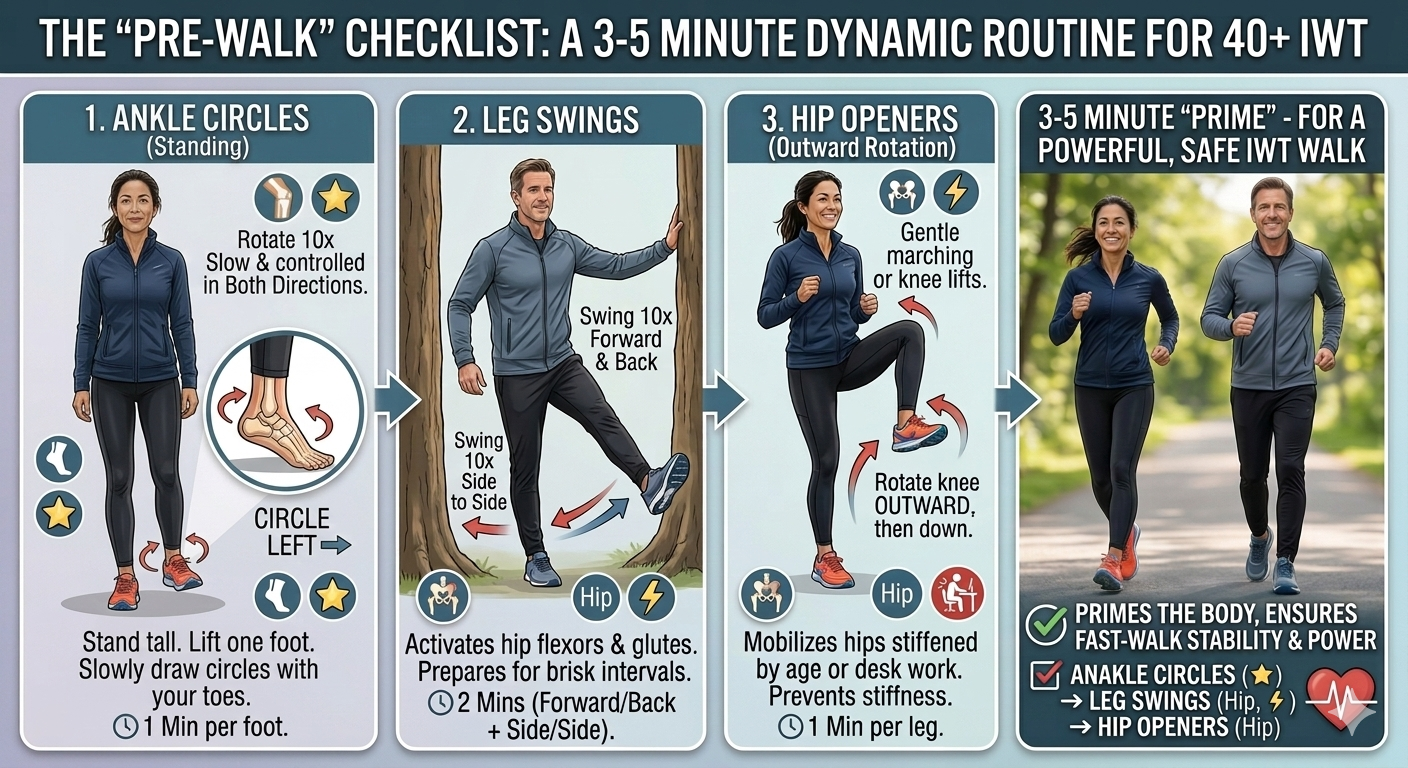
Just 3-5 minutes of these movements primes the body for the intensity of this 40+ fitness hack, ensuring the “fast” walk feels powerful but safe.
Common Japanese Interval Walking Training Mistakes
The “Too Fast” Mistake
The “Protein Window” Mistake
The “No Push” Mistake
The “No Baseline” Mistake
The 12‑Week Progression Plan
Japanese IWT is a journey. For adults over 40, gradual progression is the safest way to build endurance without overloading joints or burning out.
Build the Base
Start with 4 cycles (24 mins). Focus on the rhythm: 3 mins brisk, 3 mins recovery. Condition your muscles and joints for the intensity ahead.
Extend the Challenge
Increase to 5 cycles (30 mins). As your body adapts, you’ll notice better stamina and lower blood pressure. This stage is about consistency.
Add Resistance
Introduce a 2‑kg weight vest or moderate hills. This boosts bone density and strength without the joint impact of running.
Frequently Asked Questions
What if I miss a week of IWT?
Can I do IWT indoors on a treadmill?
How do I know if I’m walking fast enough?
Is IWT safe if I have knee pain?
Do I need special shoes or equipment?
40+ Fitness Hack: Your Next Step
Japanese Interval Walking Training is more than a workout – it’s a gateway to midlife vitality. Every brisk step helps to build strength, keeps the energy alive, and protects your long-term health. Consistency is the real secret: four sessions a week can reshape your metabolism, joints, and confidence.
Once you’ve built a solid base with IWT, you may experiment with occasional slow runs or hill walks to test your progress. If you feel ready to transition from power walking to a steady jog, my guide on Running for Beginners will show you how to start smartly. Always monitor your vitals – heart rate, blood pressure, recovery time – and let them guide your next steps. Think of this 40+ Fitness Hack as your foundation: a joint-friendly system that prepares you for whatever fitness challenges you choose next.
References
Medical & Research Sources
Fitness & Lifestyle
Additional Reading
Want professional content writing services to turn your ideas into engaging blog posts that your readers love?
 Chat with Nady on WhatsApp
Let’s build your authority in the fitness and health niche together.