
- Introduction: The "Success Tax" and the Sedentary Executive
- The Success Tax: The Weekly Exhaustion Cycle
- Executive Longevity Training: From Fitness to Resilience
- The Antifragile Shift: Moving Beyond "Robust"
- Executive Longevity Training: Auditing Your Stress Budget
- The Gold Standard for Executive Longevity Training: HRV-Guided Training
- Executive Longevity Training: The Daily Fitness Strategy
- Executive Longevity Training: Cognitive Ergonomics in Practice
- Executive Longevity Training: Field Notes from NadyFitness
- The Power of the Maintenance Pivot in Executive Longevity Training
- Conclusion
- For – Brands | Businesses | Coaches
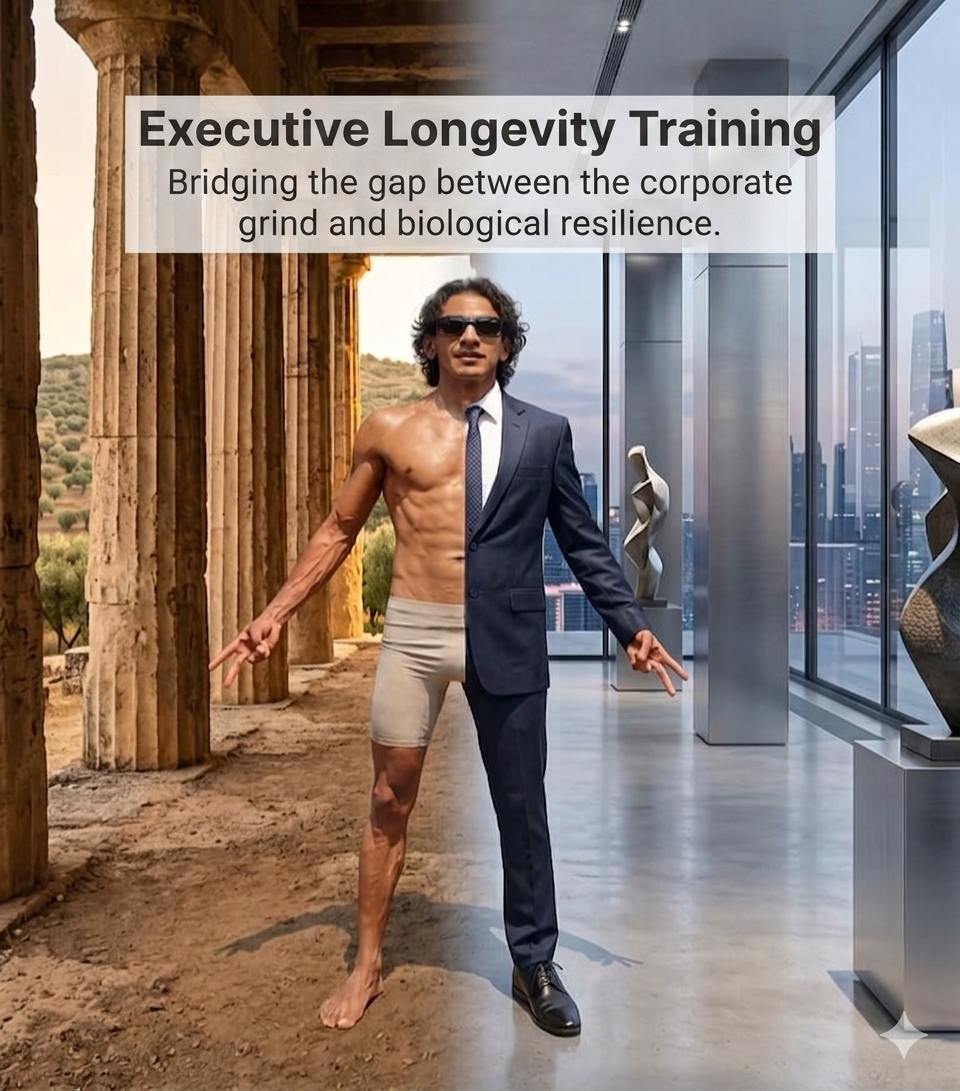
True Executive Longevity Training isn’t about grinding harder – it is about bridging the corporate grind and the biological resilience required to sustain it in the long run. In an era where professional burnout is so common, mastering your internal machinery is the right way to transform your high-pressure work environment into a sustainable career success platform.
Introduction: The “Success Tax” and the Sedentary Executive
In the global corporate arena, professionals are expected to endure years of high-pressure environments to reach the upper echelons of management or the elusive C-Suite. While this traditional “grind” is often worn as a badge of honor that can propel your career, 2026 data reveals a hidden “Success Tax” that most boards and HR departments refuse to discuss.
This tax isn’t financial; it’s a chronic physiological and cognitive drain caused by decades of high-stress coupled with sedentary behavior. According to the Wellhub State of Work-Life Wellness Report (2026), nearly 90% of employees report burnout symptoms, with 40% experiencing them weekly. For executives over 40, this hidden ‘Success Tax’ manifests as chronic fatigue and declining resilience.
I remember my time in the corporate environment; the coffee dispenser was never more than a few steps from my cubicle. We had an unlimited supply of caffeine for free, yet we had to pay for the food at the cafeteria. The message was clear: they wanted us awake and alert, regardless of whether we had actually rested or recovered from the stress of the previous day. I learned quickly that there is no such thing as “free” – there is always a hidden price to pay in biological capital.
The Success Tax: The Weekly Exhaustion Cycle
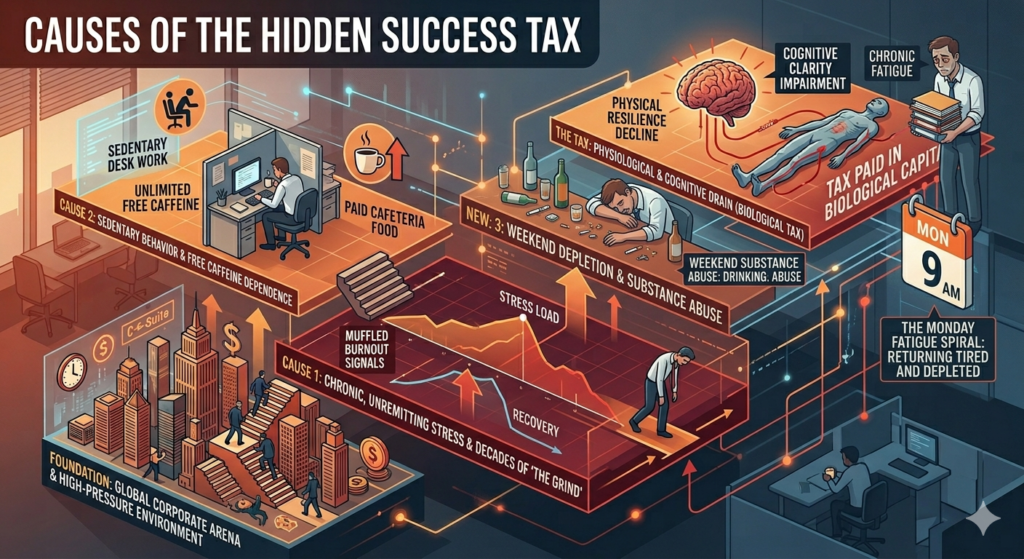
- The Foundation: High-pressure corporate environments and sedentary desk work create a baseline of chronic, unremitting stress.
- The Muffled Signals: Career success and the “grind” often muffle early burnout signals, causing executives to ignore physiological red flags for decades.
- Weekend Depletion: To cope with the “Biological Tax” paid during the week, many resort to weekend substance-based unwinding—often involving heavy drinking, binge eating, and poor recovery due to sleep deprivation.
- The Monday Fatigue Spiral: Late Sunday nights lead into Monday morning transitions where the recovery phase fails to restore biological capital, causing the professional to feel tired and depleted immediately upon returning to work.
- The Result: A continuous decline in physical resilience and cognitive clarity, eventually leading to total system failure if not corrected by Executive Longevity Training.
Executive Longevity Training: From Fitness to Resilience
This is where a new paradigm emerges – Executive Longevity Training. For the professional over 40, the objective has shifted. The goal is no longer just “fitness” in an aesthetic sense. It isn’t just about how you look in a suit; it has become about how long you can perform without burning out. Often, the drive for career success muffles the early warning signs of burnout, forcing you to drag yourself forward despite a depleting tank.
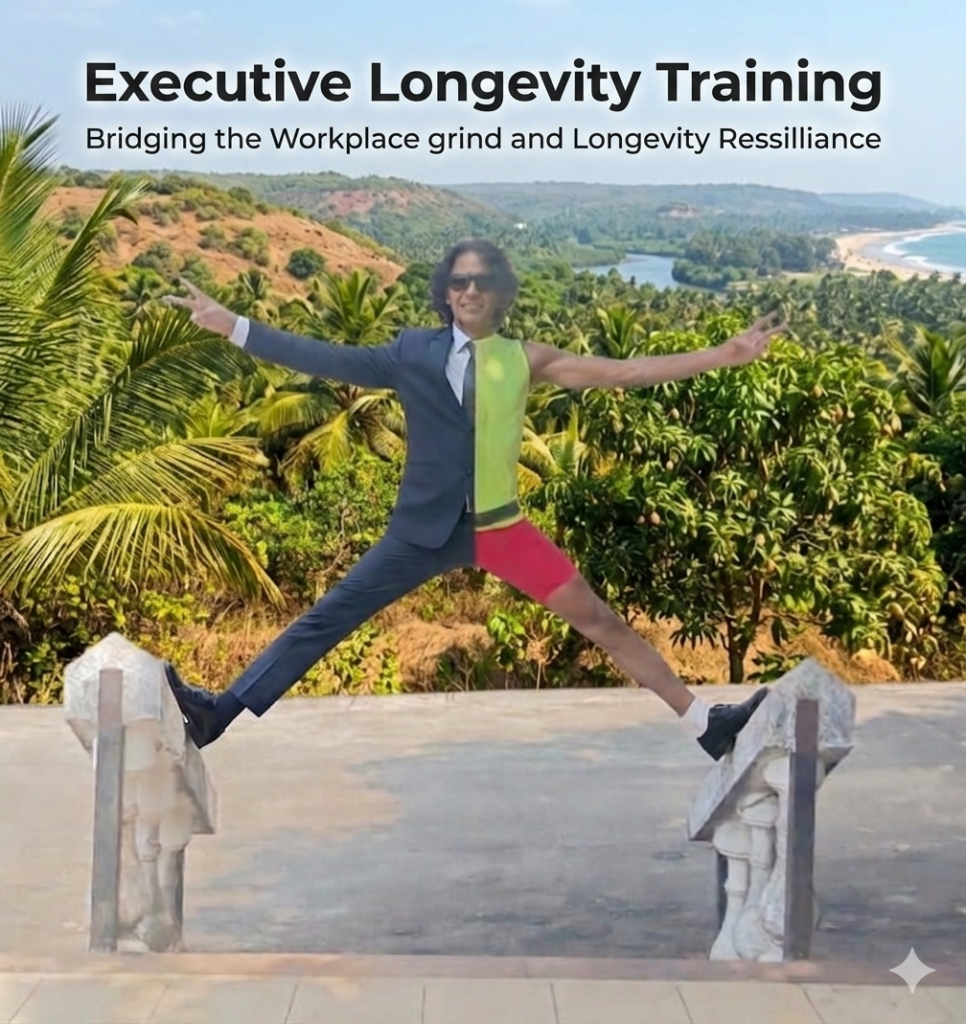
A resilient professional requires a strategic reallocation of their most limited resource: TIME. You must create the mental and physical space to give equal weight to both your professional output and your antifragile mindset. The common “no time” complaint is often just a symptom of the Success Tax. In reality, even the most crowded executive calendar has “hidden holes” waiting to be leveraged. By strategically perforating a dense schedule with short, high-impact resilience markers, you can power your internal machinery. I have explained this further as a “stress basket” later in this post.
To thrive, you must stop viewing your health as a distraction from your work and start seeing it as the very foundation of your career’s longevity. If you are over 40, it is time to make a strategic pivot toward Executive Longevity Training. In a world overwhelmed by the corporate rat race, physical resilience is no longer a hobby – it is your most valuable professional asset.
The Antifragile Shift: Moving Beyond “Robust”
There is no denying the fact that your career is important and is linked to most of your responsibilities, but there comes a point when you have to also take what you are losing into account. You will need to start paying attention to the body signals that you have been ignoring for years.
This strategic pivot shifts the focus from simply being “robust” – where you are merely resisting stress and become Antifragile. You mind and body don’t have to break down so easily. Antifragile doesn’t just mean resisting stress- it means growing stronger because of it. In a 2026 workplace defined by an AI-driven pace and constant ambiguity, your physical health has become your primary competitive advantage.
The good news – Unlike machines that wear out with use, the human body is designed to adapt and improve when faced with the right stressors (e.g., interval training, fasting, or deliberate recovery practices). If you are not actively training for longevity, you are effectively allowing your most critical assets – cognitive clarity, metabolic health, and emotional resilience – to depreciate. In this “Infinite Game,” the goal is to ensure that your physical capacity consistently meets or exceeds the escalating demands of your professional rank.
Executive Longevity Training: Auditing Your Stress Budget
One of the most critical concepts in modern longevity science is the “Total Stress Budget.” Most high-performers treat their energy as an infinite resource, but your biology operates on a strict ledger. There is a physiological limit to the “Allostatic Load”,which is the cumulative wear and tear that your system can handle before the infrastructure begins to fail.
Think of your body as having one single “Stress Bucket.” Your nervous system doesn’t have separate compartments for tackling “Work Stress,” “Physical Strain,” or “Domestic Chaos.” To your HPA axis (Hypothalamus-Pituitary-Adrenal axis), the body’s central stress response system, the following two scenarios are virtually indistinguishable:
- The Corporate Spike: A missed deadline, a high-stakes negotiation, or an unexpected issue escalation at work triggers a surge of cortisol and adrenaline. Your heart rate climbs, your breathing becomes shallow, and your body enters a “Fight or Flight” state.
- The Physical Strain: A heavy deadlift session or a high-intensity run requires the same sympathetic nervous system to ramp up. Cortisol rises to mobilize energy, and your heart rate spikes to meet the demand.
To your internal biology, these events look nearly identical. Now if you attempt to pour a high-intensity workout into a Stress Bucket that is already overflowing from a 12-hour workday, you aren’t building strength – you are accelerating bankruptcy. For a senior leader, this might mean that a tense board meeting and a punishing workout both drain the same stress account.
The Universal Stress Bucket
Think of your body as having one single “Stress Bucket” with a limited capacity. This bucket is filled by everything life throws at you – from the stresses of high-stakes board meetings to intense gym sessions.
From a physiological standpoint, there is no “good” or “bad” stress; there is only allostatic load. The mental pressure that drives professional success isn’t the same physical stimulus your body needs to stay resilient. Conversely, while a workout builds physical strength, it doesn’t solve a complex business crisis.
The trap? Filling your bucket entirely with one type of stress (usually professional) while neglecting the other.
Because your business demands most of your active time, a traditional “proper” workout session often feels impossible. The solution is interstitial resilience: sprinkling brief physical stressors throughout your workday. By alternating mental and physical loads, you build a type of resilience that doesn’t just protect your health – it actually empowers your professional performance.
The Gold Standard for Executive Longevity Training: HRV-Guided Training
In 2026, the elite leader doesn’t guess how much “space” is left in their stress bucket – they measure it. Heart Rate Variability (HRV) has emerged as the “gold standard” for measuring the state of the autonomic nervous system. It is the most objective way to tell if you are truly recovered or merely “caffeinated.”
HRV measures the variation in time between heartbeats, reflecting how adaptable your nervous system is. For instance, if your HRV drops after a week of late nights and deadlines, it’s a signal to prioritize recovery over intensity. This is where Executive Longevity Training becomes data‑driven rather than guesswork.
HRV is widely used in sports science and corporate wellness programs. That shows it’s not just theory but already applied at elite levels. A high HRV indicates a resilient, “ready” system, where you have the biological capital to push hard. A low HRV is a clear signal that your Stress Budget is exhausted, and pushing further from that state does more harm than good.
Executive Longevity Training: The Daily Fitness Strategy
The essence of Sustainable Performance is the ability to make appropriate changes based on this data. If your HRV is low after a grueling week of work at the office, forcing a high-intensity interval session (HIIT) will yield poor returns and may even suppress your immune system. Your breathing has slowed down, and your muscles and joints may not be able to take the load of an intense workout session.
Instead of high intensity training, the antifragile executive shifts to active recovery session. It could be a zone-2 aerobic flush session like a nice long walk, proprioceptive reset drills, or mobility work. For many leaders, this might mean swapping a HIIT session for a 45‑minute walk while listening to an audiobook.
This isn’t “skipping a workout” – it is a strategic decision to protect your longevity and ensure you have the cognitive energy to lead the next morning. The reverse is also true: after a dull day at the office, you may have more energy to push harder in your workout.” This daily calibration ensures your training builds resilience rather than draining it.
Executive Longevity Training: Cognitive Ergonomics in Practice
The standard standing desk was a 2010s solution to a 1990s problem, where standing and working instead of sitting and working was considered an ingenious way to break the sedentary lifestyle. However, that no longer works in 2026 because it does not take your personal stress bucket into account, so we must evolve into Cognitive Ergonomics. Cognitive Ergonomics is the science of designing environments that optimize mental performance. This discipline acknowledges that your physical environment is the primary driver of your neural output.
To maintain an Antifragile mindset , you must engineer your office for “Micro-Movement” to break the sedentary drain that causes the Success Tax. Most people complain about the time-constraint to do workouts because of office hours, daily commuting, and other responsibilities. The concern is real, but if you wait for a 60-minute gym window that never comes, you lose. Instead, we use Stealth Fitness Habits:
- Environmental Triggers: Position some portable mobility tools, such as a grip trainer or a lacrosse ball for foot rolling, within your peripheral vision. These act as visual cues to prompt movement during “dead time” at work. If you have one hour break for lunch, you don’t have to finish eating in 20 minutes and sit for the rest of your break. You have been sitting for hours before your lunch and will be doing the same thing once you get back to your desk. Your body needs a walk to reset your breathing from shallow to intentional deep breathing.
- Proprioceptive Resets: These are brief windows of opportunity to do balance or coordination drills. It could be something as simple as standing on one leg while reviewing a brief or waiting for your food at the cafeteria. By challenging your body’s sense of where it is in space, you force the brain to re-engage the prefrontal cortex, the area responsible for complex decision-making and emotional regulation.
- Neural Priming: Utilizing 60-second bouts of isometric tension (holding a muscle contraction like a plank or a wall sit) to stimulate BDNF (Brain-Derived Neurotrophic Factor). Think of this as “biological software updates” that sharpen your cognitive edge before a high-stakes decision. Holding a wall sit before a presentation can sharpen focus and calm nerves.
Executive Longevity Training: Field Notes from NadyFitness
I have learned some lessons from the decades of long hours on computers combined with running six days a week. While the data and science support the lessons I have learned, the actual result lies in long-term execution.
Over 17 years of running six days a week without fail, I feel like I am operating a Live Laboratory. I am doing it through professional demands, “survival work” phases, and the natural process of aging into my 50s. Here is what 6,000+ days of consistency has taught me about the Human Intelligence (HI) of longevity. HI is the art of listening to signals your body whispers before it screams:
The Fallacy of the “Perfect Window”
As a freelance content writer, active blogger, and WordPress Developer, I cannot get that perfect hour for running or strength training. All I know is I have to go out running at some time, and I don’t care if the sun is right above my head on a hot and humid summer day. Since I work remotely from my home, I know I can squeeze in 1 hour at some stage after my first session of work on most days. Sometimes it is not possible, especially when faced with an unexpected situation in the work or personal front. Then I somehow try to make some time before the end of the day, even if it is just for 40 minutes.
You may not have that flexibility if you’re commuting to an office or business location. In my 17-year running streak, I’ve learned that the perfect workout window is a myth. Mastery is found in working around these imperfections. If you can’t run 10km because the domestic chaos or the workday overflowed your bucket, you do a 15-minute “maintenance mile.” This keeps the neurological habit alive without overdrawing your biological capital. You could do things like pullups, squats, lunges, resistance bands, or pushups in 10 to 15 minutes.
Reading the “Muffled” Burnout
As I mentioned earlier, career success can often muffle the signals of burnout. Nevertheless, you learn to “drag yourself” forward because your future depends on that.
Working on my blog on fitness after 40, I’ve learned that HI (Human Intelligence) is about developing a sensory awareness that no AI can replicate. It’s the ability to feel the difference between “lazy” and “depleted.” If your breathing is shallow and your joints feel “heavy” before you even start, that is your HPA axis asking for an easier pivot, not a push.
Stardust and Strategy
We are all just stardust, and eventually, we return to the dust. We train not for a trophy, but to remain capable, alert, and fully functional for as long as possible. Longevity training is simply the act of maintaining the strength and agility so we can experience this world to the fullest. When life is chaotic, you don’t quit; you scale. If a long run is too “expensive” for your stress budget today, a 15-minute maintenance mile keeps the habit alive. Antifragility is found in the “imperfect 10 minutes.” Scaling down doesn’t mean giving up; it means protecting the streak that builds resilience.
The Power of the Maintenance Pivot in Executive Longevity Training
The goal of executive longevity training is to ensure your physical capacity consistently meets or exceeds the escalating demands of your career. This doesn’t require a perfect environment; it requires strategic consistency.
- Small Windows are always better than No Windows: A 10-minute session of isometric holds or a “maintenance mile” is far more valuable than a skipped 60-minute workout. It keeps the HPA Axis regulated and the habit circuitry in the brain active. Even a 10‑minute plank and pushup routine between calls keeps resilience intact.
- Audit, Don’t Guess: Use data like HRV to decide when to push and when to go slow. This shifts training from emotion to evidence. This objective approach removes the guilt of a sedentary lifestyle and replaces it with the precision of strengthening and recovering.
- Continuous Integration: By using Cognitive Ergonomics and Stealth Fitness Habits, you turn your 8-hour workday with 2 hours of commuting into a series of micro-recoveries. Think of it as sprinkling micro‑recoveries into the day instead of waiting for one big workout session.
Executive Longevity FAQ
What is Executive Longevity Training?
Executive Longevity Training is a strategic health framework for professionals over 40. It focuses on building executive resilience and an antifragile mindset to sustain elite career performance without the risk of burnout.
How do I find time for fitness with a busy executive schedule?
We leverage “hidden holes” in your calendar. By identifying micro-windows, you can perform high-impact resilience markers that power your internal machinery without the need for hours at a gym.
What is the ‘Success Tax’ in a corporate career?
The Success Tax is the biological cost of the corporate grind. It occurs when professional drive muffles early burnout signals, leading to chronic fatigue and weekend depletion that erodes your biological capital.
Can I start training if I haven’t exercised in years?
Absolutely. The paradigm shift starts with incremental “perforations” of your schedule. We build foundational resilience first, meeting you where you are to ensure long-term sustainability.
How does an antifragile mindset prevent career burnout?
An antifragile mindset ensures you don’t just resist stress, but actually grow stronger from it. It transforms workplace volatility into a tool for sharpening your cognitive and physical resilience.
Conclusion
Executive Longevity Training is not a 12-week program – it is a long-term strategy for sustainable performance. In a corporate environment that demands constant output, your physical and mental resilience is the most critical infrastructure you have.
The most significant mistake a professional can make is viewing fitness as an “all-or-nothing” endeavor. By shifting to a “Micro-Win” mindset, you ensure that your biological systems never fall into a state of total depreciation.
Longevity isn’t built in perfect hours – it’s forged in the imperfect minutes you refuse to skip…
In the 2026 landscape, the most successful leaders are not those who grind the hardest until they break, but those who have mastered the art of the strategic scaling. When life is chaotic, you don’t quit; you scale back to a level that keeps the machine running. Mastery isn’t found in the perfect hour; it’s found in the imperfect 10 minutes. Don’t forget, you can always use Sunday to make up for lost mobility and strength with a proper session.
Longevity isn’t built in a day; it’s built in the margins. Are you ready to claim a micro-window right now? Drop and do just 5 pushups before you move to the next task. Your antifragile journey starts with that single, intentional perforation of your schedule.
For – Brands | Businesses | Coaches
If your brand or website needs top-quality blog content or end-to-end blog management, chat with me today. I create content with the same clarity, science-backed storytelling, and motivational rhythm you just read.
I offer blog management and content writing services across diverse sectors, whether your niche is fitness and health (my favorite), technology, lifestyle, or business – I specialize in turning topic ideas into engaging, SEO-optimized blog posts that your readers will trust and love.
Let’s build your business authority online with content that delivers both value and results.
 Chat With Nady on WhatsApp
✍️ Explore Our Blog Writing Services
Chat With Nady on WhatsApp
✍️ Explore Our Blog Writing Services