
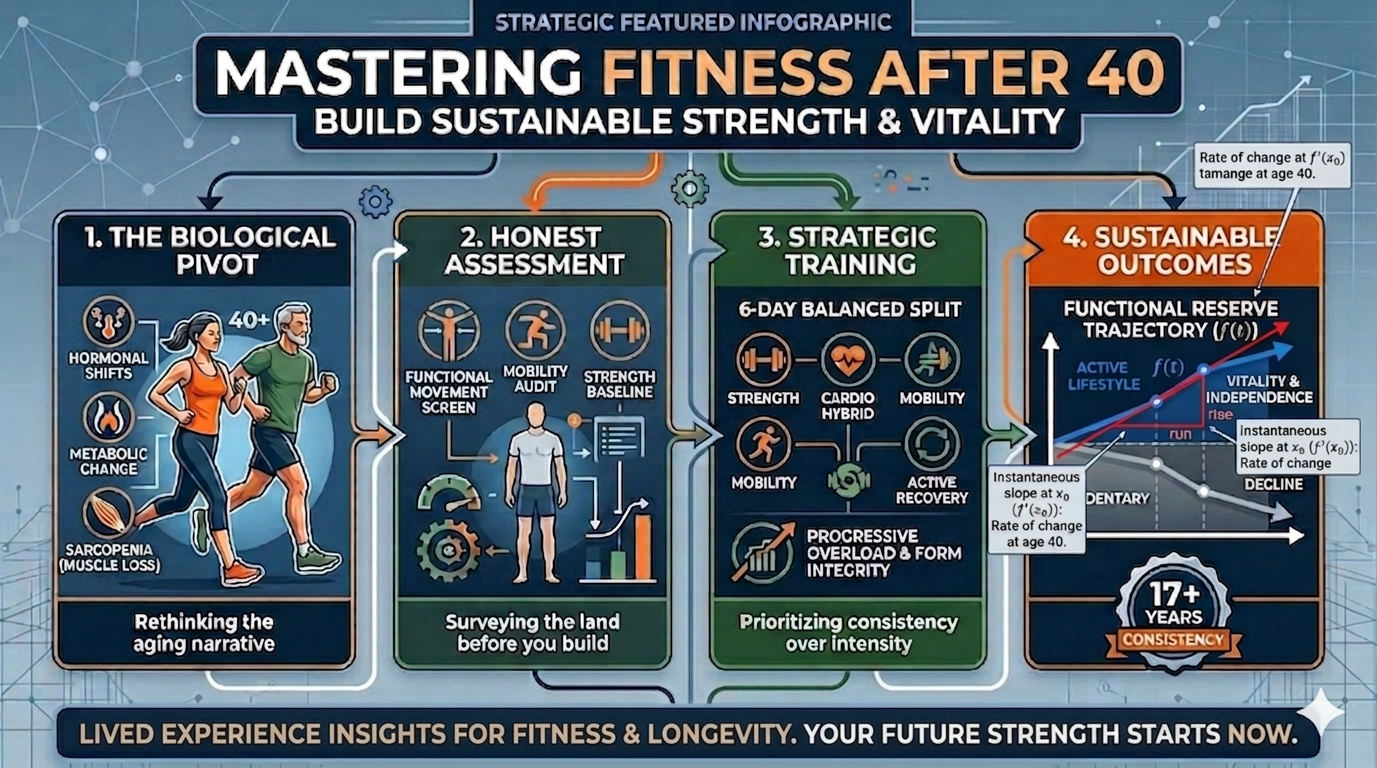
Fitness After 40 isn’t just about “staying in shape” or how you look in your Instagram photos. After 17 years of daily running and navigating the fitness landscape myself, I can tell you that things are fundamentally changing inside your body. It is about acknowledging and respecting these physiological shifts to train your body accordingly. While the natural declines in muscle mass (sarcopenia), bone density, joint mobility, and hormonal secretions are a reality, these aren’t roadblocks; they are signals that your training methods must evolve.
The “no pain, no gain” mantra may have worked for you in your 20s and even in your 30s. However, that approach often leads to burnout, chronic inflammation, or injury in your 40s and 50s. To achieve true fitness after 40, you need a strategy that prioritizes biomechanical efficiency and metabolic health over raw and uncalculated intensity.
Many people abandon their health goals because they try to force their old routines onto a changing physiology, usually resulting in injury. On the other hand, integrating smart lifestyle adjustments and recovery-focused training can counteract age-related declines. This post is not just about what you need to do in the next few months; it’s about building a foundation for sustained physical performance and high-level wellbeing for decades to come.
Beyond the gym, true fitness after 40 is measured by your ability to navigate daily life with ease and confidence. This is where functional fitness becomes your greatest asset. It’s the difference between struggling to carry heavy groceries up the stairs and doing it without a second thought. It’s about having the core stability to lift your child (or even your grandchild) without fear of losing your balance.

Forget the ego of heavy deadlifts at the gym; don’t you wish to have the joint strength and mobility to bend down, tie your shoelaces, or pick up a dropped item with fluid ease? When you train for longevity, you aren’t just lifting weights; you’re ensuring you can still dance at a wedding, hop over a puddle without feeling the jarring impact in your joints, and keep pace with your kids in the backyard.
Physical freedom after 40 means your body remains a tool for joy. Instead of seeing it as a source of limitation, you must do what it takes to keep yourself strong and fit for the decades ahead.
Fitness after 40: Navigating the biological declines
As you cross the 40-year mark, your body undergoes a series of predictable but significant shifts. Hormonal changes, a natural decline in muscle mass (sarcopenia), and a shift in metabolic efficiency often coincide with the psychological realization that your physical “baseline” is changing. For many, this age also brings newfound anxieties regarding health issues – often the cumulative result of a sedentary professional life.
Recalculating the route for longevity
This phase of life is less about “slowing down” and more about recalculating the route. Just as you would pivot a business strategy based on new market data, you must reassess your fitness strategy based on your body’s new biological data. This is an inner journey of reassessment that must balance your physical needs along with the high demands of career and family.
The “Cost of Delay”
The years following 40 are a critical window that will dictate your health trajectory for the next several decades. While it is never too late to start, the “cost of delay” rises exponentially after this point. Postponing a structured fitness plan doesn’t just make the task harder; it leaves the door open for preventable metabolic and structural health issues.
Yes, your body has changed, and the natural decline is measurable, but retiring from physical activity is not the answer. On the contrary, this is the most important time to lean into a smarter and more intentional training regimen.
Fitness after 40: Where should you start?
The most critical step in rebuilding your body after 40 is establishing an accurate baseline. You wouldn’t build a house without surveying the land, and you shouldn’t jump into a high-intensity routine without auditing your current strength, stability, and cardiovascular health. An honest assessment is the difference between a temporary fitness kick and a lifelong transformation.
Assess your current fitness level
As age impacts your strength, stability, mobility, and cardiorespiratory fitness, regular assessments are a necessity. Ideally, you should seek a personalized training program based on a professional evaluation from an exercise physiologist, physical therapist, or certified personal trainer. These experts can identify biomechanical imbalances before they turn into chronic injuries.
For those looking for a technical benchmark, a VO2 Max test is the gold standard for measuring cardiorespiratory fitness. This requires a clinical setting, but it provides a precise measurement of your body’s oxygen utilization during aerobic exercise and high-intensity interval training (HIIT). Knowing your VO2 Max allows you to train within specific heart rate zones, ensuring you are pushing hard enough to trigger adaptation without overstressing your nervous system.
The self-assessment path
Alternatively, you can begin the assessment process yourself as you start your training. However, the rule for fitness after 40 is simple: start slow to find your true thresholds. You must evaluate your current endurance, functional strength, and joint mobility through a lens of gradual progression.
Remember, you are not looking for quick-fix solutions, so don’t start with drastic intensity. In my experience, the biggest setback for the 40+ demographic is the “regrouping time” after a workout session or a run. You may have already noticed that it takes significantly longer to recover from a connective tissue or muscle injury than it did in your 20s. If you have any existing health issues or haven’t been active for years, a medical consultation is non-negotiable.
Plan your training timing: Building a sustainable rhythm
For the busy professional, the greatest enemy of a workout is decision fatigue. By establishing a non-negotiable training rhythm, you remove the mental burden of “when” to train, allowing your focus to shift entirely to the “how.” A well-planned schedule treats your fitness as a high-priority appointment that your future self cannot afford to cancel.
The 6-Day baseline
To move the needle on your health and physical longevity, consistency is more important than intensity. I recommend a baseline of one 60-minute session per day, six days a week. This isn’t just a random number; it is an achievable threshold needed to maintain metabolic momentum and structural adaptation. For those with advanced goals, doubling up with two shorter sessions – perhaps a morning cardio base and an evening mobility flow – can accelerate results, provided your recovery (sleep and nutrition) can keep up.
Defending your “Golden Hour”
The biggest barrier to fitness after 40 isn’t a lack of time; it’s a lack of boundary setting. Most people spend significantly more than an hour scrolling through social media or browsing streaming platforms. To succeed, you must identify your “Golden Hour.” This is the time of day when you are least likely to be interrupted by professional or family obligations.
- The Morning Advantage: If your evenings are unpredictable due to work or family, finish your training in the morning. Completing your session before the world starts asking for your time ensures your fitness doesn’t become a “negotiable” task.
- The Non-Negotiable Slot: Once you allot this time, treat it with the same respect as a high-stakes business meeting.
Managing the “Consistency Gap”
Life is rarely linear or predictable, so there will be days when your schedule collapses. The key is to avoid the “all or nothing” trap. Your approach has to be flexible to cope with unexpected interruptions.
- The 24-Hour Pivot: If you miss your morning slot, find a 20-minute window in the evening. Something is always better than nothing.
- The “Never Miss Twice” Rule: Missing a day or two happens, but “cheat days” can easily transform into “cheat months” if you lose your psychological grip. Be mindful of these gaps and return to your workout routine today rather than tomorrow.
From discipline to lifestyle
In the beginning, you may have to rely on raw discipline to show up. However, as your strength and biomechanics improve and your “fluid ease” of movement returns, the dopamine reward of feeling strong will take over. Fitness after 40 eventually stops being a chore and becomes a fundamental part of your lifestyle. This shift doesn’t happen overnight, but through consistent, intentional effort, it becomes your new baseline for living.
Fitness after 40: The power of variations
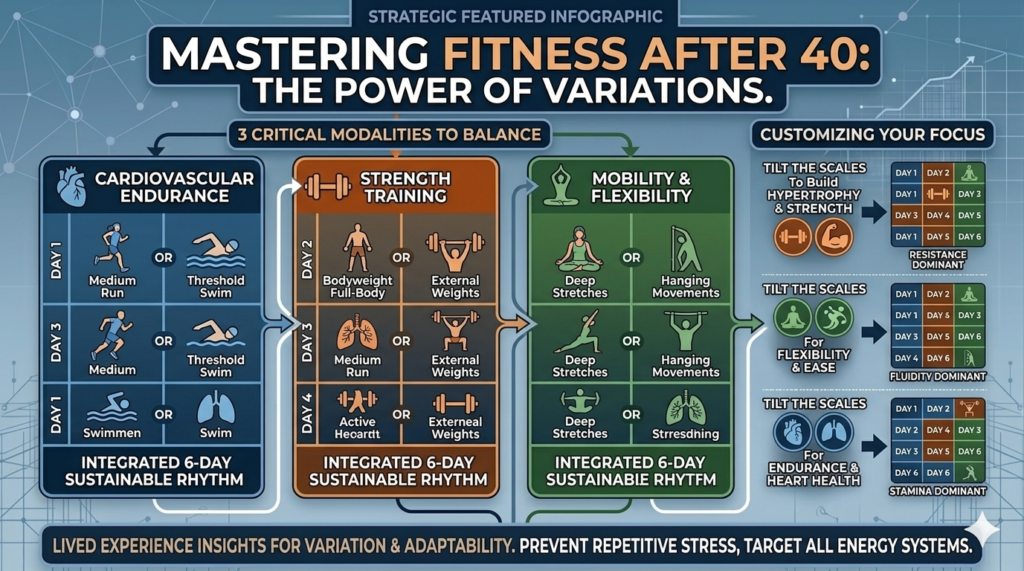
To achieve comprehensive physical longevity, you must balance three critical modalities: cardiovascular endurance, strength training, and mobility work. All of these must be integrated into your six-day schedule. The way you prioritize these will depend on your specific goals and time you spend, but for fitness after 40, none of them can be entirely neglected.
Customizing your focus for fitness after 40
While a balanced approach is best, you can tilt the scales toward your personal objectives:
- To build Hypertrophy (big muscles) and Strength: If your goal is to maintain or grow muscle mass, your schedule should lean more heavily toward resistance or weight training.
- For Flexibility and Ease: If you prioritize a “fluid” body, focus on mobility drills and deep flexibility stretches.
- For Endurance and Heart Health: If you wish to improve your stamina, prioritize cardiovascular activities like swimming or running.
Breaking the monotony
There is no rigid, one-size-fits-all rule in fitness, but there is one undeniable law: consistency. While you must show up every day, you should continuously introduce variations into your workouts.
As a runner, I personally utilize variations like uphill climbs, road running, and hybrids of both. I also alternate between medium-paced runs, interval training, and threshold runs to challenge different cardiovascular systems. For weight training, I rotate between full-body routines, focused muscle sets, bodyweight exercises, external weights, and hanging movements.
Variation in your regimen does more than just keep you mentally engaged; it prevents the repetitive stress injuries that become more common as we age. By rotating through different movements, you target various muscle groups and energy systems, ensuring that your body remains adaptable and resilient.
Ultimately, it doesn’t matter which specific regimen you choose on a given day, as long as you are moving with intention. Every session is an investment in your future self.
Think beyond toned biceps and 6-pack abs
If approached with technical precision, strength and cardio training can become your true “fountain of youth.” In our younger years, fitness motivations are often driven by aesthetics; the desire to look great in photographs, social circles, or the mirror. In those days, a high activity level often masked a lack of structured training.
However, the biological landscape shifts once you cross 40. True fitness after 40 requires you to move past the “mirror muscles” like biceps or abdominals. You must engage the overlooked stabilizer muscles that are vital for functional strength and long-term joint integrity.
True core strength goes far beyond the visible “six-pack.” It involves the deep posterior chain, the gluteal complex, and the spinal stabilizers that protect your back and maintain your posture. Strengthening these foundational areas, rather than just focusing on superficial muscle groups, is what allows you to remain powerful and resilient for decades to come.
Challenge yourself, but control the load
To optimize the benefits of fitness after 40, you must adopt the principle of progressive overload. This means consistently raising the bar, whether by increasing resistance, distance, duration, or repetitions. Improvement is a direct result of challenging the body to adapt to new stressors. By intentionally and safely pushing your physical limits, you are effectively “future-proofing” your body against the frailty often associated with aging.
Master the “Control-to-Load” Ratio
As you progress, your neuromuscular system becomes more efficient, allowing you to take on greater physical challenges. However, the golden rule of longevity is to increase the load only as fast as you can maintain perfect form and posture.
- Form over Ego: Never sacrifice the alignment of your spine or the stability of your joints to hit a new personal best. If your form breaks down, your joints and connective tissues are forced to compensate, and they could buckle under the load.
- Intelligent Breathing: Utilize diaphragmatic breathing to stabilize your core during lifts and maintain consistent oxygen flow during endurance sessions. Proper breath control is the secret to maintaining internal pressure and protecting your spine.
- The “Stop” Signal: Expertise lies in knowing the difference between “productive discomfort” and “injury-predicting pain.” Listen to your body’s signals; joint “stinging,” numbness, or sharp pains are non-negotiable cues to stop immediately.
The Psychology of Progression
Embrace the mindset that growth occurs only when you move outside your comfort zone. Whether you are a runner aiming for a longer “threshold run” or a lifter adding five pounds to the bar, this progression is the ultimate motivator. Navigating the aging process isn’t about slowing down; it’s about evolving your capabilities so that your future self remains resilient, capable, and strong.
FAQ: Mastering Fitness After 40
1. Is it too late to start exercising after 40?
2. How many days a week should I work out after 40?
3. Why is lifting weights important for adults over 40?
4. How can I avoid injuries when starting a new fitness plan?
5. Can I still improve my cardio endurance after age 40?
6. What is the secret to fitness success after 40?
Fitness after 40: Embracing your future stronger self
Achieving fitness after 40 is not about chasing the ghosts of your 20s; it is about engineering a resilient, high-functioning body for the decades ahead. By envisioning your future stronger self, the version of you that remains mobile, strong, and capable at 60, 70, and beyond, you shift your focus from temporary aesthetics to long-term structural integrity.
To succeed, you must move beyond generic advice and adopt a proactive, data-driven mindset:
- Audit your baseline: Use regular professional or self-assessments to identify biomechanical gaps before they manifest as injury.
- Diversify your stimulus: Balance the “aerobic base” of cardiovascular work with the metabolic necessity of strength training and mobility drills.
- Prioritize the “Invisible” muscles: Look past the mirror and strengthen the core and posterior chain stabilizers that act as your body’s true armor.
- Master Progressive Overload: Continually challenge your thresholds, but never at the expense of form integrity or joint safety.
Navigating the aging process is a marathon of consistency. It requires acknowledging the physiological shifts in your body and responding with smarter approach – leveraging trial and error and experience to find what truly works. A progressive, holistic fitness plan is your most powerful tool for maintaining optimal well-being. Start today, stay consistent, and turn your body into a tool for lifelong joy and physical freedom.
Why fitness after 40 makes a big difference to your life
The decision to prioritize fitness after 40 acts as a powerful hedge against the “accelerated aging” that modern, sedentary lifestyles often trigger. When you commit to this path, you aren’t just burning calories; you are fundamentally altering your biological trajectory. You are building a reservoir of “functional reserve” and extra capacity in your heart, lungs, and muscles. This reservoir allows you to handle life’s unexpected stresses, from illness to physical accidents, with far greater resilience.
By taking control now, you ensure that your later decades are defined by vitality and independence rather than limitation and a loss of mobility. Ultimately, the work you do today is the difference between simply growing older and actually growing stronger.
Want professional content writing services to turn your ideas into engaging blog posts that your readers love?
 Chat with Nady on WhatsApp
Let’s build your authority in the fitness and health niche together.