
Is Your Fitness Goal Feeling Like “Running in Sand”?
You’re putting in the effort, but the results are just too slow?
You work out regularly and eat right. Yet, the weight is creeping up, your joints feel tight, and that Monday soreness now lingers until Thursday. It isn’t a lack of discipline; it’s a rhythm mismatch due to Hormonal Decline After 40.
Behind the scenes, a silent shift in SHBG (which ‘handcuffs’ your Testosterone), Cortisol, and Estrogen is stalling your progress. This guide isn’t about working harder – it’s about adopting a smarter strategy to reclaim your vitality.
- Hormonal Decline After 40 – Introduction
- ✔ Reality Check of Midlife Fitness
- Where We’re Headed after hormonal decline after 40
- The Sex Hormones and Growth (With Nuance)
- The Hormonal Interaction
- My Take from Deep-Dive with Lived Experience
- Fitness Impacts You’ll Notice with Hormonal Decline After 40 (The Red Flags)
- Sustainable Solutions for Hormonal Decline After 40
- Building Your Sustainable Weekly Routine – Overcome Hormonal Decline After 40
- Frequently Asked Questions on Hormonal Decline After 40
- Don’t Get Betrayed by Hormonal Decline After 40 – Adapt
- The Path Forward after hormonal decline after 40
- For – Brands | Businesses | Coaches
Hormonal Decline After 40 – Introduction
Are your body and mind slowly making you accept that your days of fitness are behind you? If you are thinking like that after 40, you are not alone. Yes, your body is changing – you are losing muscle mass, your joints are getting tighter, and hormones are depleting. But that does not mean you cannot be fit and have a healthy body after your 40s and beyond.
Testosterone, estrogen, growth hormone, and thyroid function all decline with age. These shifts affect muscle mass, metabolism, recovery, and even motivation. Building strength, staying lean, and bouncing back after a workout was easy when you were young. It is still possible to achieve peak fitness after 40, but now you need smarter strategies.
The changes in your body are real, and unless you adapt to them, your body will start betraying you. Let’s not undermine the fact that the pain is also real, especially if you have stayed away from physical activity for many years or even decades. It is important to assess your current physical condition before considering the kind of fitness plan that will meet your goals.
Thousands of 40 plus people are running marathons, lifting weights, swimming across rivers, and achieving new physical benchmarks that few thought possible. They are not defying biology or science of hormonal decline after 40 – they have learned to adapt to changes with resilience and consistent workouts.
Here’s the good news: with sustainable fitness routines midlife, proper nutrition, and strategic recovery habits, you can work with your changing physiology instead of submitting to negative feelings. This isn’t about fighting your age – it’s about adapting intelligently to stay strong, vital, and resilient.
✔ Reality Check of Midlife Fitness
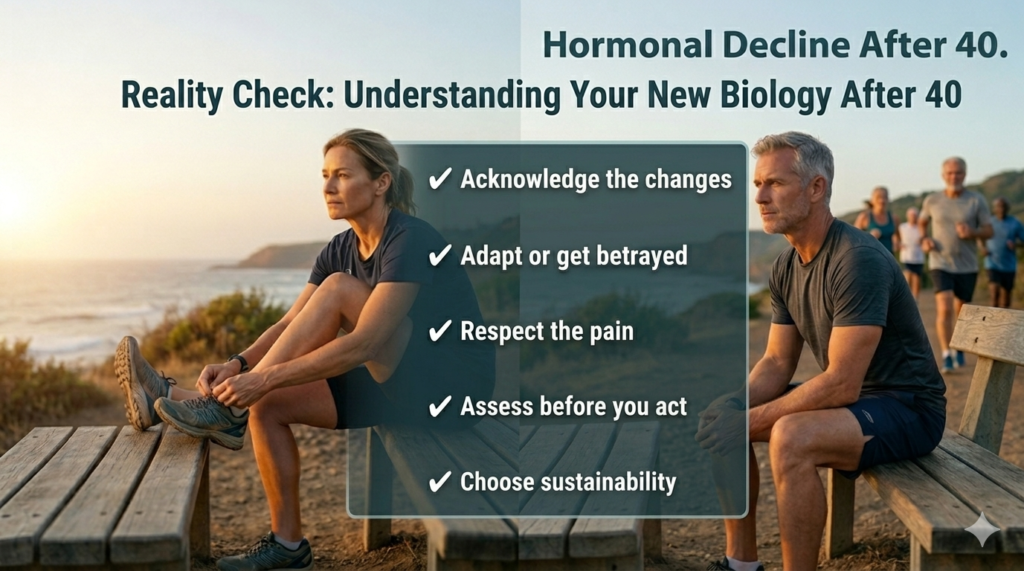
- Acknowledge the changes – Your body is changing in more ways than one. Muscle mass is declining, joints are tighter, hormones are depleting, breathing capacity dips, and your confidence often drops with them.
- Adapt or get betrayed – Unless you adapt to these changes, your body will start betraying you.
- Respect the pain – The pain is real, especially if you’ve stayed away from physical activity for years or even decades.
- Assess before you act – Evaluate your current physical condition honestly before choosing a fitness plan. Seek professional help if needed.
- Choose sustainability – Pick a fitness approach that matches your goals and can be maintained in the long run. This will involve making lifestyle changes.
Where We’re Headed after hormonal decline after 40
After 40, hormonal decline after 40 fitness becomes one of the biggest reasons fitness activities feel harder. Testosterone, estrogen, growth hormone, and thyroid function all shift downward, affecting muscle mass, metabolism, recovery, and even motivation. These changes are real – but so are the solutions.
In this blog post, we’ll examine the science behind hormonal decline and then explore sustainable strategies that help you adapt intelligently and stay strong, vital, and resilient. Think of this next section not as a biology lesson, but as a ‘User Manual’ for your body’s new operating system. Let’s look at the chemicals that are actually pulling the strings.
The Sex Hormones and Growth (With Nuance)
Disclaimer: Hormonal changes vary by individual. Impact depends on genetics, lifestyle, and existing fitness levels.
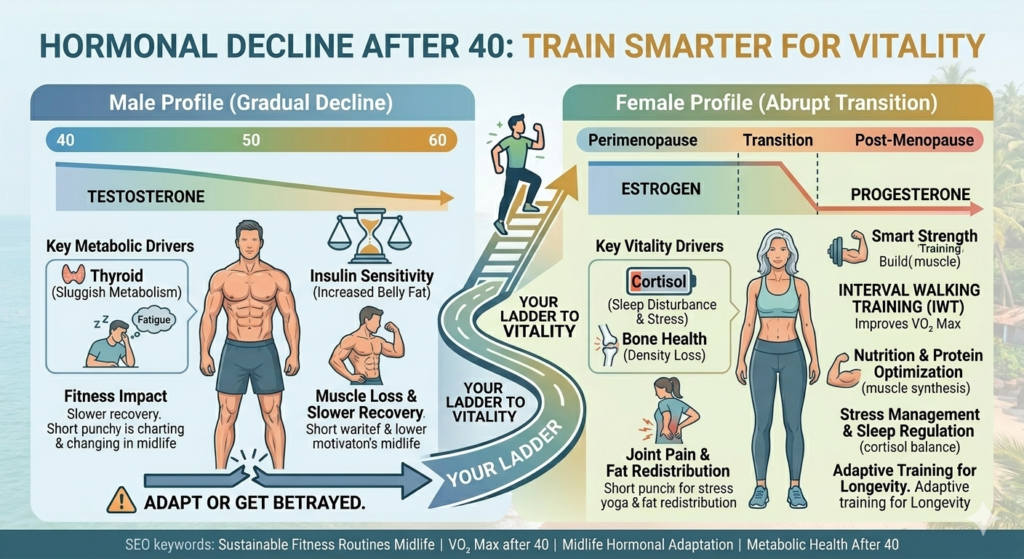
1. Testosterone (Gradual Decline, Metabolic Driver)
Starting in your 30s, levels drop by about 1% per year.
⚠ The Nuance: It’s not just about the total amount of testosterone; it’s about “Free Testosterone.” As we age, a protein called SHBG (Sex Hormone Binding Globulin) often increases, “grabbing” the testosterone in your blood and making it unusable for muscle repair. You might have “normal” total levels on a lab test, but if it’s bound up, your body can’t use it to fuel that metabolic engine. This is a primary hurdle for testosterone decline exercise solutions.
- The Fitness Signal: You feel like the “pilot light” of your motivation has been turned down. It’s not just physical muscle loss; it’s a subtle drop in the drive to hit the pavement or the gym.
2. Estrogen & Progesterone (The Abrupt Shift)
The transition of perimenopause can feel like a hormonal cliff.
⚠ The Nuance: The real “betrayal” here is the loss of collagen integrity. Estrogen and fitness after 40 are linked by more than just energy; estrogen plays a massive role in keeping your connective tissues (tendons and ligaments) elastic. When estrogen drops, those tissues become more brittle. This is why women over 40 often see a spike in “overuse” injuries like Achilles tendonitis or plantar fasciitis, even if they haven’t changed their mileage.
- The Fitness Signal: Your “internal cushioning” feels gone. Every step on a hard surface feel “bony” or stiff, and your joints might feel “loose” or unstable one day and completely locked up the next.
3. Growth Hormone (GH) (The Repair and Recovery Lag)
GH drops by roughly 14% per decade after your 20s.
⚠ The Nuance: Growth Hormone release is almost entirely dependent on Deep Sleep (Stage 3 & 4). Because Cortisol and Estrogen shift often disrupt sleep quality in midlife, you get hit with a “double whammy”: you have less GH naturally, and you aren’t getting the deep sleep required to pulse the little GH you do have left. It’s a recovery debt that compounds daily.
- The Fitness Signal: The “soreness” from a Monday workout used to be gone by Tuesday morning. Now, it lingers until Thursday. You’re forced to choose between “training through the pain” (injury risk) or “extra rest” (losing consistency).
While the sex hormones and Growth Hormone handle your structural integrity, these next two – Thyroid and Cortisol – are the “Command and Control” center for your energy and body composition.
4. Thyroid Hormones (The Sluggish Thermostat)
Your thyroid is essentially the thermostat for your body’s metabolism.
⚠ The Nuance: It is important to note that thyroid decline is not a universal rule. Many people maintain “normal” clinical levels well into their 60s. However, as we age, our sensitivity to small fluctuations increases. What was a “low-normal” level at 25 might have been unnoticeable; at 50, that same level can be the difference between feeling energized and feeling like you are “running in sand” – meaning not seeing enough results for your efforts.
- The Fitness Signal: You aren’t necessarily “broken,” but your margin for error is smaller. This is why a consistent routine becomes more critical – your body no longer has the hormonal “slack” to ignore poor nutrition or erratic training.
5. Cortisol (The Stress-Driven Saboteur)
Cortisol is your primary stress hormone.
⚠ The Nuance: A common myth suggests cortisol just “drops.” In reality, the issue after 40 is dysregulation. Your “Cortisol Awakening Response” becomes inverted. Instead of being high in the morning to get you moving, it stays low (fatigue). Then, it spikes at night when it should be low (insomnia).
- The Fitness Signal: This is why you might feel “sluggish” during your morning run but then find yourself wide awake and stressed at 11:00 PM. This “rhythm mismatch” prevents the deep, restorative sleep required for tissue repair and growth hormone release.
The Hormonal Interaction
None of these hormones act in isolation. Low Testosterone or Estrogen makes you more sensitive to Cortisol. High Cortisol suppresses your Thyroid. It’s a delicate feedback loop that requires a Smarter Strategy – not just more “grinding.”
Disclaimer: Hormonal changes vary by individual. Impact depends on genetics, lifestyle, and existing fitness levels.
My Take from Deep-Dive with Lived Experience
The “Collagen Betrayal”: If the ground feels “harder” lately, it’s likely not the road – it’s your tendons. For women, the drop in estrogen reduces connective tissue elasticity. This is why “overuse” injuries suddenly appear even if your mileage stays the same. Understanding estrogen and fitness after 40 is the first step in protecting your joints.
The SHBG Factor: For men, “Total Testosterone” on a lab test can be deceiving. As we age, a protein called SHBG often “handcuffs” your testosterone, making it unusable for muscle repair. We focus on Usable (Free) Testosterone to keep that metabolic engine humming.
The Rhythm Mismatch: Cortisol isn’t “bad” – it’s just often mistimed. If you’re sluggish at 8:00 AM but wired at 11:00 PM, your hormonal clock is out of sync. Fixing this “rhythm mismatch” is the secret to waking up without that “running in sand” feeling.
Fitness Impacts You’ll Notice with Hormonal Decline After 40 (The Red Flags)
After 40, your body stops giving you a “free pass” for high-intensity grinding. If you are experiencing these shifts, it’s a sign that your hormonal foundation is changing:
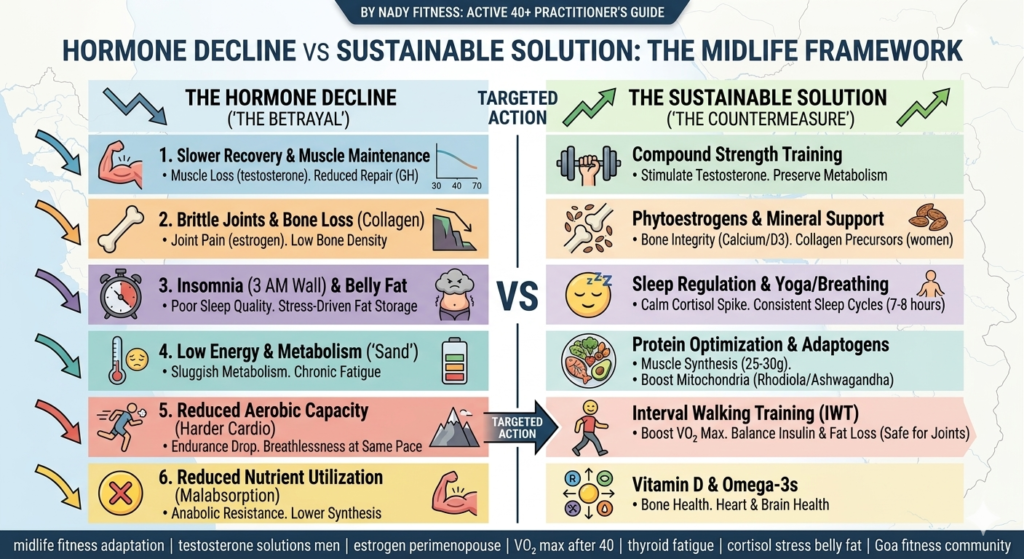
The “Melt-Away” Muscle (Maintenance Struggle): You haven’t changed your routine, yet you’re noticing difficulty in building or even maintaining muscle. You feel “softer,” and definition seems to evaporate despite your consistency. This is the SHBG Factor making your testosterone unusable.
The 3:00 AM Wall (Sleep Fragmentation): You fall asleep fine, but you wake up in the middle of the night with a racing mind. This poor sleep quality (shallow sleep and early waking) is a direct result of Cortisol dysregulation and estrogen decline. Without deep sleep, your body never enters the “repair shop” of Growth Hormone release.
The “Running in Sand” Effect (Endurance Drop): You’ve noticed your usual cardio pace feels significantly harder. This Endurance Drop stems from a lower VO₂ Max after 40 and reduced mitochondrial efficiency – the engines of your cells are simply getting less “boost” from Growth Hormone.
The Midsection Migration (Belly Fat): This is the “stubborn” flag: increased belly fat despite the same effort. Even with clean eating, the “spare tire” inflates due to a sluggish Thyroid and the Cortisol-driven survival response.
The “Phantom” Injury (Bone & Joint Risk): Inexplicable aches in the heels, knees, or hips. You face a higher risk of injuries and bone loss because the Collagen Betrayal has left your connective tissues brittle and less elastic.
Sustainable Solutions for Hormonal Decline After 40
Your body isn’t asking you to work harder; it’s asking you to work smarter. Here is the protocol to stabilize your internal environment and reclaim your vitality.
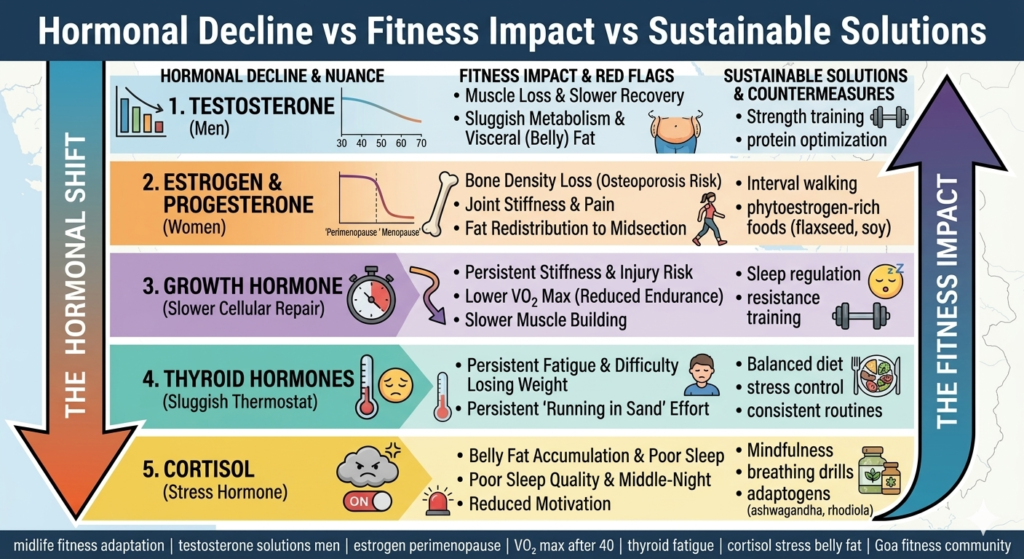
1. Strength & Resistance Training (The Hormone Anchor)
- The Mechanism: This is the only way to “force” the body to keep metabolically expensive muscle. It directly stimulates the release of testosterone decline exercise solutions and Growth Hormone.
- The HI Nuance: Focus on “Compound Movements” (squats, deadlifts, presses). These move multiple joints and signal a full-body hormonal response rather than just isolating a small muscle.
2. Interval Walking Training (IWT) (The Vitality Ladder)
- The Mechanism: By alternating speeds, you boost your VO₂ Max after 40 and improve Insulin Sensitivity without the massive cortisol spike of high-mileage running.
- The HI Nuance: Interval Walking Training is your “Ladder.” It bridges the gap between sedentary life and high-performance endurance, allowing your heart and lungs to adapt without trashing your joints.
3. Protein & Macronutrient Optimization
- The Mechanism: To combat “Anabolic Resistance,” aim for 25–30g of protein per meal.
- The HI Nuance: Don’t eat protein in isolation. Pair it with healthy fats (for hormone production) and complex carbs (to keep cortisol stable) to ensure the body actually uses the protein for muscle synthesis.
4. Stress Management and “Vagal Tone”
- The Mechanism: Practices like Mindfulness, Yoga, and Breathing Drills (specifically nasal breathing) lower cortisol and activate the parasympathetic nervous system.
- The HI Nuance: This isn’t just “relaxing” – it’s a physiological “off-switch” for the belly-fat-storing survival state.
5. Sleep Regulation (The Repair Shop)
- The Mechanism: Aim for 7-8 hours with a consistent sleep-wake cycle.
- The HI Nuance: Consistency is more important than duration. Waking up at the same time every day stabilizes your Cortisol Rhythm, ensuring you’re alert in the morning and sleepy at night.
6. Nutrition & Natural Support
- Women’s Support: Use Phytoestrogens (flaxseed, soy) to mimic estrogen’s protective effects on bone and heart health.
- The Foundation: Vitamin D & Omega-3s are non-negotiable for joint integrity and cardiovascular resilience.
- The Adaptogen Shield: Herbs like Ashwagandha and Rhodiola help the body handle stress without triggering a massive cortisol spike.
Building Your Sustainable Weekly Routine – Overcome Hormonal Decline After 40
The key after 40 is consistent output, not heroic effort. We are no longer in the business of “grinding” our bodies into the ground; we are establishing a rhythm. Think of your hormones like a compounding interest account. A single “heroic” workout won’t fix a cortisol imbalance, but small, daily habits – like a 30-minute lift or a breathing drill, compound over weeks into a stabilized hormonal environment.
An Example High-ROI, Hormonal-Stabilizing Weekly Framework:
Monday: The Strength Anchor
- Action: 30 mins of Heavy-ish Compound Lifts + Light evening stroll.
- Why: Keeps Testosterone high and signals muscle maintenance. Note: Mobility work here is critical to prep the joints and prevent “phantom” injuries.
Tuesday: The Metabolic Ladder (IWT)
- Action: 40 mins Interval Walking + Mobility/Stretching.
- Why: Boosts VO₂ Max without the joint-stress of high-impact running.
Wednesday: The Cortisol Reset (Active Recovery)
- Action: 45 mins Yoga/Pilates + Breathing Drills.
- Why: This is “Vagal Tone” training. It pulls you out of a stress-state and into a repair-state.
Thursday: The Strength Anchor
- Action: 30 mins Compound Lifts + Light evening stroll.
- Why: Frequent, short signals to the body to keep the metabolic engine burning. Flexibility Tip: If your schedule allows, a 3rd short session on Saturday can further optimize muscle preservation.
Friday: The Metabolic Ladder (IWT)
- Action: 40 mins Interval Walking + Mobility/Stretching.
- Why: Stabilizes insulin levels and clears metabolic waste before the weekend.
Saturday: The “Play” Day (Movement is Mandatory)
- Action: A longer steady walk, beach/trail activity, or swimming.
- Why: Functional movement that feels like fun, not “work.” Even if “optional,” aim for at least 30 minutes of light movement to maintain the hormonal rhythm.
Sunday: Total Rest & Deep Recovery
- Action: Focus on optimal sleep hygiene and restorative rest.
- Why: While GH pulses every night during deep sleep, Sunday is your dedicated “Repair Shop” to clear any lingering systemic fatigue before the new week begins.
The key after 40 is consistent output, not heroic effort. We aren’t grinding; we are establishing a rhythm to overcome hormonal decline after 40.
The Final Piece on Hormonal Decline After 40 – Community & Accountability
My Take from Lived Running Experience for more than 17 years: Motivation in your 20s was about looking good. Motivation in your 50s is often about showing up for others. I am a solo runner and usually workout alone, but I have seen people get great results with social support.
Whether it’s a training partner on the beach or road, a group class, or an online fitness community – it can be a massive driver of consistency for those seeking motivation and discipline. When your internal “drive” is low, the external expectation of a friend waiting for you at the start of the trail becomes your most powerful tool. Don’t train in a vacuum if your mind doesn’t agree, train in a tribe.
Frequently Asked Questions on Hormonal Decline After 40
Don’t Get Betrayed by Hormonal Decline After 40 – Adapt
Hormonal decline after 40 is a biological reality, but it doesn’t have to be a fitness death sentence. You simply cannot outrun the Collagen Betrayal or the Rhythm Mismatch with the same “grind” tactics you used in your 20s.
To thrive after 40, you must grind smarter and start adapting. By using the Nady Fitness Ladder to Vitality, focusing on VO₂ Max after 40, smart strength training, and metabolic recovery, you aren’t just slowing down the clock; you’re rewriting the rules of your own aging.
The Path Forward after hormonal decline after 40
Your biology is Not a Limitation:
Pick one “countermeasure” from the infographic above. Whether it’s starting IWT or hitting a 25g protein goal tomorrow morning, start your ladder today.
“Your body isn’t broken after 40 – it just needs smarter training.”
➡️ Want to see this in practice? Read my 12-Week IWT Blueprint post for a full routine.
For – Brands | Businesses | Coaches
If your brand or website needs top-quality blog content or end-to-end blog management, chat with me today. I create content with the same clarity, science-backed storytelling, and motivational rhythm you just read.
I offer blog management and content writing services across diverse sectors, whether your niche is fitness and health (my favorite), technology, lifestyle, or business – I specialize in turning topic ideas into engaging, SEO-optimized blog posts that your readers will trust and love.
Let’s build your business authority online with content that delivers both value and results.
 Chat With Nady on WhatsApp
✍️ Explore Our Blog Writing Services
Chat With Nady on WhatsApp
✍️ Explore Our Blog Writing Services