
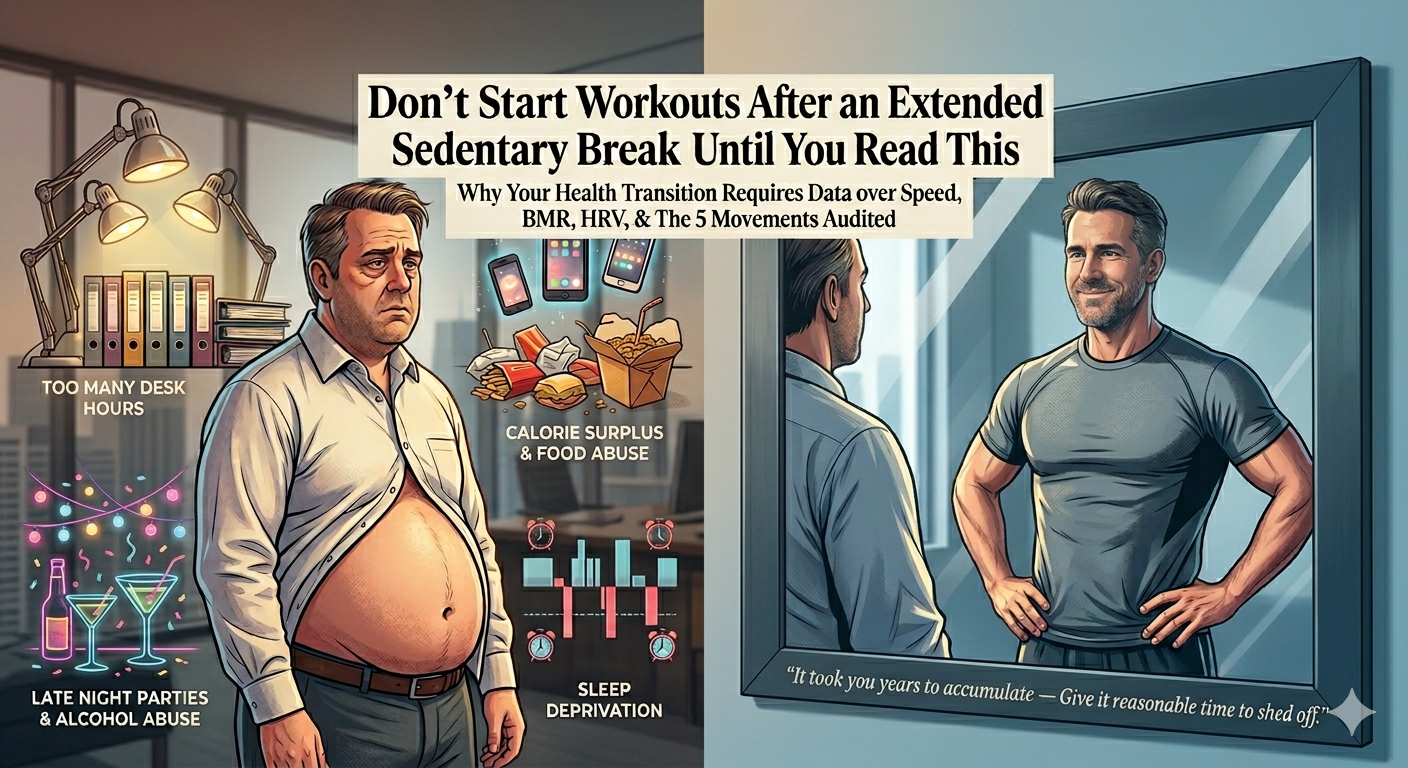
Don’t start workouts after an extended sedentary break until you read this post completely. Here I explain how to restart fitness safely after years of desk hours and unhealthy lifestyle choices. It is never too late to make a comeback to your fitness journey.
Disclaimer: This post is written specifically for individuals who are witnessing their health deteriorate and their body weight increase after years of a sedentary lifestyle and structural neglect. If you have any underlying medical or health conditions, you must first secure a comprehensive medical clearance from your healthcare provider to restart fitness safely. This data ensures your fitness trainer can accurately design a physical progression framework that strictly aligns with your doctor’s recommendations and official health reports.
- The Dangerous Trap of Fast-Track Fitness Goals
- The Illusion of the 4kg-a-Month Weight-Loss Victory
- The Hidden Danger of Drastic Calorie Deficits: Eating Muscle, Not Fat…
- The 500g Per Week Rule: The Scientific Sweet Spot
- The Pre-Workout Assessment: Auditing Your True Entry Point
- 1. The Nutritional Assessment: Calculating the BMR & Macronutrient Floor
- 2. The Cardiovascular Checkpoints: HRV and HRR
- 3. The Biomechanical Assessment: The 5 Primary Movements
- Adjusting Your Exercise Intensity for a Safe Transition
- Using HRR to Restart Fitness Safely (The Karvonen Formula)
- Frequently Asked Questions on How to Restart Fitness Safely
- The Blueprint to Restart Fitness Safely for Lasting Results
- For – Brands | Businesses | Coaches
The Dangerous Trap of Fast-Track Fitness Goals
You have been doing a lot of desk hours and have been feeding a calorie surplus for many years. One day you see that your body has become an invitation to lifestyle diseases and wish to do something about it. You approach a gym trainer, and he gives you a plan with the goal of losing 4kg a month.
The trainer knows that you are impatient and looking for quick results, and he has to give you something drastic, like cutting down your calorie intake to half. He may see it as a strategy to retain the client, because they tend to come back to him if he is showing quick results. Let’s break this down further and see if this kind of goal-setting is sustainable, or could it lead to a relapse that will make your body heavier than before.
The Illusion of the 4kg-a-Month Weight-Loss Victory
Most trainers know that clients are impatient, buy with their emotions, and want instant gratification. This is why promising rapid drops like 4kg in 30 days is common to secure quick sales. Client retention is important for trainers, no doubt, but should it come at the cost of safety and sustainability?
When a plan calls for a rapid drop like 4kg a month, the required calorie deficit has to be incredibly severe. To hit that number, the daily calorie intake is often cut down drastically, frequently pushing it straight into the danger zone: dropping well below your Basal Metabolic Rate (BMR).
The Hidden Danger of Drastic Calorie Deficits: Eating Muscle, Not Fat…
Your BMR is the absolute line in the sand. It represents the exact amount of energy (calories) your body requires just to perform baseline biological tasks including breathing, circulating blood, cellular repair, and organ function, while at complete, non-activity rest.
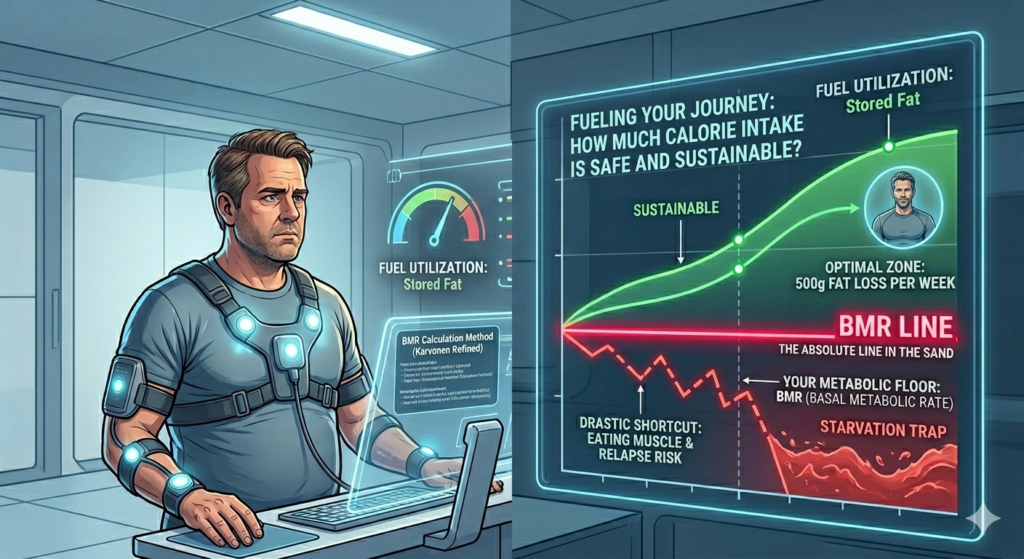
When you force a previously sedentary body into a drastic deficit that falls beneath this biological floor, the body panics. Unable to distinguish between a modern cosmetic diet and a primitive famine, it triggers a severe survival response:
- Metabolic Slowdown: To keep you alive, the body downregulates its energy expenditure, slowing your overall metabolism to conserve fuel.
- Cannibalizing Muscle Tissue: Because muscle tissue requires a massive amount of energy to maintain, a starving body views it as a liability. Instead of efficiently utilizing stored fat, the body actively breaks down its own muscle mass for energy.
- The Relapse Trap: This is why aggressive shortcuts are entirely unsustainable for the long run. The moment you stop working out or slightly alter your food intake, your permanently lowered metabolism causes a massive, aggressive weight relapse, leaving your body heavier and with less muscle tissue than when you started.
The 500g Per Week Rule: The Scientific Sweet Spot
To prevent a metabolic crash and ensure your body actually utilizes fat stores, fitness science relies on a sustainable target: 500 grams (0.5 kg) of weight loss per week.
To lose 500g of pure fat tissue, you need to create a weekly deficit of roughly 3,500 calories, which breaks down to a highly manageable 500-calorie deficit per day.
Instead of cutting all 500 calories entirely from your food, which triggers hunger panics and threatens your BMR, an elite strategy implements a Smart Split:
- Nutritional Contribution: Cut a modest 300 calories from your daily food intake.
- Activity Contribution: Burn the remaining 200 calories through controlled, low-intensity movement.
This approach keeps your energy intake safely above your biological floor, allowing you to protect your health while consistently burning fat.
Important Note – The 3,500-calorie rule is an average; actual fat loss can vary depending on age, sex, metabolic rate, and body composition.
Once you understand why drastic goals backfire, the next step to restart fitness safely is to audit your true entry point with a structured pre‑workout assessment.
The Pre-Workout Assessment: Auditing Your True Entry Point
Because an extended sedentary break alters both your internal chemistry and your physical mechanics, you cannot simply jump straight into an intense exercise routine. To make a safe transition, you must undergo a comprehensive entry assessment that evaluates your structural, nutritional, and cardiovascular needs simultaneously.
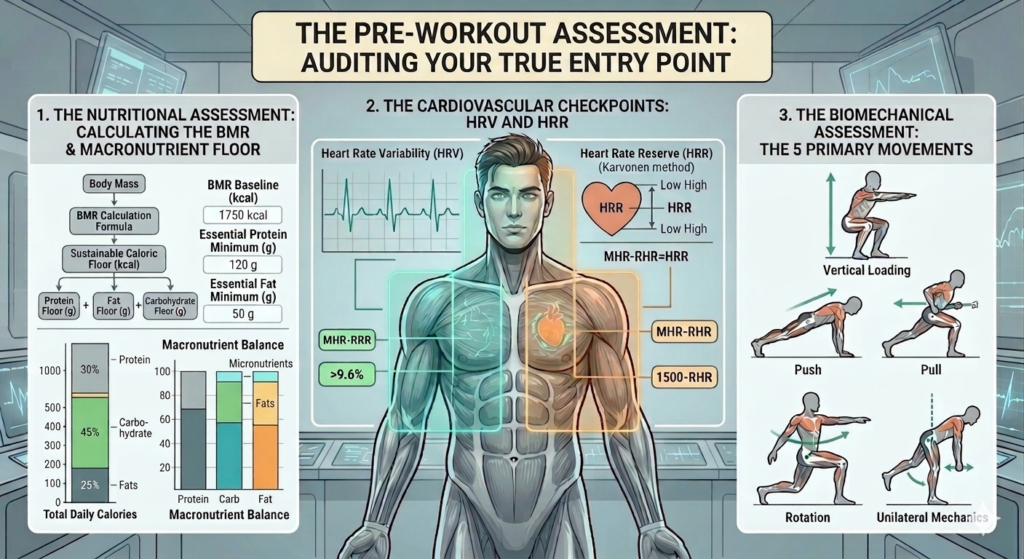
An entry assessment ensures you never guess where your body is starting; instead, it provides hard data on your biological floor, your nervous system, and your physical architecture.
1. The Nutritional Assessment: Calculating the BMR & Macronutrient Floor
Before tracking a single calorie, an assessment must establish your exact BMR. Once this baseline caloric floor is known, your energy budget must be distributed across the three main macronutrients to support your transition:
- Proteins: The primary weapon for muscle preservation. Ensuring adequate protein intake prevents the body from cannibalizing lean tissue during a deficit, while boosting fullness to prevent a dietary relapse.
- Carbohydrates: The primary fuel source for your central nervous system. Carbohydrates break down into glucose and are stored as glycogen, giving you the mental clarity and energy required to perform movement patterns with perfect precision.
- Fats: The structural foundation for hormone regulation and joint health. Dropping fat intake too low degrades metabolic efficiency and reduces joint lubrication, which is vital when restarting an active life.
Few other points to restart fitness safely
- Micronutrients: Vitamins/minerals (like calcium, vitamin D, magnesium) are also part of the nutritional floor, especially for bone and joint health after inactivity.
- Individualization: Macronutrient distribution should be tailored to body composition, age, and training goals.
- Protein quality: Complete proteins (with all essential amino acids) are most effective for muscle preservation.
- Hydration: Water intake is also part of the nutritional floor, especially for joint lubrication and metabolic efficiency.
- Fiber: It plays a role in satiety, gut health, and stabilizing blood sugar during calorie deficits.
With your nutritional floor secured, the next checkpoint is your cardiovascular system to ensure your heart and nervous system can safely handle the load.
2. The Cardiovascular Checkpoints: HRV and HRR
Before starting any physical exertion after an extended sedentary break, you must establish an objective baseline for your heart and nervous system. This requires tracking two distinct cardiac metrics:
- Heart Rate Variability (HRV): Measured at rest, HRV tracks the millisecond differences between consecutive heartbeats. It identifies your autonomic stress baseline. Years of sedentary desk hours typically result in a low baseline HRV, signaling a rigid, unrecovered nervous system that is highly susceptible to early burnout and injury if overloaded too quickly.
- Heart Rate Reserve (HRR): Calculated using the Karvonen method, HRR is the exact cushion between your Maximum Heart Rate (MHR = 207 – 0.7 x age) and your true Resting Heart Rate (RHR). Your HRR represents your actual cardiovascular working capacity. A lower fitness level means a smaller reserve, highlighting exactly how narrow your safe training window is when you first restart.
Few other points to restart fitness safely
- Context for HRV measurement: HRV is best tracked consistently (e.g., morning at rest) to establish a reliable baseline.
- Other cardiovascular markers (optional): Resting blood pressure or VO₂ max estimates are sometimes included in entry assessments, but they may be too advanced for this stage.
After setting safe cardiac boundaries, it’s time to evaluate your body’s structural mechanics through the five foundational movement pillars.
3. The Biomechanical Assessment: The 5 Primary Movements
Simultaneously, your body’s structural readiness must be evaluated. All human movement is built upon five foundational biomechanical pillars:
- Push: Upper-body horizontal and vertical pressing mechanics.
- Pull: Scapular control and upper-body posterior chain activation.
- Rotation: Core stabilization through the transverse plane.
- Vertical Loading: Up-to-down mechanics, observing joint tracking during a baseline squat or hip hinge.
- Unilateral Mechanics: Single-legged stability, gait balance, and symmetry.
The Golden Rule of Progression
If your initial physical assessment shows that you are not able to execute these 5 basic movements properly, all workout intensity, speed, and weight progressions must be completely frozen.
A professional weight-loss or fitness plan must approach these corrective aspects first. You cannot build strength or push for high performance on top of a compromised movement pattern without risking direct joint damage. You must earn the right to progress by fixing the mechanics first.
Adjusting Your Exercise Intensity for a Safe Transition
Once your nutritional floor is set and your movement patterns are audited, your exercise intensity must match your current baseline. If you are transitioning away from years of desk hours, throwing yourself straight into high-intensity training is a mistake. It overloads an unconditioned cardiovascular system, breaks down structural form, and spikes stress hormones.
The optimal tool for your initial transition is Low-Intensity Steady State (LISS) movement, such as structured, brisk walking or steady cycling:
Using HRR to Restart Fitness Safely (The Karvonen Formula)
Instead of using generic age-based formulas that simply guess your ideal training intensity, you can establish your personalized cardiovascular boundaries using your unique Heart Rate Reserve (HRR) to restart fitness safely. To ensure you remain in a safe, fat-burning zone that protects an unconditioned system, aim for an intensity range of 40% to 59% of your HRR. You can follow the official Karvonen Method Framework to calculate these exact heart rate baselines using your morning resting pulse.
Target Heart Rate Range = (HRR × 0.40 to 0.59) + RHR
Staying strictly within this mathematically calculated zone prevents your heart rate from spiking into a high-intensity danger zone, protecting your joints and ensuring steady progress.
- Optimizing Fuel Sources: Exercising at 40% to 59% of your HRR ensures your body primarily utilizes stored fat as fuel, rather than burning through quickly accessible stored sugars (glycogen).
- Preserving Your Central Nervous System: Because this HRR-guided low-intensity movement fulfills your 200-calorie activity deficit without exhausting your nervous system, it leaves you mentally fresh. This ensures you retain the cognitive focus needed to practice, fix, and master those 5 basic movement patterns safely during your sessions.
HRR Calculation Example:
Let’s say:
Your Age = 40
Resting Heart Rate (RHR) = 70 bpm
Step 1: Calculate Maximum Heart Rate (MHR)
MHR = 207 – (0.7×40) = 207 – 28 = 179 bpm
Step 2: Calculate Heart Rate Reserve (HRR)
HRR = (MHR – RHR) = 179 – 70 = 109 bpm
Step 3: Apply Karvonen Formula for Target Zone (40–59%)
Lower Scale = (HRR × 0.40) + RHR = (109×0.40) + 70 = 43.6 + 70 ≈ 114 bpm
Upper Scale = (HRR×0.59) + RHR = (109×0.59) + 70 = 64.3 + 70 ≈ 134 bpm
✅ Therefore, The Target Heart Rate Range = 114-134 bpm
Note – The safe zone shifts with age and resting pulse rate (Example for Age 50, Here the RHR is 65. Therefore, the Target Heart Rate Range → 108-128 bpm).
Few other points to restart fitness safely
Movement screening tools: Trainers often use standardized assessments (like FMS – Functional Movement Screen) to evaluate those 5 movement pillars.
Joint mobility: Mobility and flexibility checks are part of structural readiness to restart fitness safely but may not be needed in the initial stages when you just start working out after an extended gap of many years.
Progression: Once mechanics are corrected, intensity can be gradually increased using HRR zones beyond 59%.
Example of a mobility check: Simple assessments like ankle dorsiflexion range or shoulder overhead reach can help getting an all-round assessment.
Mobility + stability link: When mobility is restricted, the body compensates with poor stability. For example, tight hips limit squat depth, forcing the lower back to take over. Note that is a faulty pattern that increases injury risk. Screening mobility ensures stability can be built on a solid foundation.
Once nutrition, cardiovascular readiness, and biomechanics are aligned, you finally have a blueprint for lasting results – a roadmap that guarantees sustainable progress.
Frequently Asked Questions on How to Restart Fitness Safely
How do I restart fitness safely after years of inactivity? ▼
The safest approach is to begin with a comprehensive structural and movement assessment rather than jumping straight into intense workouts. Prioritize establishing a baseline for your metabolic rate (BMR) and heart rate variability (HRV), and always secure medical clearance if you are reversing years of sedentary habits.
Why are drastic diet changes dangerous when returning to exercise? ▼
When recovering from years of desk hours, forcing your body into a massive calorie deficit while simultaneously starting a new workout routine shocks your metabolism. This drastic approach triggers a high relapse rate and muscle loss instead of sustainable fat loss and longevity.
Do I need a doctor’s clearance before restarting fitness? ▼
If you have been completely inactive for many years, have noticed deteriorating health markers, or possess underlying medical conditions, a medical assessment is highly recommended. This ensures your fitness trainer can build a progression framework tailored to your official health reports.
What is Heart Rate Reserve (HRR) and why does it matter? ▼
HRR is the difference between your maximum heart rate and your resting heart rate. It defines your true cardiovascular working capacity. Using HRR helps set safe training zones that protect your heart, prevent overtraining, and ensure fat loss without exhausting your nervous system.
How much weight loss per week is considered safe? ▼
Fitness science recommends aiming for about 500 grams (0.5 kg) of fat loss per week. This requires a manageable 500-calorie daily deficit, split between modest food adjustments and controlled activity. Faster rates often trigger muscle loss, metabolic slowdown, and relapse weight gain.
Why is mobility screening important before workouts? ▼
Mobility limitations often force the body to compensate with poor stability. For example, tight hips can limit squat depth, shifting stress to the lower back. Screening mobility ensures you correct these issues first, so strength and endurance are built on a safe foundation.
The Blueprint to Restart Fitness Safely for Lasting Results
Transitioning back to better health and fitness after an extended sedentary break requires a commitment to data over speed for success. While a drastic 4kg-a-month goal satisfies immediate impatience, it threatens your metabolism and invites structural injury.
Seeking sustainable and safe choices to restart fitness safely rather than drastic ones ensures a permanent transition. By conducting a strict assessment that includes calculating your BMR to balance your three main macronutrients, using your HRV and HRR to set safe cardiovascular boundaries, and auditing the 5 primary movements before adding weight, you protect your physical architecture and build a body that thrives for the long haul.
I hope you find this blog useful to build back your fitness or weight-loss journey after years of leading a sedentary lifestyle. Your trainer may be compelled to validate your impatience or unreasonable expectations for fast results, but it is better you know what is sustainable for you to restart fitness safely, so you can carry your fitness journey for years and decades to come without relapsing. Trust the process, and don’t worry too much about results. You should be able to achieve your desirable goals.
The assessment is your roadmap. Once you know your baseline, progress becomes inevitable. The goal isn’t just losing weight – it’s building resilience so your body serves you well for decades to come. Stay consistent, and the results will follow – Good Luck!
For – Brands | Businesses | Coaches
If your brand or website needs top-quality blog content or end-to-end blog management, chat with me today. I create content with the same clarity, science-backed storytelling, and motivational rhythm you just read.
I offer blog management and content writing services across diverse sectors, whether your niche is fitness and health (my favorite), technology, lifestyle, or business – I specialize in turning topic ideas into engaging, SEO-optimized blog posts that your readers will trust and love.
Let’s build your business authority online with content that delivers both value and results.
 Chat With Nady on WhatsApp
✍️ Explore Our Blog Writing Services
Chat With Nady on WhatsApp
✍️ Explore Our Blog Writing Services