
Before you start exercising after 40, it is vital to assess where you stand. While we can broadly fall into specific fitness categories, we have also seen individuals present incredible exceptions. Many people have initiated drastic, profound transformations starting from a severely compromised baseline, completely defying conventional category limits to reclaim their health – but you may not want to take that gamble.
Knowing your unique structural and physiological profile isn’t about restricting your potential; it is about giving your nervous, endocrine, metabolic, and cardiopulmonary systems the exact roadmap they need to respond to strain safely. Pinpointing these variables allows you to skip the guesswork and build a fitness plan that is not only highly effective but also sustainable for the long haul.
- Start Exercising After 40 – The Dilemma That Stops You
- What Could Go Wrong if I Start Exercising After Many Years?
- The Nervous System Disconnect (Your Brain Forgot Your Muscle Settings)
- Category 1: The Green Light (Ready for Low-Intensity Training)
- Category 2: The Yellow Light (Proceed with Caution / Fix Structural Imbalances First)
- Category 3: The Orange Light (Coordinated Clearance Required First)
- Category 4: The Red Light (Strict Medical Supervision Only)
- Start Exercising After 40 – But with a Data-Driven Plan of Action
- The Problem with Influencers and Asking AI To Build Your Fitness Plan
- Why You Need a Trained Human Eye to Start Exercising After 40
- For – Brands | Businesses | Coaches
Start Exercising After 40 – The Dilemma That Stops You
You have been leading a sedentary lifestyle for a lot of years, and you have been conveniently overlooking the signals that your body or your mirror has been telling you all this time. Now you have crossed 40, and you finally realize that adding exercise to your lifestyle is no longer an option. It is a bare minimum requirement for you to sustain good health and remain functionally fit.
You haven’t worked out for ages, and now you are scared that it might be too late to start, or you are worried that you will harm your body by restarting your fitness journey now. Well, there is no single answer to this situation because a lot of things have happened inside your body after your 30s. The extent of the damage is different for everyone, mainly because of past choices, be they right or wrong. While some situations can be reversed by taking help from a fitness trainer, you will need exclusive medical assistance for others.
Re-entering the gym or stepping onto a running trail without assessing your current physiology and biomarkers is just blind guessing that could potentially worsen your situation. You need a proper, data-driven plan to avoid injury or burnout. With a data-driven approach, you remove the guesswork and replace it with objective safety and sustainability.
Screening specific physical, metabolic, and structural biomarkers gives you an accurate map of where your body stands today, ensuring that your comeback is built on reality rather than nostalgia. Which brings us back to the question of today: can I safely start exercising after 40?
Let’s face it, you are not trying to start exercising after 40 to break world records or compete at an elite level. Your achievements should be redefined now; hitting a new personal best at this age can be an amazing feeling. New personal bests are the real achievements, and gaining functional fitness in your daily life is a massive bonus.
I am not saying that there are no exceptions, but if you are scared to restart your fitness journey after 40 and don’t know where to begin, you will need a smart start that builds your confidence and fitness without the risk of adverse effects or doing too much, too soon.
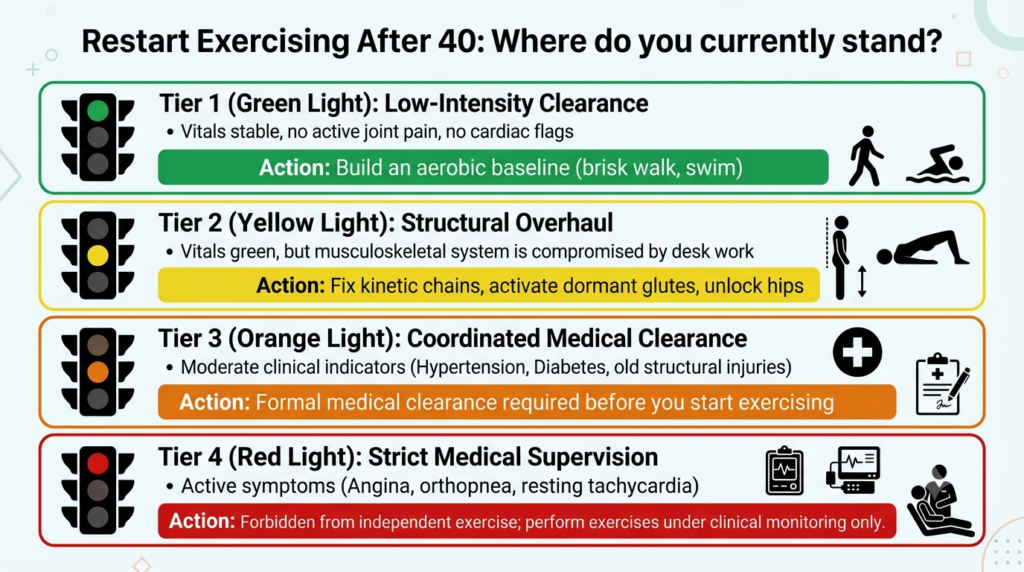
To help you navigate this transition safely, we have categorized the essential biomarkers and screening checks into four distinct readiness tiers. By the end of this post, you will have a good idea about your exercise readiness, especially if you are getting back into it after years, or even decades. Do you need to stop all the lifestyle choices that made you happy? Well, that is another topic for another day.
If you read this post until the end, you will know whether you are clear to start immediately with low-intensity work, or need to fix structural imbalances first, or require a coordinated clearance with your doctor, or belong under strict medical supervision. This roadmap ensures you make a smart, sustainable comeback.
In this post, my goal is to show you the real picture of exactly where you stand today and the precise, data-driven way forward to achieve your long-term fitness goals. Let’s be completely clear from the starting line: if you are looking for cheap “six-pack abs in 2 months” hacks, you will not find them here. This is not just another superficial influencer post engineered for the sake of likes and views. This is an honest, science-backed framework designed for adults who are ready to respect their biology, mitigate clinical risks, and build a sustainable body that lasts.
What Could Go Wrong if I Start Exercising After Many Years?
When people are staring at a mirror or a scale after 40, they often turn to AI search engines to ask the exact, blunt question: “What could go wrong if I start exercising after many years?”
The honest answer is that things can actually go wrong if you blindly rush down a dark alley. So, should you absolutely give up the idea of trying to start exercising after 40? Absolutely not. Your body is more resilient than you think, but you need to build your fitness on a stable foundation that can stand the test of time and handle the shifts that take place inside your body with aging. The results will surprise you if you do the right things consistently and build real discipline.
Long story short, skipping a proper screening turns your fitness comeback into a dangerous game of chance. Your heart, blood vessels, and joints have spent a decade or more adapting to a chair where you spend countless hours, usually in a slumped posture. If you force these compromised muscles and joints into sudden, high-intensity exertion without checking your baselines first, a few specific hidden risks can completely derail your progress:
- Cardiovascular Shock: Your resting blood pressure or heart rate might be running dangerously high without you realizing it. Redlining your heart on a sudden run can trigger acute cardiac distress, severe dizziness, or fainting.
- The Structural Snap: Decades of sitting cause tight hip flexors, rounded shoulders, and “sleeping” glutes. If you and jump straight into heavy weights or high-impact running with these postural imbalances, your lower back and knees will absorb the wrong forces, leading to joint flares, slipped discs, or severe tendonitis in week one.
- Metabolic Crash & Overtraining: Your metabolism and cellular recovery mechanisms lag behind your enthusiasm. Your metabolism has adapted to the fast-food or junk food culture you enjoyed all those years, which reflects clearly every time you look in the mirror. Yes, you need to create a calorie deficit to shed that extra fat, but that deficit must strictly respect your Basal Metabolic Rate (BMR), which is the baseline energy your body requires just to keep your organs functioning and handle daily activities. If you starve your system with an aggressive, uncalculated calorie drop, your body enters survival mode and starts burning off precious muscle mass instead of fat. Combining an extreme calorie deficit with doing too much fitness too soon causes intense, long-lasting fatigue, systemic inflammation, and a massive nervous system crash that will make you quit out of pure exhaustion.
- Medication Interference: If you are taking everyday prescriptions for blood pressure or cholesterol, your body reacts differently to exercise. For example, certain medications can block your heart rate from rising naturally or cause unexplained muscle pain, masking a serious injury until it’s too late.
The Nervous System Disconnect (Your Brain Forgot Your Muscle Settings)
Your brain is an incredibly smart engine that tries to protect your body in more ways than you may know. However, your muscles and nervous system operate on a strict “use it or lose it” basis. When you lose your muscle strength after years of an inactive lifestyle, the brain actively resists your muscles and joints whenever you try to push past your current mobility or power limits. It may even send sharp, sudden pain signals to force you to stop that movement immediately.
When you decide to start exercising after 40, you might still vividly remember how it felt to lift heavy, move fast, or sprint effortlessly in your twenties. But while your mind remembers, your nervous system has completely lost the map. Over years of living a sedentary lifestyle, your brain deliberately turned down the volume on the neural communication lines that control muscle recruitment, balance, and quick coordination just to save daily energy.
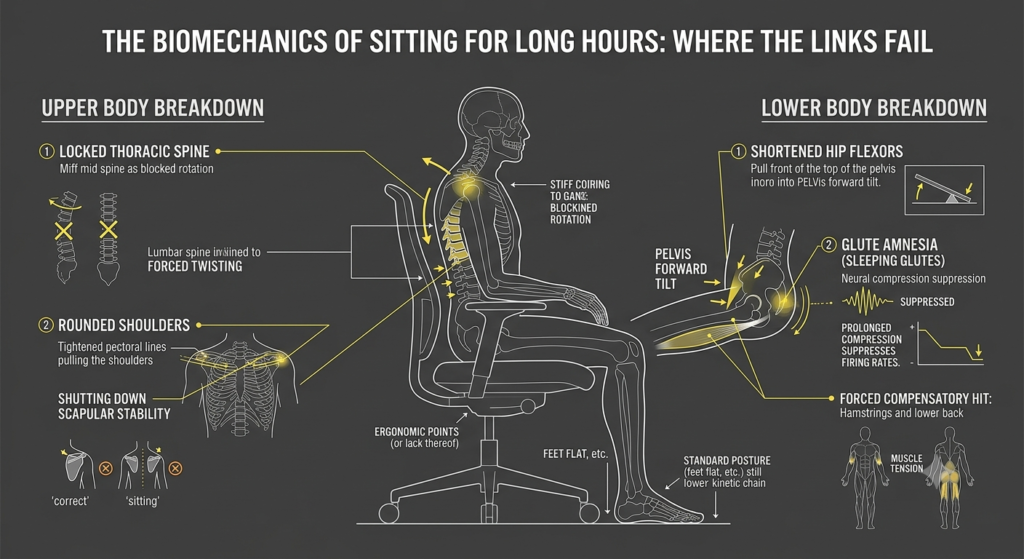
In fact, clinical studies on neuromuscular adaptation to disuse show that inactive motor pathways actively suppress motor unit firing rates, heavily downgrading your body’s unconscious stabilization reflex before you even pick up a weight.
The muscle memory from your good old fit days has become weak, and your brain is not going to simply open the floodgates just because your enthusiasm is high today. Think of it like your brain completely forgot your body’s original factory muscle settings.
Trying to force complex movements, heavy weights, or sudden running miles right out of the gate creates a massive communication breakdown. Because the lines are down, your brain cannot cleanly deliver the firing signals your muscles urgently need to stabilize and protect your joints.
This neurological disconnect doesn’t just make you feel clumsy; it leads to immediate muscle tears, joint misalignment, and an overwhelming central nervous system crash that will leave you feeling completely wiped out and defeated for days afterward.
Category 1: The Green Light (Ready for Low-Intensity Training)
If you aren’t experiencing any active pain at rest, numbness, or concerning chest symptoms, you are generally clear to start exercising right away, but only with low-intensity work. This initial phase is not about testing your limits; it is entirely about waking up your cardiovascular system and building a safe aerobic baseline. Think of it as a mandatory warm-up phase for your new lifestyle using controlled movements like brisk walking, stationary cycling, or basic swimming.
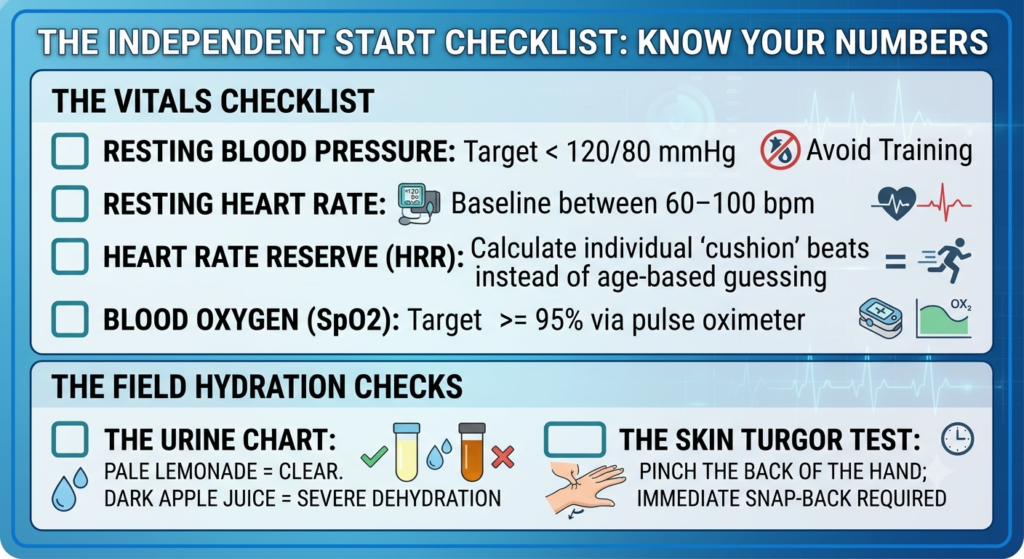
Before you take that first step, you need to pull out your tracking tools and map these essential baseline metrics:
- Resting Blood Pressure (BP): You need to ensure your baseline numbers sit within a safe, non-hypertensive range (ideally under 120/80 mmHg). Forcing your body into a workout when your resting blood pressure is already dangerously high can cause sudden spikes that lead to severe dizziness or vascular strain.
- Resting Heart Rate (RHR) & Heart Rate Reserve (HRR): Checking your baseline heart beats per minute tells us exactly how much stress your heart is under just to keep you alive while sitting still. A healthy baseline should sit comfortably between 60 and 100 bpm. However, the real data-driven magic happens when you use your RHR to calculate your Heart Rate Reserve (HRR). Instead of using lazy, age-based formulas that treat every individual over 40 the same, HRR measures the exact “cushion” of heartbeats you have available between resting and maximum effort. By calculating your personalized HRR, you can map your entry-level training zones with absolute precision. This ensures you never accidentally redline your system or rely on dangerous guesswork. I have explained this data-driven baseline approach elaborately in my guide on how to restart fitness safely after many years, which you can use to map out your exact numbers.
- Resting Blood Oxygen: A quick, non-invasive pulse oximeter check on your finger ensures your baseline oxygen saturation is healthy (at or above 95%). If your body isn’t oxygenating your blood well at rest, it certainly won’t handle the demands of a workout.
- Basic Hydration Status: Years of office work usually go hand-in-hand with relying on coffee and forgetting to drink water. Monitoring your hydration levels before you start sweating prevents sudden, dangerous drops in blood pressure, muscle cramping, and premature fatigue during your initial sessions. How to test it: You don’t need a lab for this. Use the Urine Color Chart test as your primary baseline. If your urine looks like dark apple juice, you are severely dehydrated; you want it to look like pale lemonade before you train. Alternatively, use the Skin Turgor (Pinch) test: pinch the skin on the back of your hand for a few seconds and let go. If it takes more than a moment to snap back flat, your tissues are running on empty. If you fail these basic checks, drink 500ml of water and wait an hour before starting your workout.
Category 2: The Yellow Light (Proceed with Caution / Fix Structural Imbalances First)
The Mobility Caveat: Even if your vitals (like your blood pressure and oxygen levels) give you a perfect clinical green light to start moving, you are still not clear to push your body hard. Before you even think about increasing your workout intensity, adding weights, or picking up the pace on a run, you must test your structural alignment.
Moving a body that has been structurally warped by decades of desk work will only accelerate joint wear and tear. I highly recommend running a static posture assessment as the ultimate imbalance detector before you start exercising after 40. This will pinpoint exactly which muscles have fallen asleep and which joints are locked up before you force them under a heavy load.
Think of this tier as a blinking yellow traffic light. Your heart and lungs are capable of handling low-intensity movement, but your musculoskeletal system has serious structural vulnerabilities. If you try to run fast or lift heavy right out of the gate, your restricted joints and asleep muscles will cause an immediate breakdown.
Once you have cleared that initial static checkpoint, you need to evaluate your functional movement capabilities across these critical screening points before you think about going hard:
1. Functional Movement Capabilities & Screening Points
- Flexions and Extensions (The Linear Foundation): You must test your body’s ability to bend (flexion) and straighten (extension) through a full range of motion. If decades of desk work have shortened your hip flexors, your hip extension will be physically blocked; forcing your lower back to over-arch and take the hit. Likewise, poor ankle flexion (dorsiflexion) will completely ruin your squat mechanics, forcing your knees to absorb destructive forces.
- Rotational Capacity (The Twisting Axis): Sitting slouched over a keyboard locks up your thoracic spine (mid-back), destroying your ability to rotate your torso. If your mid-back cannot twist freely, your body will forcedly steal that rotation from your lumbar spine (lower back) or your shoulders. Because those areas are built for stability rather than twisting, forcing rotation there leads to severe injury.
- Controlled Contractions (Neural Muscle Recruitment): This tests whether your brain can actually make a muscle fire under load, specifically targeting “glute amnesia.” Sitting on your glutes for hours a day degrades the neurological signal to your backside. If you cannot execute a strong, deliberate glute contraction on command, your hamstrings and lower back will take over the workload during exercise, leading to chronic strain.
- Vertical Loading & Mechanics (Gravity Alignment): This screens how your skeletal frame handles vertical forces traveling through your spine, hips, and ankles. A simple, unweighted overhead squat test reveals if your joints can stay stacked and aligned under the pull of gravity. If your knees cave inward or your torso collapses forward, your body cannot safely handle vertical weightlifting or high-impact running yet.
- Dynamic Balance and Stability (The Single-Leg Baseline): True stability is your body’s ability to resist unwanted movement. Testing your balance with frills such as a single-leg stand (also check it with your eyes closed) screens the communication between your brain and joint receptors (proprioception). If you cannot hold a stable single-leg baseline for 20 to 30 seconds, your ankles and hips lack the stability needed to protect you on uneven running surfaces.
- Explosiveness Baseline (Rate of Force Development): Before you attempt rapid, explosive movements like sprinting or jumping, your tendons and muscles must be screened for baseline elasticity. A basic test, like a low-impact, soft countermovement jump, ensures your connective tissues can absorb and release elastic energy without tearing. If your joints feel unstable or painful during a gentle jump, explosive training must be strictly put on hold.
2. Next Steps: How to Improve After Your Tests are Cleared
If your structural checks reveal restrictions, do not panic. This is your immediate roadmap to fix your imbalances while keeping your low-intensity training on track:
- Awaken the Dormant Links: Spend 10 to 15 minutes on isolation-activation drills before any low-intensity exercise. Use bodyweight bird-dogs, glute bridges, and deadbugs to physically rebuild the neural connection between your brain and your sleeping core and glute muscles.
- Unpack the Locked Joints: Prioritize dynamic mobility drills specifically targeting hip extension and thoracic spine rotation. Focus on opening up the tight structures (like your hip flexors and chest) using active stretches rather than static holds, teaching your joints to feel safe through a complete range of motion.
- Build Single-Leg Integrity: Introduce unilateral (one-sided) stability work into your routine. Exercises like static lunges, step-ups, and single-leg balance holds force your deep stabilizing muscles to fire, directly correcting the left-to-right strength discrepancies created by years of sitting unevenly at a desk.
Category 3: The Orange Light (Coordinated Clearance Required First)
This tier is for individuals who have clear, measurable health or structural indicators that carry moderate risk. You aren’t sidelined permanently, but you are strictly forbidden from starting any exercise program until you get a formal clearance from a doctor, physical therapist, or specialist.
The Essential Screening Points & Clearance Triggers to Start Exercising After 40:
Clinical Cardiovascular Flags (The Vascular Red Line):
- Stage 1 or 2 Hypertension: A resting blood pressure consistently reading at or above 140/90 mmHg.
- Unexplained Arrhythmias or Palpitations: A resting heart rate that routinely skips beats, flutters, or spikes above 100 bpm (Tachycardia) without exertion.
Metabolic Fault Lines:
- Diagnosed Type 2 Diabetes or Chronic Insulin Resistance: Exercising changes how your body processes blood sugar instantly. If you are on insulin or metabolic medications, you require a coordinated plan to prevent dangerous, sudden crashes (hypoglycemia) during workouts.
- The Blood Sugar Protocol: Even after you get a doctor’s clearance or if your blood sugar is stable enough to start working out, you will need to follow a strict protocol if you plan to start running as your primary fitness goal. I have mapped out a detailed case study to break down exactly how to handle your fueling and timing in our guide on running with diabetes and what you need to know to stay entirely safe on the pavement.
Active Joint Pathology (Beyond Simple Stiffness):
- Chronic Pain or Structural Damage: This isn’t just “tight hips” from sitting. This triggers if you have an active herniated disc, a history of knee meniscus tears, osteoarthritis, or chronic pain that alters how you walk or stand. You need a physical therapist to clear your structural loading capacity first.
The Lifestyle Shock Check (The 20-Year Gap):
- If you are over 45, have smoked for years, have a heavy family history of early heart disease, and have done zero physical activity for over two decades. Even if you feel “fine,” your vascular walls need a professional look before handling the pressure of a new exercise habit.
How Do You Get a Medical Green Light to Start Exercising After 40?
Securing your coordinated clearance isn’t about getting a simple “yes” or “no” from your doctor. Instead, a medical professional will likely run specific diagnostic tests to establish your baseline health, providing you with clear, safe guidelines on exactly how far you can push your body. From there, a certified fitness trainer can design a customized workout plan that fits perfectly within that prescribed medical framework.
In fact, the relationship between medicine and movement is a two-way street: many doctors directly refer their patients to trusted, certified fitness trainers to ensure their workouts are done safely under professional supervision. Likewise, qualified trainers will immediately halt a setup and refer an individual to specialized clinicians or labs the moment they fail an initial screening. This collaborative loop ensures your comeback is backed by both medical science and smart coaching.
Most importantly, remember that sitting in this category today isn’t a permanent life sentence. With consistency and dedicated effort, countless individuals have successfully rebuilt their baselines, safely graduating from the orange light of Category 3 down into Category 2, and eventually earning a full green light in Category 1.
Category 4: The Red Light (Strict Medical Supervision Only)
This is the ultimate clinical threshold where you cannot just start exercising. If you flag for any of the symptoms or conditions in this tier, you are strictly barred from independent exercise of any kind. You do not just need a doctor’s signature on a piece of paper; your health status dictates that your initial physical conditioning must be directly monitored, measured, and supervised by clinical professionals or specialized medical exercise specialists.
Cases When you Can’t Independently Start Exercising after 40
Cardiopulmonary Distress Signals (Immediate Stop Signs)
- Angina and Chest Discomfort: Pain, squeezing, pressure, or a tight burning sensation in your chest, neck, jaw, or arms during minor physical exertion.
- Unreasonable Breathlessness: Severe shortness of breath or labored breathing triggered by minimal tasks (like speaking a full sentence or a slow walk) that is completely out of proportion to the activity.
- Orthopnea: Sudden, terrifying breathing difficulty when lying flat, forcing you to prop yourself up with pillows or wake up gasping for air at night.
Vascular & Circulatory Red Flags
- Unexplained Vertigo or Syncope: Persistent spells of dizziness, lightheadedness, or any history of completely losing consciousness or balance.
- Ankle Edema: Sudden, unexplained swelling in your lower ankles and feet (not caused by an injury), which often signals severe circulatory or cardiac strain.
- Intermittent Claudication: Sharp, burning, or severe cramping pains in your calves that predictably kick in when walking short distances and disappear promptly with rest (a major sign of peripheral artery issues).
Autonomic & Structural Triggers
- Resting Tachycardia: An unpleasant, forceful, racing, or highly irregular heart rhythm felt suddenly while sitting completely at rest (resting heart rate consistently exceeding 100 bpm).
- Uncleared Heart Murmur: A diagnosed structural heart issue that has not been specifically cleared by a cardiologist for progressive physical stress.
The Diagnostic Blueprint: What Clinical Supervision Looks Like
When you are in Category 4, your medical team won’t just tell you to sit on the couch forever. Instead, they use an extensive, data-driven battery of tests to find your safe entry point into movement. If you are under strict supervision, your clinical team will actively monitor:
- Hemodynamic & Lab Baselines: Tracking your resting blood pressure, Heart Rate Reserve (HRR), and advanced metabolic panels—including ApoB (atherogenic plaque-forming particles), hs-CRP (vascular wall inflammation), and Fasting Insulin to watch for hidden metabolic resistance.
- Organ & Muscle Resilience: Running blood markers like eGFR and Creatinine (kidney filtration), ALT/AST (liver function), and Creatine Kinase (to establish a baseline for muscle damage before you even begin moving).
- Pulmonary & Recovery Metrics: Utilizing Resting SpO2 pulse oximetry checks and Peak Expiratory Flow (PEF) to rule out exercise-induced asthma, while auditing your Heart Rate Variability (HRV) to ensure your central nervous system isn’t completely overwhelmed by daily stress before adding workout stress.
The Professional Hand-Off: Just like Category 3, this is a bridge, not a dead end. Medical professionals in clinical settings rely heavily on specialized, clinical exercise physiologists to execute these highly monitored protocols. Once your biomarkers stabilize, your medication interferences (like Beta-Blockers or Diuretics) are accounted for, and your symptoms subside, the goal is always to safely graduate you out of the red light and independently start exercising after 40.
Start Exercising After 40 – But with a Data-Driven Plan of Action
I don’t know which specific category you will find yourself in after reading this post, and my intention is certainly not to make you feel discouraged about where you are today. This guide is simply a broad classification to give you a fair, honest idea of what your immediate next step should be. It is not meant to build a permanent prison around you. In fact, these tiers mirror the official ACSM clinical guidelines for exercise preparticipation screening, which medical professionals use globally to identify hidden risks before an adult restarts a training program.
Let’s face it: many of us have made wrong choices in the past, and those choices can result in health consequences of various degrees as we age. But remember this one absolute rule: we do not give up.
You have likely seen innumerable cases where people have fought back from severe, chronic conditions like cancer and gone on to build incredible levels of physical fitness. Some have even achieved major athletic milestones that many “healthy” people never reach.
The secret isn’t a miracle cure; it is understanding your current category and doing the needful, consistently, with the sole spirit and goal of making progress. Even when you are already fit enough to start exercising after 40 and train hard, your body is a dynamic system; there are critical biomarkers that you must continue to test in labs from time to time to stay ahead of the curve.
The Problem with Influencers and Asking AI To Build Your Fitness Plan
It would have been incredibly easy for me to just tell you to get out of your desk chair and start running or lifting to “become healthy”. That is what thousands of fitness influencers scream on social media every single day. But that lazy advice is exactly how people over 40 end up getting severely injured or in medical emergencies.
Even a highly advanced AI agent can fail to give you the right answers here. If your prompts don’t provide the highly specific, sufficient biological data needed to personalize your workouts, an AI can easily give you answers completely out of context. Other times, it might get stuck in a technical glitch, feeding you the same generic answers in a loop. These limitations are real.
Why You Need a Trained Human Eye to Start Exercising After 40
Because this is your life and your unique physical situation is real, walking forward with a blindfold on is a massive gamble. I highly recommend getting in touch with a certified fitness trainer or personal coach for in-person screenings and biomechanical assessments before you start exercising after 40.
A truly qualified professional is trained to:
- Accurately identify the exact structural or clinical category you currently fall into.
- Recommend a highly tailored workout plan built specifically for your joint mechanics.
- Safely refer you out to specialized medical professionals or diagnostic labs the moment an initial screening flags a risk.
Acknowledge your current category. Accept exactly where your baseline is today, and use it to build a data-driven plan of action. Let me remind you one more time: we do not give up. We understand the reality of our situation, we look at the data, and we take the right steps forward.
For – Brands | Businesses | Coaches
If your brand or website needs top-quality blog content or end-to-end blog management, chat with me today. I create content with the same clarity, science-backed storytelling, and motivational rhythm you just read.
I offer blog management and content writing services across diverse sectors, whether your niche is fitness and health (my favorite), technology, lifestyle, or business – I specialize in turning topic ideas into engaging, SEO-optimized blog posts that your readers will trust and love.
Let’s build your business authority online with content that delivers both value and results.
 Chat With Nady on WhatsApp
✍️ Explore Our Blog Writing Services
Chat With Nady on WhatsApp
✍️ Explore Our Blog Writing Services