
- Heart Rate
- Heart Rate Zones
- The importance of using heart rate zones for your workouts
- Different Heart Rate Zones
- Using heart rate zones
- How to determine your target heart rate zone?
- Best practices for heart rate training for people over 40
- Heart Rate Zones – Conclusion
- Frequently Asked Questions on Heart Rate Zones
As people age, their heartbeats tend to slow down, making it harder to stay fit and healthy. However, staying fit is not an option after 40; you have to do it to keep health disorders and age-related diseases at bay. To maintain a healthy lifestyle as you age, it is essential to adopt a balanced approach that includes being physically active, eating a balanced diet, and getting sufficient sleep. you can develop a strong heart and manage stress better by doing regular workouts. Understanding of Heart Rate Zones will help you do your workouts safely and efficiently.
Workouts can be categorized into three levels: low, moderate, and high intensity. The workout intensity you choose will make a significant difference to the results you get but be sure to have reasonable expectations and progress gradually towards higher intensities. Fitness after 40 is a different ballgame altogether, where you will need to make wise choices to get good results and avoid injuries.
You may have heard the motivational phrase, ‘Listen to Your Heart.’ We runners must follow this phrase literally, and not just emotionally. At the core of your running success is how well you manage your heart rate.
Heart Rate
Heart rate is the measure of the number of beats per minute or BPM. The more the heart beats, the more the blood gets pumped across your body. The heart beats fluctuate according to the intensity level of our workout and are categorized into 5 heart rate zones. To get the most from your workout routines, it is prudent to monitor your heart rate and plan your exercise schedules according to specific heart rate zones. Your normal resting heart rate (while not working out) is a reliable indicator of your overall health, stress level, and physical condition.
Heart Rate Zones
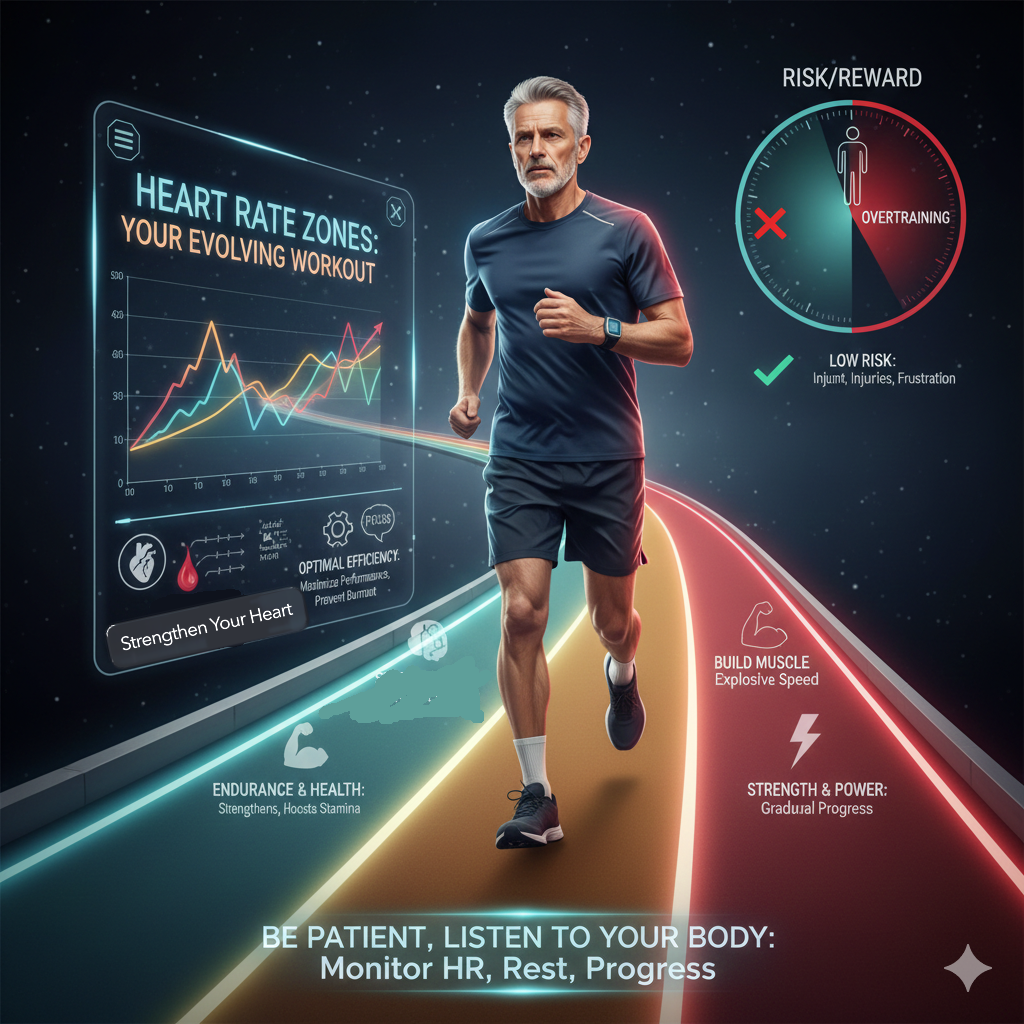
Heart rate training zones are a range of BPM that correspond to different levels of exercise intensity. As you grow older, it becomes essential to use these zones to enhance your training. You can improve your endurance, cardiovascular fitness, and reduce the risk of injuries with a proper understanding and training within the right heart rate zones.
The importance of using heart rate zones for your workouts
Optimize exercise intensity
Your body changes as you age. The intensity at which youngsters do their workouts may not be suitable for your ageing body. It is vital to find the correct heart rate zone that your body can handle. You must adjust the intensity of your workout routine accordingly.
For example,
- To build endurance, you must train within the aerobic zone. It is a moderate heart zone that helps your body get stronger and last longer.
- On the other hand, if you want to build strength and muscles, try anaerobic training. It involves working at a higher intensity, which helps to build muscle and enhance your ability to do explosive movements [like burst in speed while sprinting]
Training in proper heart rate zones allows you to maximize the benefits of your workouts and achieve your fitness goals more quickly.
Prevent overtraining
Another problem for older runners is overtraining, especially when you are pushing your body too hard without sufficient rest. In short, your workout goals go on the back foot if your body and mind can’t sustain the impacts.
- Physical effect: For example, anaerobic training is excellent for building strength and power, but it can also be tough on your body. If you spend too much time in this zone without resting, you can get burned out and become prone to injuries.
- Mental impact: Not just your physical; even your mind gets negatively influenced. You start feeling frustrated and drained. When you are constantly pushing yourself to the limit, it can be hard to stay positive and stick to your workout plan.
Be Patient and Confident: Monitor your heart rate, pay attention to your body signals, and take proper breaks. Remember to increase your workout time and intensity slowly and gradually. It may take months for you to level up, but with this approach, you will see a new level to pursue.
Enhance cardiovascular health
Regular exercise within target heart rate zones can significantly enhance your cardiovascular health. It strengthens the heart muscles, making it better at pumping and circulating. You will improve your endurance and stamina. Enhanced pumping and blood flow can lessen the strain on your heart. Even in aerobic zone activities, you can improve the blood flow with regular workouts. Oxygenated blood and nutrients reach every blood tissue, which reduces the risk of heart and cardiovascular diseases.
Reduces the risk of injuries
Overexertion, whether it is due to excessive intensity, insufficient sleep, or warm-up, can lead to sprains, strains, and musculoskeletal problems. By staying within target heart rate zones, you can train your body to gradually get used to the exercise intensity, which lessens the risk of injuries.
During high-intensity training, listen to body signals like discomfort or pain. You must learn when to reduce the intensity or completely stop the workout for that day. You must add warm-up drills to activate your muscles to adapt to the challenge of the session, and also cool-down drills in the end to recover from the impact.
People over 40 need more time to recover compared to younger runners, so avoid excessive training in the anaerobic zone. Remember, most of the post-run recovery happens when you sleep. Allow your body to recover adequately and prevent overtraining in that zone.
Different Heart Rate Zones
Technically, 5 heart rate zones correspond to different intensity levels.
- Zone 1 [Easy Aerobic]: Easy aerobic means low-intensity workouts like steady cardio or leisurely swimming/walking. In this zone, you can easily speak while doing your workouts without gasping for oxygen. It is ideal for warm-up or cool-down routines.
- Zone 2 [Moderate Aerobic]: You will be in this zone while jogging, brisk walking, or swimming at a moderate pace. It is somewhat challenging, but you can still talk comfortably. This zone is great for enhancing your cardiovascular endurance and burning calories.
- Zone 3 [Threshold]: In this zone, you will feel the burn and conversing will be hard. This zone helps you to enhance your lactate threshold, making your body eliminate unwanted lactic acid at the same rate at which it is produced. Lactic acid buildup in muscles leads to fatigue and a drop in performance, but this Zone 3 training helps you to level up to a higher threshold. Exercises like tempo runs, interval training, or uphill training are suitable for lactate threshold training in this zone.
- Zone 4 [Anaerobic]: It is a high-intensity zone where you can barely manage to utter a couple of phrases before you get breathless. It is a great zone to build power and strength. Some of the workouts include sprinting, HIIT, or weight-lifting.
- Zone 5 [Maximum Effort]: You put all-out effort in this zone. You push your body to its absolute limit. For older adults, it is not recommended, but if you still want to, consider the guidance of a healthcare professional.

Using heart rate zones
In general, exercise time in zones 1 and 2 is recommended for people over 40. These safer zones offer significant health benefits without putting too much strain on your knees, lungs, and heart. However, you will get better results by progressing to Zone 3 in at least a couple of sessions every week. If you are fit in your 40s, you can even try to touch for Zone 4 in short sessions, like a couple of 100m sprints on full throttle. If your health and fitness level permit, you must incorporate some zone 3 workouts in your weekly fitness plan. It will help to enhance your cardiovascular fitness and prevent muscle loss.
While heart rate zones offer a general guideline, you need to determine your optimal heart rate range because there will be individual variability in terms of physiology, health condition, and fitness level. You get better control and can perform workouts better by being aware of the heart rate zone that you are in. It will let you know when you need to heat up and when you need to cool down.
How to determine your target heart rate zone?
You need to accurately determine your target ranges to use heart rate zones efficiently. There are several methods to calculate your heart rate zones –
Maximum Heart Rate [MHR]
MHR is the maximum number of beats your heart can reach during intense exercise in a minute. Often, it is estimated using the formula: 220 minus your current age. Remember, it is just an approximation because MHRs can differ based on:
- Genetics: Some people naturally have lower or higher MHR.
- Fitness level: Regular workouts can increase your MHR over time. As your heart gets stronger and efficient, it beats faster.
- Overall health: Certain medical problems, like respiratory or heart issues, can impact your MHR.
To determine the correct MHR, there are a couple of methods. You could take a fitness test while being graded by a sports therapist. You can wear a heart rate monitor during workouts and identify your peak.
Heart Rate Reserve [HRR]
You need to know your Resting Heart Rate to derive your HRR. Resting heart rate is again the maximum heart rate, but when your body is physically inactive. You can calculate your target heart rate zone by using HRR and MHR. Here is how to calculate your HRR.
- In the morning, before you get out of bed, take your pulse reading. Count the beat numbers in one minute.
- Use the formula 220 minus your age and get a rough MHR estimate.
- Deduct the Resting Heart Rate [pulse reading that you got in the morning] from the MHR estimate.
For example, if your Resting Heart Rate is 70 BPM, and the estimated MHR is 180 BPM (which means 40 years old, i.e., 220 – 40 = 180), then your –
- HRR is 180 – 70 = 110 BPM.
Now, you can determine your target heart rate zone –
- Your HRR is 110 BPM
- You want to train in a moderate intensity zone [where your heart rate 50% to 70% of the MHR]
- For a 60% heart rate intensity – Multiply HRR (110) by 0.6, and then add the Resting Heart Rate (70).
- 0.6 x 110 = 66
- 66 + 70 = 136 BPM
It means your Target Heart Rate for doing moderate-intensity zone workouts must be between 136 and 154 BPM.
Best practices for heart rate training for people over 40
- Begin with low-intensity workouts and gradually increase the levels to prevent injuries.
- Consider using a chest strap heart rate monitor rather than a wristband for more accurate readings.
- When you start feeling discomfort or pain, slow your workout pace or take some rest.
- Decline of muscle mass and bone density is an inevitable issue with older adults, so include strength training exercises to enhance them.
- Engage in a variety of workouts and activities to keep things fun and body challenged.
- Avoid getting dehydrated, as it can affect your heart rate.
- Workout with a friend or group keeps you driven and responsible.
Frequently Asked Questions on Heart Rate Zones
How do I restart fitness safely after years of inactivity? ▼
The safest approach is to begin with a comprehensive structural and movement assessment rather than jumping straight into intense workouts. Prioritize establishing a baseline for your metabolic rate (BMR) and heart rate variability (HRV), and always secure medical clearance if you are reversing years of sedentary habits.
Why are drastic diet changes dangerous when returning to exercise? ▼
When recovering from years of desk hours, forcing your body into a massive calorie deficit while simultaneously starting a new workout routine shocks your metabolism. This drastic approach triggers a high relapse rate and muscle loss instead of sustainable fat loss and longevity.
Do I need a doctor’s clearance before restarting fitness? ▼
If you have been completely inactive for many years, have noticed deteriorating health markers, or possess underlying medical conditions, a medical assessment is highly recommended. This ensures your fitness trainer can build a progression framework tailored to your official health reports.
Why are standard age-based heart rate formulas inaccurate after 40? ▼
Generic formulas like “220 minus age” completely ignore individual cardiovascular health, stress levels, and athletic history. For trainees over 40, these formulas often underestimate true capabilities or overstress the nervous system, making personalized metrics like Heart Rate Reserve (HRR) essential.
Which heart rate zone should I train in most after 40? ▼
Trainees over 40 should spend roughly 80% of their cardiovascular training volume in Zone 2. This low-intensity aerobic zone builds mitochondrial function, enhances fat oxidation, and preserves metabolic health without overactivating the sympathetic nervous system or stressing joint mechanics.
How often should I reassess my heart rate zones? ▼
Reassess your target heart rate zones every 8 to 12 weeks. As aerobic efficiency improves, your resting heart rate decreases and stroke volume expands. This shifts your metabolic thresholds, requiring an updated Heart Rate Reserve calculation to keep training intensities accurate.
Can HRV help guide training intensity after 40? ▼
Yes. Heart Rate Variability (HRV) serves as an objective marker for autonomic nervous system recovery. For individuals over 40 balancing career stress and exercise, a suppressed HRV score signals high systemic fatigue, indicating you should downshift into Zone 2 or recovery work rather than forcing an anaerobic interval session.
Looking for more technical detail on calculating heart rate zones and optimizing Zone 2 training? Check out our companion guide: Know Your Heart Rate Zone for the Best Running Performance .
Heart Rate Zones – Conclusion
Heart rate zones help to optimize training for people over 40. You can improve your endurance, cardiovascular fitness, and maintain a healthy lifestyle even beyond 40 by using heart rate zones as a guide. So, understand and incorporate heart rate zone training to enjoy your physical activity without pushing your body over the limit.
Ready to rebuild your physical baseline safely? Read our blueprint: How to Restart Fitness Safely After Many Years
Want professional content writing services to turn your ideas into engaging blog posts that your readers love?
 Chat with Nady on WhatsApp
Let’s build your authority in the fitness and health niche together.