
- How Running Can Affect Your Heart Rate?
- Factors that Can Influence Your Heart Rate While Running
- How to Determine Your Perfect Running Heart Rate
- What is Heart Rate Training?
- Higher vs. Lower Running Heart Rate – What to aim for and when
- Know Your Running Heart Rate Zones
- Running Heart Rate Zone – Conclusion
- Frequently Asked Questions on Running Heart Rate Zones
The number of times your heart beats in one minute defines your heart rate. It increases during cardio-intensive activities as the body requires additional oxygen and nutrients to fuel working muscles. Running is one of the most popular cardio workouts enjoyed by people of all ages. As a runner’s speed increases, so does their heart rate. However, the rate of increase can vary between individuals. Monitoring heart rate is an effective way to assess a person’s fitness level and cardiovascular capacity. Therefore, you must first try to identify your ideal heart rate zone.
You can improve your pace and meet your fitness goals by tracking your personal running heart rate over time. People have varying heart rates, but cardio activities like running help to improve our cardiovascular strength. Runners must identify their ideal heart rate zone because it is dependent on multiple factors and varies from person to person. A proper assessment of your current body conditioning and fitness goals will help to determine the correct zone.

You can achieve this through daily observations and basic math. While running, pay attention to your body and also monitor your heart rate at different paces. This practice will help you determine the ideal pace that your body can sustain. By making these observations, you can identify your heart rate zones. Understanding your heart rate zones will enable you to make informed adjustments to your pace during runs. I have provided more details on heart rate measurements later in this post.
How Running Can Affect Your Heart Rate?
The heartbeat rates increase when you do cardiovascular exercises like running, cycling, and swimming. You can track it with monitoring devices like fitness trackers or smartwatches. When your muscles exert continuous energy, your heart must work at a higher rate to deliver oxygenated blood to them. According to Matt Wilpers, who teaches at Peloton, the body sends your heart rate up to assist your performance.
The elevation of your heart rate during running comes down to the resting heart rate point while cooling down. The heart rate ranges between 60 to 100 beats per minute when you are relaxed or seated. This is called as the resting heart rate, and your cardiovascular health is supposed to be good if it is on the lower side.
Your resting heart rate will gradually decrease if you do regular exercises and maintain your fitness. To measure your resting heart rate, find a quiet place to sit or lie down. Rest for a few minutes, then locate your pulse. Count the number of beats you feel in 60 seconds. A low resting heart rate demonstrates exceptional cardiovascular fitness levels. Athletic activities like running offer multiple benefits to your heart rate during sessions and also help improve your overall health.
During his explanation, Dr. Leis explained that enhanced fitness from running will gradually reduce your heart rate at rest. A better heart pumping efficiency signals improved cardiovascular health because of this heart-positive change. Your heart rate monitoring data will show how your body interacts with different intensities of exercise activities. Regular running practices enhance heart efficiency. As a result, your heart will be healthy during and outside the exercise sessions.
Factors that Can Influence Your Heart Rate While Running
Each person’s average heart rate during running differs according to the following significant factors:
- Age: Your exercise target heart rate decreases gradually with each advancing year of your life – Aging results in a gradual decrease of maximum heart rate.
- Fitness level: You will have stronger cardiovascular health with improved efficiency throughout rest periods and exercise sessions if you lead a physically active lifestyle. Both your resting heart rate (minimum) and your exercise heart rate (Maximum) will be slower than people who do not exercise regularly.
- Temperature: The body requires additional effort from your heart to maintain proper temperature control. Therefore, you will see an increase of 5 to 10 beats per minute during hot and humid running conditions.
- Medication use: Some medications can alter your heart rate performance. The heart rate tends to decrease with beta-blockers, whereas high doses of thyroid medication result in increased heart rate.
- Emotions: Emotions can also alter your heart rate while running. Stress, excitement, and anger can either decelerate or accelerate your beats, depending on how you decide to cope with the emotion that you are going through.
Several individual factors, including age, fitness level, environmental conditions, current health status, and mood, influence your running heart rate. Remember, your heart rate zone is unique to you and should be measured according to your personal baseline, not according to other runners. This uniqueness makes your fitness journey special and tailored to your needs.
Regular heart rate tracking is not just a tool. It’s a key to understanding your body’s system better. It empowers you to make personalized decisions that support your fitness goals, giving you a profound sense of control and confidence in your training.
How to Determine Your Perfect Running Heart Rate
To determine your perfect running heart rate, begin with first identifying your maximum heart rate. Maximum heart rate is the highest heart rate you can achieve during maximum physical exertion. You can determine your maximum heart rate by simply subtracting your age from 220. The estimated maximum heart rate for a 30-year-old individual is approximately 190 bpm (220-30). This calculation represents only an estimate and is not a rule of thumb because your maximum heart rate depends on various other factors besides your age. After determining your maximum heart rate, you need to identify your workout intensity level.
The American Heart Association (AHA) recommends these guidelines:
- The target heart rate zone for brisk walking exercises should fall between 95 and 143 bpm for a 30-year-old.
- To perform a cardio-intensive exercise such as running, aim for a heart rate within 70–85% of your maximum heart rate. For a 30-year-old, the normal range is 133–162 bpm.
- If you target a heart rate of 50–75% of your maximum, your heart rate will range from 95–142 bpm.
- The heart rate will dip and become stable when you slow down, but you must also touch the max rate on a few sessions to prepare your lungs and body for higher intensity.
By using these heart rate ranges as a broad outline, you can train effectively to achieve various athletic objectives. The specified heart rate numbers serve as reference points for exercise, but each individual’s target zone will differ based on wellness and specific fitness conditioning.
You can determine the optimal heart rate zone for running by undergoing body health checkups that include heart rate tracking.
Important note: Individuals with diabetes and other health conditions should closely monitor their heart rate throughout the session. They should not let the heart rate get too high or too low at any point in time. To be on the safer side, they should run with a partner if they are going on a long run. It is advisable to undergo a proper medical assessment before starting their running journey. You may also be interested in reading my post on running for people with diabetes.
What is Heart Rate Training?
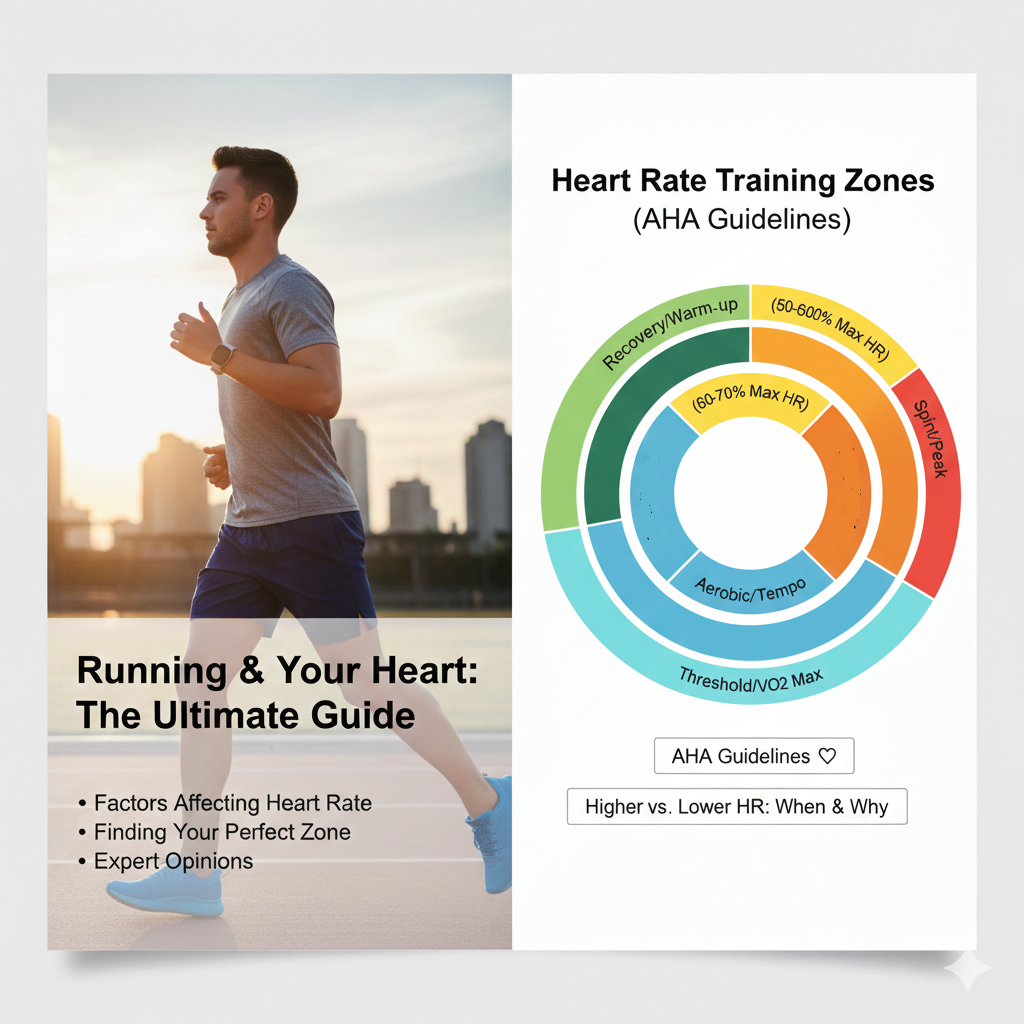
The bpm measurement system (not the pace) guides runners through varying intensity levels during heart rate training sessions. The system separates running intensity into five heart rate divisions according to your maximum capacity:
- Very light: Less than 57% of max heart rate.
- Light: 57-63%.
- Moderate: 64-76%.
- Vigorous: 77-95%.
- Maximal: 96-100%.
The training direction for you to follow must depend directly on your performance targets. Remember to set reasonable targets and make gradual progress. A heart rate monitor aids you in monitoring your level of workouts.
- The endurance-building training of marathon runners is zones from 1–3.
- Sprinters running 5K races will need to train in zones 3–4 to increase speed.
- Professional athletes and sprinters need to train at levels 4 through 5 according to peak performance standards.

You can also approach professional trainers for help. They will create a customized plan according to your personalized objectives. Heart rate training helps runners improve their performance.
Higher vs. Lower Running Heart Rate – What to aim for and when
Exercise intensity determines the heart rate zones when engaging in cardio activities, such as running.
- A brisk walking warm-up enables you to stay within the low-intensity Zone 1.
- A steady running tempo would normally place you in the moderate-intensity heart rate zone 2 or 3.
- Switching to short-speed intervals or pushing your limits will lead your heart rate into either Zone 4 or 5, which are high-intensity zones.
- Ending the workout with walking allows your heart rate to return progressively to Zone 1.
Heart rate zones naturally shift throughout each session, but the session’s purpose and planning should determine the duration spent at each level.
You should spend additional time in the higher heart rate zones (Zone 4 or 5) during sprint workout preparation to develop speed and power. The training goals for marathon distance racers require them to build endurance by staying in Heart Rate Zones 2 or 3 at a steady pace.
Many runners employ heart rate training by monitoring their heart rate throughout sessions to reach or stay within the heart rate zones necessary for achieving their speed and endurance goals. The usage of heart rate as a measurement tool offers useful data, but you must consider other critical factors, too. The assessment of speed or intense interval training does not require heart rate as a metric for evaluation.
Opinions from experts
Peloton instructor Matt Wilpers notes that heart rate is a time-delay response to physical activity, which means there will be some delay for your heart rate to reach your target zone. Moreover, external factors, such as stress levels, fatigue, and weather conditions, can compromise the reliability of heart rate monitoring under certain circumstances. In such situations, the tracking progress works better through pace and distance measurements.
Your highest possible heart rate serves as a critical indicator to establish different heart rate training zones. In ideal conditions, your maximum heart rate calculation is 220 minus your age, but this is not the rule of thumb. This calculation should be taken as a general guideline because there are other factors, such as your heart rate capacity, genetic makeup, fitness level, and medical issues, to consider.
According to observations from Dr. Gordon F. Tomaselli, who is both a cardiologist and a past president of the American Heart Association, the maximum heart rate stands as a set number for each individual. It is different training intensities that help them achieve diverse max heart rates. Workouts in different heart rate zones bring different advantages. For example, you improve endurance together with fat burning at lower zones while you develop speed and power by training in higher-intensity zones.
Knowing these zones will enable you to customize your workouts to match your specific targets. You will develop better aerobic capabilities when you spend extended durations in Zone 2, but intense Zone 4 and Zone 5 work will strengthen your anaerobic system along with speed ability.
The measurement of heart rate represents only a small part of overall health assessment. Your training success depends equally on paying attention to your body signals and monitoring your performance, as well as adapting your workouts according to your current condition. Heart rate zones serve as a guide for all levels of runners to maximize their training efficiency and achieve their objectives.
Know Your Running Heart Rate Zones
1. Running Heart Rate Zone 1 (50 to 60% of Max Heart Rate)
During warm-up and cool-down periods, your heart rate operates within this same zone as walking at light intensities. The minimal-intensity workout of this level supports vital blood circulation to your muscle tissues and general body activities, according to Matt Wilpers. According to Dr. Tomaselli, moderately continuous activities help people burn calories and achieve their weight loss goals, provided they consume a balanced diet.
2. Running Heart Rate Zone 2 (60 to 70% of Max Heart Rate)
Light to moderate intensity exercise forms the foundation for your cardio workout training. The Department of Health and Human Services, in collaboration with the American Heart Association, recommends 150 minutes of aerobic activities per week within Zone 1 or 2. Although this speed seems neither challenging nor speedy, it delivers exceptional results for cardiovascular fitness and endurance development.
Dr. Leis says that individuals training for unrelated events should primarily focus on training within Zone 2 to obtain maximum benefits. Sustainable use of this approach will help to achieve long-term fitness goals.
3. Running Heart Rate Zone 3 (70 to 80% of Max Heart Rate)
The moderately increased heart rate falls within the middle-intensity range, where aerobic endurance training typically occurs. According to Matt Wilpers, the higher heart rate zone enhances blood circulation to both muscles and the heart, thereby making your movements more efficient over time. You can develop your cardiovascular health and stamina by staying in this specific zone.
4. Running Heart Rate Zone 4 (80 to 90% of Max Heart Rate)
This zone is challenging because it pushes you to the limit of your maximum effort level. The heart rate reaches 70–85% of the max rate during strenuous and high-intensity running. According to Dr. Tomaselli’s expertise, zones 3 and 4 provide the ideal environment for maximizing fitness development through physical thresholds. The zone delivers excellent speed, power, and performance improvements, though it demands substantial efforts and recovery between sessions.
5. Running Heart Rate Zone 5 (90 to 100% of Max Heart Rate)
Your peak performance zone allows you to reach maximum strength levels when performing short, powerful movements that involve sprinting. The high-intensity activities produce extreme shortness of breath because they need to be brief. According to Matt Wilpers, this zone requires total effort, although it cannot be sustained for an extended period. People should incorporate this training approach to develop speed and power, as well as improve anaerobic capacity while setting limits on how frequently they use it. Post-session recovery is essential.
Frequently Asked Questions on Running Heart Rate Zones
How do I calculate my true training heart rate zones? ▼
Instead of using generic age-based formulas, calculate your zones using the Karvonen formula, which factors in your Heart Rate Reserve (HRR). Subtract your resting heart rate from your maximum heart rate to find your HRR, then apply target percentages to tailor specific metabolic thresholds.
Which heart rate zone is optimal for running performance? ▼
For peak endurance and longevity, base building should occur primarily in Zone 2 (60–70% of HRR). To maximize competitive running performance, integrate structured speed intervals that target Zone 4 and Zone 5 to expand your VO₂ max and lactate threshold.
Why does resting heart rate matter for running metrics? ▼
Your resting heart rate is a direct baseline indicator of cardiovascular efficiency and systemic recovery. A lowering resting heart rate over weeks of training proves an expanding stroke volume, directly increasing your overall heart rate reserve capacity during intense aerobic efforts.
What is Zone 2 training and why is it important? ▼
Zone 2 training (60–70% of HRR) is the foundation of endurance running. It improves mitochondrial density, fat utilization, and aerobic efficiency. Spending most of your training time here builds a strong base without overstressing your nervous system.
How does Heart Rate Variability (HRV) affect running performance? ▼
HRV measures the variation between heartbeats and reflects nervous system recovery. A higher HRV indicates readiness for harder sessions, while consistently low HRV signals fatigue or stress. Tracking HRV helps runners balance training intensity and recovery.
Can heart rate zones change as I get fitter? ▼
Yes. As your fitness improves, your resting heart rate usually decreases and your stroke volume increases. This expands your Heart Rate Reserve, shifting your training zones. Regular reassessment ensures your workouts remain aligned with your current capacity.
If you’re over 40 and restarting fitness, see our related article: How to Use Heart Rate Zones for Efficient Training After 40 for safe progression tips and longevity strategies.
Running Heart Rate Zone – Conclusion
Learning to recognize your heart rate zones while running enables you to optimize your workouts and achieve your fitness goals. The measurement of your heart rate provides vital information about your workout intensity, which benefits three main fitness goals – building endurance, enhancing speed, and improving cardiovascular health.
Your heart and cardiovascular metrics depend on your health condition, chronological age, and also environmental conditions. Leveraging heart rate zones as guidance alongside listening to your body’s signals allows you to adapt your workouts for optimal performance.
Want professional content writing services to turn your ideas into engaging blog posts that your readers love?
 Chat with Nady on WhatsApp
Let’s build your authority in the fitness and health niche together.