
- Running After 40 – Introduction
- Mastering the Mental Onboarding: Your Day One Psychology
- The Internal Reset for Running After 40: Build Your Base
- The Kinetic Flow and Rotational Forces for Running
- The Diagonal Power Cross: Posterior and Anterior Slings
- Sustainable Habits: Build a Runner’s Body That Lasts
- Is it Too Late to Start Running After 40? The Definitive Guide to Starting
- Running After 40: Claim Your Next Chapter
- For – Brands | Businesses | Coaches
Running After 40 – Introduction
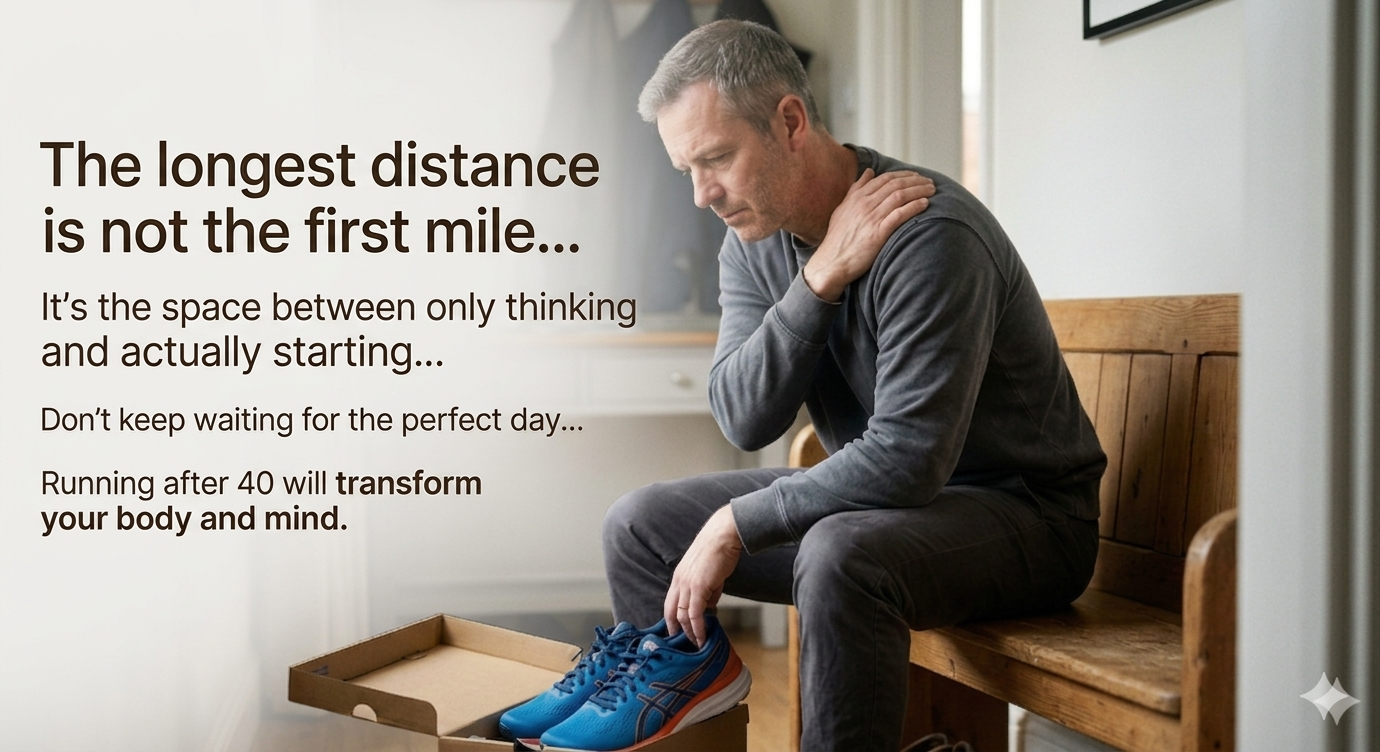
Running is a complete and easily accessible physical activity that can be done by individuals of all ages, physical conditions, and fitness levels. Anyone can embrace running anytime they want, regardless of whether you are in your 40s or older. You can start running after 40 with no prior running experience. The misconception that it is too late, or that you are not fit enough, should not deter you because, biologically, your systems are still remarkably capable of adaptation.
Your weakening body is sending signals, but you are likely misreading them as inevitable signs of “getting old.” If you are in your 40s, you may have already noticed a steady decline in muscle tone or a lingering soreness in your joints after minor physical activities. While you recognize that fitness after 40 offers profound physical and mental benefits, you remain hesitant because you have been away from intentional physical activity for a decade or more.
Crossing a certain age threshold doesn’t mean an automatic shutdown of your athletic potential; it is often a self-perceived threshold prompted by a lack of consistent movement and declining confidence. Of course, biological shifts are real, and they seem to validate your excuses to avoid the track. However, that “validation” is actually a distress signal from a dormant system. You don’t need to stress your mind with complex theories; you simply need to start showing up to reclaim your physical sovereignty. You need a system that can help you slow down or even reverse the physiological decline taking place. For me, that system is running.
Having said that, I am not suggesting you should just lace up and sprint without a proper assessment and plan. Midlife shifts are inevitable; we all face a slowdown in metabolism, Sarcopenia (the steady drop of muscle mass), hormonal shifts, and a loss of fluidity in our connective tissues. Conditions like high blood pressure or diabetes can complicate the landscape, but still, they are not the end of the road. On the contrary, they are often the most compelling reasons to start.
As the National Institute on Aging highlights in their research on how strength training builds healthier bodies as we age, targeted physical stress is the primary way we signal the body to repair and reinforce itself against these midlife shifts.
Therefore, running after 40 is not the same as running in your 20s or 30s. Those were the days when your “recovery window” was wide, and you could play a game of football or badminton without a second thought for a warmup. Things are different now. Your body requires more “onboarding.”
To succeed, you must adopt running with a solid intention and a sustainable plan that prioritizes structural integrity over ego. For those making the commitment after 40, running acts as a comprehensive reset for both your physical structure and your mental operating system.
Mastering the Mental Onboarding: Your Day One Psychology
The biggest hurdle to starting your journey of running after 40 is rarely physical; it is overcoming decades of sedentary self-talk and doubts. Breaking this “psychology of stagnation” requires engaging Human Intelligence (HI) to shift your perspective. Once your mind is made up and you begin executing a routine plan, the body will naturally break the shackles of self-doubt – one session at a time.
A profound transformation occurs when you stop viewing running through the lens of obligation and instead see it as a high-stakes investment in your physical potential. This journey isn’t just about weight loss and general health. Running after 40 reshapes your mindset, providing a “chemical recalibration” that allows you to handle life’s complexities with a sharper, calmer focus and a highly functional body.
- Mindset: Recalibrate Daily: Rebuilding fitness after years of inactivity requires a shift away from the “quick fix” mentality. Running isn’t a “one-off” event; it is a systemic update. As I’ve observed from my own 17-year streak of daily running, you need to recalibrate your entire biological system every single day. This becomes critical after 40, as the body requires more frequent “pings” to maintain its metabolic and structural integrity.
- Presence Over Speed: For a beginner over 40, success is never defined by pace. Chasing a personal record (PR) early on is a mistake, especially when comparing yourself to those who have been training for years. Your cardiovascular system and connective tissues need time to develop capillarization – the growth of new micro-vessels to fuel your muscles. This is a vital adaptation where aerobic exercise triggers angiogenesis, creating the infrastructure required for sustained performance. In the Live Fitness Laboratory blog, we respect this “construction phase” because without this capillary network, your muscles simply cannot clear waste products or receive the nutrients required to recover.
Mastering the mental onboarding is not about forcing your mind and body into something drastic or unsustainable. Don’t overthink your current limits – simply convince yourself to be consistent. Confidence isn’t something you have before you start; it is something you earn as you log the miles.
Don’t wait for motivation. Motivation is a fickle emotion that disappears on a rainy Monday. Anyone can run on a good day; how you respond to your “bad” days is what defines you as a runner for life. You need to build Discipline, which is the mechanical execution of your plan regardless of your emotional state. In the “Live Fitness Laboratory” of your life, discipline is the data that proves you are serious about your next chapter.
The Internal Reset for Running After 40: Build Your Base
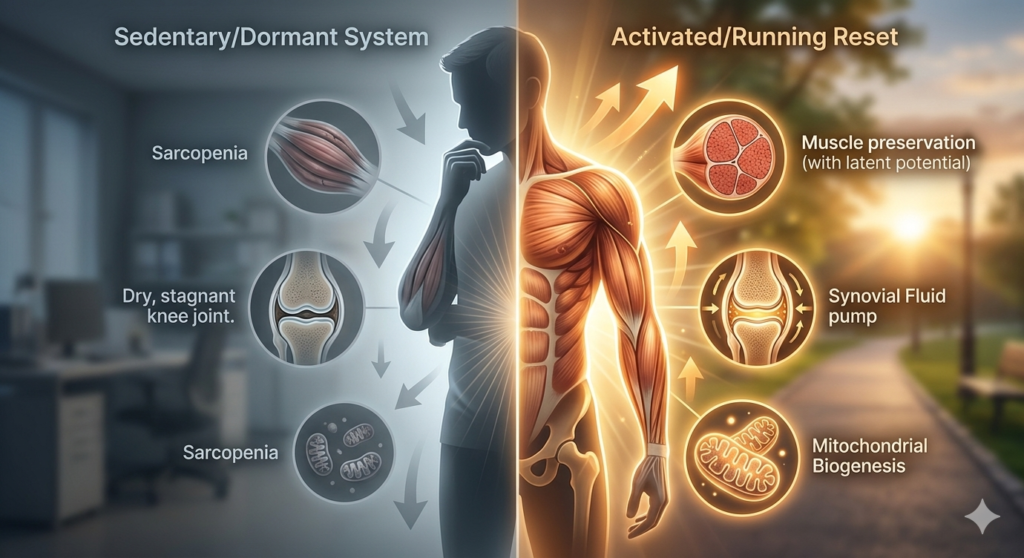
To appreciate the true advantages of beginning now, we must look beyond surface-level fitness and understand the internal physiological changes that occur during this decade. Running after 40 addresses the Biological Shift in that period when sedentary habits cause a rapid decline in muscle strength, joint mobility, and breathing capacity. In this Live Fitness Laboratory blog, we don’t view this as an inevitable decay; we see it as a high-performance system waiting for the right inputs and stimuli to get charged up.
1. The Cellular Antidote to Sarcopenia (Muscle Preservation)
Sarcopenia, the age-related loss of skeletal muscle mass, is a silent structural decline that accelerates after 40. Research indicates that sedentary adults can lose 3% to 5% of their muscle mass every decade. Running provides the essential weight-bearing mechanical stress required to signal your body to preserve and build lean muscle. By engaging prominent leg muscles like the quadriceps, hamstrings, and glutes, you aren’t just running; you are protecting your metabolic engine and skeletal structural integrity.
Expert Note: You will soon learn that running is not just about the legs. Your whole body is a high-performance engine that facilitates smooth running. While your lower body produces vertical and horizontal drive, your core and upper body are responsible for generating rotational power. Through proper arm swings and scapular gliding, you create a cross-body torque that pulls your hips forward. As physical therapy experts note, a significant portion of shoulder mobility is directly tied to scapular movement; mastering this timing of how your torso twists and stores elastic energy is what transforms a “stiff jog” into a powerful, graceful, and highly efficient movement.
2. Fascial Vitality: Actively “Removing the Rust”
The “rustiness” you feel after hours at a desk isn’t imagined; it’s located in your complex web of connective tissue called Fascia. This web exists both around and between muscles and organs, packed with countless nervous sensors. As we age, fascia naturally loses moisture and elasticity, becoming “sticky” and restrictive.
The rhythmic, spring-like motion of running stimulates the rehydration and nourishment of these fascia tissues. This “internal lubrication” is essential for maintaining the mobility and optimal functionality required for everyday life, effectively “removing the rust” from your physical chassis and allowing your muscles to slide over one another without friction.
3. Boosting Aerobic Capacity & Mitochondrial Health
Many beginners struggle with feeling “out of breath” within the first few minutes. This isn’t just because of a “weak heart.” It’s because your cells have forgotten how to efficiently process oxygen. Consistent running signals your body to create more Mitochondria (the energy factories in your cells) and improves your VO2 Max.
VO2 Max is the measure of the maximum volume of oxygen your body can process, and it has almost certainly declined if you led a sedentary life in your 30s. Improving your VO2 Max creates a vital fitness buffer. Don’t you wish you had the physical capacity to trek for hours or play football with your kids without gasping for air? By triggering mitochondrial biogenesis, you aren’t just “getting fit”; you are actively slowing down the biological decline of your body.
4. Skeletal Reinforcement: The Truth About Joints
There is a common misconception that running “destroys” knees after 40. In reality, cartilage is like a sponge; it lacks its own blood supply and requires the compression and release of movement to circulate Synovial Fluid, which delivers essential nutrients to the joint.
Your joints aren’t fixed parts; they are living, breathing tissues. Movement is the pump that circulates Synovial Fluid, delivering oxygen and nutrients to the cartilage that doesn’t have its own blood supply.
Recent radiological research on the ankle joint confirms that physical activity like running significantly increases this fluid presence. Think of it as “greasing the gears” while simultaneously feeding the machine. Without consistent motion, your joints become stagnant – a process often mistaken for simple “old age.” By running, you are effectively “shampooing” your cartilage with the lubrication it needs to stay resilient and pain-free.
As long as you follow a sustainable plan, running qualifies as essential weight-bearing loading. This mechanical “noise” signals your bones to deposit minerals and increase density rather than lose it to age. Instead of wearing your joints out, you are essentially feeding or nourishing them through movement.
The Kinetic Flow and Rotational Forces for Running
This part is a little technical for beginners to understand, but it will help you know about what kind of biomechanics drive your body forward without putting too much pressure on a specific joint. Don’t worry too much about remembering the names of muscles mentioned in this block – just try to understand the biomechanics as it will help you build your running journey for the long haul.
You could start your running journey with a few cues like landing your foot below your center of mass, looking towards the horizon, keeping your body erect, and hitting the ground when your feet are moving back towards you. But when you start becoming familiar and running comfortably, you can finetune your technique where all these standalone cues will fall into a proper sequence to allow for a smooth kinetic flow of force, soft landing, and forward drive.
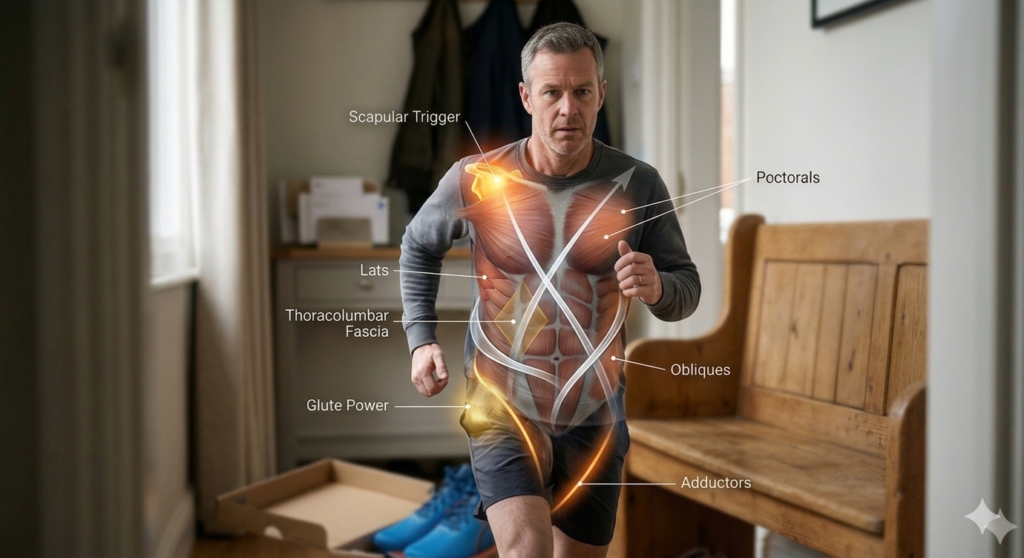
When you run, your core and upper body aren’t just staying still. They have a role to play in supporting the legs on each stride. They are active participants in force production and energy return. This is where the concept of the “Serape Effect” comes into play – the diagonal link between your opposite shoulder and hip.
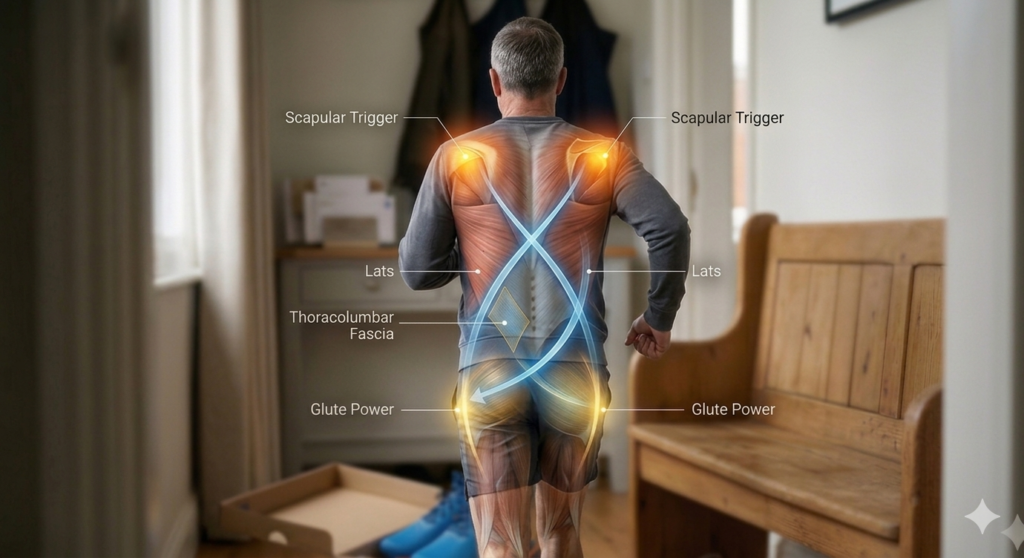
Mastering the Serape Effect is what separates a mechanical, “stiff” runner from one who moves with fluid power. This isn’t just about core strength; it is about the diagonal tension created between your opposite shoulder and hip. As detailed by Juan Carlos Santana in his research on the Serape Effect, this cross-body sling allows your torso to store elastic energy during the arm swing and “snap” it back to pull the opposite hip forward.
- Rotational Force & Torque: As your right leg drives forward, your left arm swings back. This creates a rotational stretch across your torso. Your core muscles (specifically the obliques) act like a giant rubber band, storing elastic energy and then snapping it back to help “pull” the opposite hip forward.
- Scapular Gliding & Arm Drive: Proper hand swings aren’t just for balance. The rhythmic gliding of your scapula (shoulder blades) allows for a powerful rearward elbow drive. This elbow drive provides a counter-balance to the forward knee drive, allowing you to maintain momentum without wasting energy on side-to-side wobbling.
- The Global Tension: Your upper body acts as a “tensioner.” By timing the arm swing and scapular movement perfectly with your foot-strike, you create a synchronized wave of force. This is what we call Kinetic Flow.
The Diagonal Power Cross: Posterior and Anterior Slings
When you run, your body utilizes “X-shaped” patterns of muscle engagement to transfer force. This is why you feel the connection between your shoulder and the opposite hip.
1. The Posterior Functional Sling (The Back Power)
This chain connects the Latissimus Dorsi (the large muscle of your back) to the opposite Gluteus Maximus through the thoracolumbar fascia (a thick diamond of tissue in your lower back). As physiotherapy research on anatomical slings explains, this diagonal connection is what allows your upper body to “prime” your lower body for a more powerful push-off.
- The Action: As your elbow drives back (scapular gliding), your “Lat” engages. Because of that diagonal connection, it helps the opposite glute fire more powerfully to push you off the ground.
- The Benefit: This diagonal tension stabilizes your sacroiliac (SI) joint and provides the “snap” in your stride.
2. The Anterior Functional Sling (The Front Power)
This involves the Pectorals (chest) and the External Obliques (the diagonal abs) connecting to the opposite Adductors (inner thigh). As discussed in the Anatomical Slings guide, this front-side “X” manages rotational forces so your energy goes forward instead of leaking out sideways. By coordinating your chest and core with your opposite hip, you ensure every ounce of effort contributes to forward momentum.
- The Action: As your arm swings forward, the chest and obliques contract diagonally to help pull the opposite leg forward and inward.
- The Benefit: This prevents the “wobbling.” It manages the rotational forces so your energy goes forward instead of leaking out sideways.
3. Scapular Gliding as the “Trigger”
Think of the scapula as the trigger for these slings. If your shoulder blades are “stuck” or frozen from sitting at a desk all day, the diagonal chain is broken. By ensuring proper scapular gliding, you unlock the ability of your lats and chest to assist your legs. This is how you move from “running with your legs” to “running with your entire system.”
Expert Note: Running is a symphony of diagonal forces. Through scapular gliding and a rhythmic arm drive, you engage the Posterior and Anterior Functional Slings. These are “X-shaped” chains of muscle connecting your chest and back to your opposite hips that store and release energy like a spring. By timing your hand swings and hip rotations correctly, you aren’t just balancing; you are using your upper body to “pull” your lower body forward, creating a fluid, efficient, and powerful kinetic flow.
Sustainable Habits: Build a Runner’s Body That Lasts
Starting your running journey after 40 is a powerful commitment, but for the best results, it cannot be your only workout. To enjoy a functional body that lasts into your 50s, 60s, and beyond, your weekly routine must integrate three critical support pillars. This “triad” ensures that your structure is strong enough to handle the engine you are building.
1. Cardio (The Daily Stimulus)
Running daily (or 5–6 days a week) provides the consistent cardiovascular base your body needs to adapt. However, to truly level up your VO2 Max and aerobic capacity, consider 1-2 sessions of cross-training. Activities like swimming or cycling allow you to push your heart and lungs to their limit without the mechanical impact of the road. This provides “active recovery” that keeps the blood flowing to repair tissues while giving your joints a break from the vertical loading of running.
2. Strategic Strength: Protecting the Chassis
You cannot be a strong runner with weak glutes, hips, or core. In the Live Fitness Laboratory, we view strength training as non-negotiable for stabilizing your stride and protecting your joints.
You don’t necessarily need heavy weightlifting or overly loaded deadlifts to become a runner. Because running is more about elastic energy return than deep hip-hinging power, your strength work should focus on functional stability.
- Calisthenics & Band Training: Using bodyweight exercises and resistance bands is incredibly effective for runners. These tools help build the “supporting” muscles like the glute medius and the obliques that manage those rotational forces we discussed earlier.
- Plugging the Leaks: Strength training “plugs the energy leaks” in your body. If your core is weak, the power generated by your “Serape Effect” (diagonal swing) is lost. A strong core ensures that every ounce of energy goes into moving you forward.
3. Mobility (Fluidity vs. Stiffness)
Functional mobility is the ultimate antidote to midlife stiffness. As we age, our joints and fascia tend to “lock down” to create stability where muscle strength is lacking. Regular flexibility work, such as a once-a-week yoga session or dedicated dynamic stretching, improves joint fluid dynamics.
By circulating synovial fluid and rehydrating the fascia, you ensure your running gait remains fluid and “springy” rather than jarring and restricted. Mobility work allows your “X-shaped” functional slings to stretch and snap back with maximum efficiency.
Is it Too Late to Start Running After 40? The Definitive Guide to Starting
Many beginners harbor deep self-doubt about starting at this stage of life. The straight answer is a resounding NO. If you can walk, you can run. The key to long-term success is gradual, sustainable progression, acknowledging that years of a sedentary lifestyle have left your muscles, tendons, and connective tissues dormant.
In this Live Fitness Laboratory blog, we don’t just “go for a run.” We follow a strategic onboarding process:
1. The Run-Walk Technique (Tissue Adaptation)
If you haven’t pushed your body in years, do not start by trying to run for 30 minutes straight. Use the Run-Walk-Run progression.
- Why it works: Your cardiovascular system (heart and lungs) adapts to stress relatively quickly, but your “structural” system (tendons, ligaments, and bone density) adapts much slower.
- The Strategy: Start with 1 minute of easy running followed by 2 minutes of walking. This allows you to build volume and “mechanical tolerance” without overloading your joints. This strategy may take months to perfect, but consistency is the only sustainable path to building meaningful volume.
2. The “Zip-Up” Core: Your Inner Stabilizer
Efficiency begins with your posture. Focus on immediately activating your deep stabilizer muscles, specifically the Transverse Abdominis (TvA) and the Multifidus.
- The Cue: Imagine “zipping up” a tight pair of high-waisted jeans. This engages the deep “inner corset” of your abdomen.
- The Result: A “zipped-up” core protects your spine, keeps your pelvis neutral, and creates a robust foundation for the rotational forces of your “Serape Effect.” It ensures that your power moves your body forward rather than causing your lower back to arch or your hips to drop.
Running After 40: Claim Your Next Chapter
I have frequently seen people train with extreme intensity until “race day,” only to immediately relapse into sedentary habits once the distance completion medal is earned.
This is a “short-term” trap. Fitness after 40 isn’t a phase or a temporary challenge to be “completed”; it’s a lifelong process of biological maintenance. Eventually, it becomes a core part of your identity. You stop being “someone who is trying to run” and you become “a runner.”
By facing your excuses and committing to this daily recalibration, you aren’t just attempting to slow down the clock. You are building a functional body that allows you to enjoy your hard-earned success and the “next chapter” of your life to the fullest. Whether it is trekking through new landscapes, playing sports with the next generation, or simply moving through the world with ease – running is your best vehicle for building that physical sovereignty.
For – Brands | Businesses | Coaches
If your brand or website needs top-quality blog content or end-to-end blog management, chat with me today. I create content with the same clarity, science-backed storytelling, and motivational rhythm you just read.
I offer blog management and content writing services across diverse sectors, whether your niche is fitness and health (my favorite), technology, lifestyle, or business – I specialize in turning topic ideas into engaging, SEO-optimized blog posts that your readers will trust and love.
Let’s build your business authority online with content that delivers both value and results.
 Chat With Nady on WhatsApp
✍️ Explore Our Blog Writing Services
Chat With Nady on WhatsApp
✍️ Explore Our Blog Writing Services