
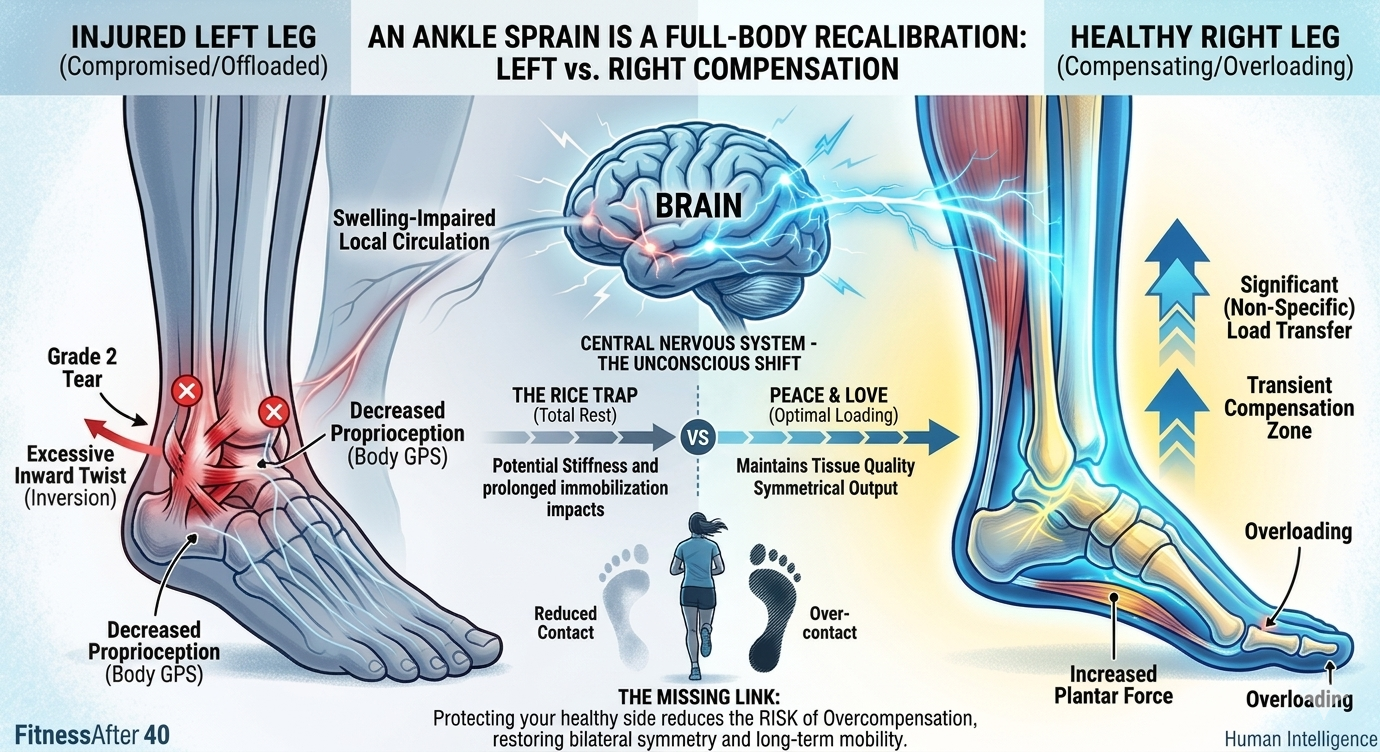
- The Hidden Danger: Contralateral Overuse & The Kinetic Chain
- How Can You Treat Your Sprained Ankle?
- When Must You See a doctor?
- Note: Why the "RICE" Method is Evolving
- The Risks of "The Old Way" (Total Rest & Excessive Ice)
- The Modern Recovery Protocol: PEACE & LOVE
- Actionable Tip: The "Cross-Education" Effect
- How can you strengthen your ankle after spraining?
- When Can You Start Running Again?
- Awareness of Overcompensation: Protecting the Healthy Side
- Ankle Sprain – Final Words
Ankle sprain is one of the most common musculoskeletal injuries in adults, with research indicating an incidence rate of 2.15 per 1,000 person/year in the general population. For runners over 40, however, a simple “twist” carries higher stakes; recovery cycles lengthen, and the risk of bilateral complications increases. Effective running depends on bilateral symmetry – the ability of both sides of your body to work in harmony for efficient power output.
While most sprains occur from a sudden inward twist (inversion) that overstretches the lateral ligaments, true rehabilitation is rarely linear. Most runners focus solely on healing the injured joint, but they often ignore the kinetic chain shift the injury causes. In many cases, you may unknowingly carry a compromised “limping form” throughout the entire healing process, even after the pain is gone.
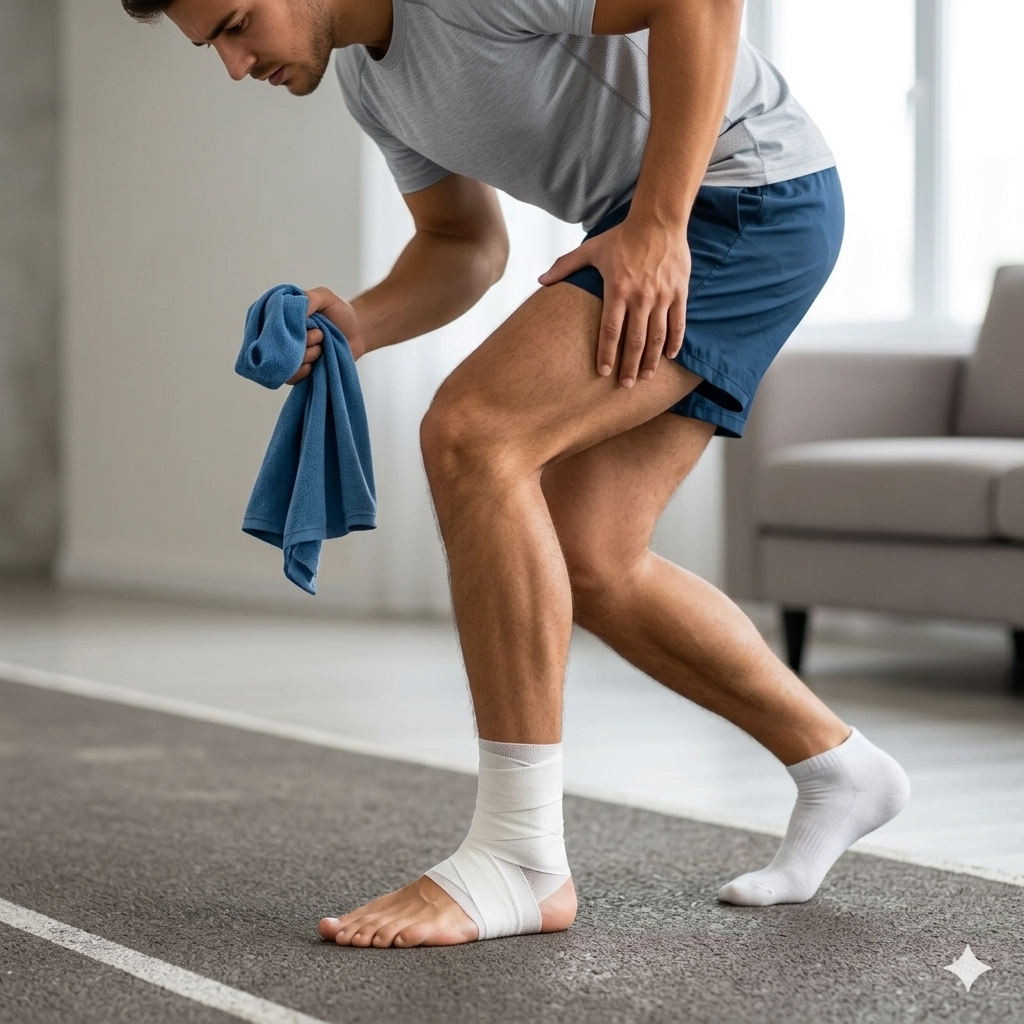
This leads to a critical issue: overcompensation from the healthy ankle. Your brain subconsciously offloads weight to the uninjured side to protect the site of pain. Protecting your healthy leg from this excessive load is the “missing link” in restoring long-term mobility and preventing a secondary injury cycle in your “good” leg.
The Hidden Danger: Contralateral Overuse & The Kinetic Chain
When you sprain an ankle, the injury isn’t isolated to that joint. It triggers a kinetic chain reaction. Because the body is a master of survival, your brain immediately shifts your center of mass toward the healthy side. This often leads to Contralateral Overuse (or a compensatory gait shift) where the uninjured leg takes on excessive mechanical stress.
In runners over 40, this shift can be taxing. The “healthy” hip, knee, and ankle suddenly take on 120-150% of their normal load to compensate for the injured side. If you don’t manage this load, you risk secondary issues like Achilles tendinopathy or plantar fasciitis on your “good” leg before your sprained ankle has even healed.
Ankle Sprain – The Pain and Swelling
Immediately following a sprain, you will likely feel excruciating pain as the ligaments are stretched or torn. While this sharp intensity usually dulls within minutes, localized swelling (edema) will begin to pool around the lateral or medial malleolus (the “ankle bones”).
For the first few days, weight-bearing will be painful. While most runners can physically “limp-walk” within 72 hours, true rehabilitation of agility and explosive strength often takes 8 to 12 weeks. Don’t mistake the absence of pain for the presence of stability.
How Can You Treat Your Sprained Ankle?
The immediate objective is to manage the inflammatory response without stalling the body’s natural repair mechanisms. While the traditional RICE method (Rest, Ice, Compression, Elevation) has been the standard for decades, modern sports medicine – and even the creator of the RICE acronym, Dr. Gabe Mirkin – has moved toward optimal loading.
1. The Shift from “Total Rest” to “Optimal Loading”
Total rest can actually lead to muscle atrophy and joint stiffness. Instead, follow the 48-Hour Rule: avoid any activity that causes a sharp, “stabbing” sensation. However, once that acute, “glass-shards” pain subsides, it is vital to start with small, pain-free movements. This keeps the neural pathways active and prevents the “healthy” leg from taking over 100% of the workload.
2. Compression & Elevation
- Elevation: Keep the ankle at or above hip level (and ideally above the heart) to assist lymphatic drainage and reduce pressure.
- Compression: Use medical-grade compression socks or wraps. This provides external support and helps “pump” swelling away from the joint.
3. The New Role of Ice vs. Heat
In the first 6-12 hours, ice is an excellent tool for natural pain relief. However, avoid icing for days on end. Excessive cold constricts blood vessels, which can actually slow down the “repair crew” (white blood cells) trying to reach the ligament. After 48 hours, consider contrast baths or gentle heat to encourage circulation.
4. Gentle “Effleurage” (Massage)
Avoid deep tissue work on the actual site of the tear, as this can disrupt the newly forming collagen fibers. Instead, use light, upward strokes (effleurage) from the foot toward the knee. This helps move stagnant fluid away from the joint and toward the lymph nodes.
Beyond Strength: Restoring your balance isn’t just about muscle; it’s about recalibrating your neural pathways. For a deeper look at how to sharpen this “sixth sense” as you age, read my guide on proprioception after 40 .
When Must You See a doctor?
Ankle sprains are among the most common running injuries after 40, but they shouldn’t always be “walked off.” You must consult a specialist if your symptoms persist, worsen, or become unbearable.
Red Flags to Watch For:
- Numbness or Tingling: This could indicate nerve involvement or a “Grade 3” tear.
- Weight-Bearing Issues: If you cannot take four steps immediately after the injury or during your self-evaluation.
- Persistent Swelling: If the edema does not begin to subside after 72 hours of elevation and compression.
The Diagnostic Process: Ottawa Ankle Rules
Many runners assume they need an X-ray immediately. However, X-rays are not the standard for every ankle injury because sprains are primarily ligamentous (soft tissue) rather than skeletal. Instead, clinicians use the Ottawa Ankle Rules – a highly accurate clinical tool (effective in over 95% of cases) to determine if a fracture is likely. This involves checking for:
- Bone Tenderness: Specifically, along the posterior edge of the lateral or medial malleolus (the ankle “knobs”).
- Midfoot Pain: Tenderness at the base of the fifth metatarsal or the navicular bone.
- Inability to Bear Weight: If you cannot walk four steps both immediately after the injury and during assessment.
By using these rules, your orthopedic or podiatric specialist can determine if you need radiographs or if you can proceed directly to a structured rehabilitation program. Clinicians follow the Ottawa Ankle Rules to determine the necessity of an X-ray after a running injury.
Note: Why the “RICE” Method is Evolving
While RICE (Rest, Ice, Compression, Elevation) has been the standard for decades, its creator, Dr. Gabe Mirkin, retracted his stance in 2015, noting that total rest and excessive icing can actually delay the body’s “repair crew” (inflammation). For runners over 40, total immobilization carries a specific risk: rapid deconditioning. If you don’t incorporate “optimal loading” (gentle, pain-free movement), your brain will aggressively offload work to your healthy leg, leading to a permanent “limping form” and potential secondary injuries on your uninjured side.
The Risks of “The Old Way” (Total Rest & Excessive Ice)
While it may feel safer to stay off your feet entirely till it heals, “Total Rest” can be a trap for the 40+ runner. The shift away from RICE isn’t just a trend; it’s a response to research showing that the evidence for traditional Rest and Ice is surprisingly limited when it comes to long-term ligament healing. Here is what modern sports science warns us about:
- Stifled Healing Signals: Excessive icing constricts blood vessels, potentially blocking the white blood cells and growth factors (your body’s “repair crew”) from reaching the torn ligament to begin reconstruction.
- Rapid Deconditioning: For athletes over 40, muscle mass and joint lubrication are lost faster and regained slower. Total immobilization leads to stiffness and atrophy, forcing your “healthy” leg to work twice as hard for a much longer period.
- The “Body GPS” Failure: Long periods of zero movement “turn off” the proprioceptive nerves that tell your brain where your foot is in space. This is often how a temporary injury turns into a permanent change in your running form.
The Modern Recovery Protocol: PEACE & LOVE
If you want to recover like a pro, it’s time to move past RICE. The British Journal of Sports Medicine (BJSM) now advocates for the PEACE & LOVE protocol. This approach treats the injury as a dynamic process rather than a static one.
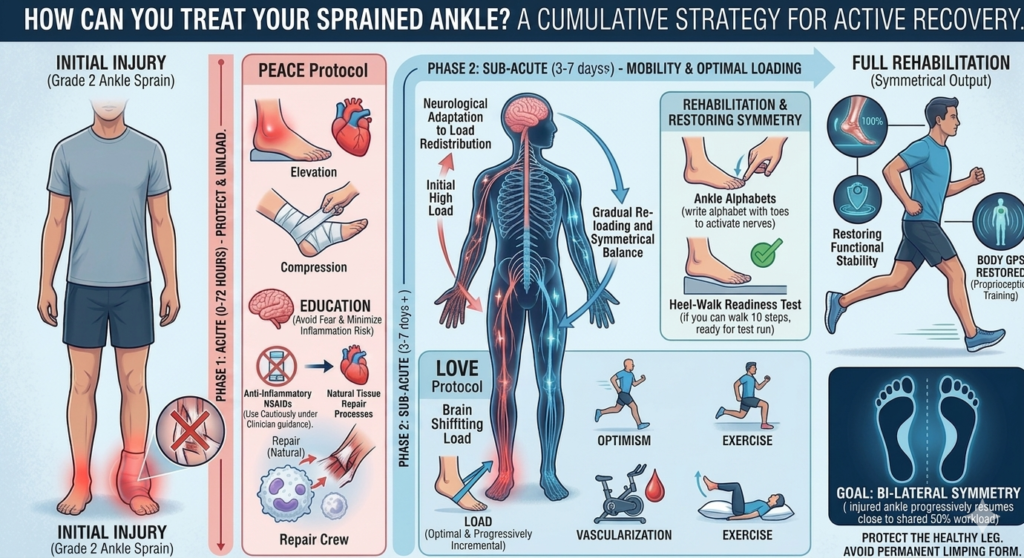
Phase 1: PEACE (The First 48-72 Hours)
- P – Protection: Unload the ankle for 1-3 days to minimize bleeding (internal) and prevent further tearing.
- E – Elevation: Keep the limb higher than the heart to promote fluid drainage.
- A – Avoid Anti-inflammatories: This is crucial. Standard NSAIDs (like Ibuprofen) can actually slow down long-term tissue repair. Let the natural inflammatory “repair crew” do its job.
- C – Compression: Use an elastic bandage or sock to reduce intra-articular swelling.
- E – Education: Understand that your body knows how to heal. Avoid unnecessary passive treatments (like over-reliance on braces) that might make you “fear” moving.
Phase 2: LOVE (After the First 3 Days)
- L – Load: As soon as pain allows, start “Optimal Loading.” This tells the new collagen fibers how to align properly for running.
- O – Optimism: The brain plays a huge role in recovery. Stay confident and avoid the “catastrophizing” mindset that leads to a permanent limp.
- V – Vascularization: Choose pain-free aerobic activity (like a stationary bike) to boost blood flow to the injured site.
- E – Exercise: Gradually restore mobility, strength, and proprioception to ensure the healthy leg doesn’t stay in “overcompensation mode.”
Actionable Tip: The “Cross-Education” Effect
While you are protecting the injured ankle, don’t let the healthy leg just be a “crutch.” Research into cross-education shows that performing strength or balance exercises on your uninjured leg can produce a “neural carry-over” effect.
Because the brain’s motor pathways for both legs are linked, stimulating the nerves on the healthy side helps maintain muscle tone and neural drive on the injured side – even while it’s immobilized.
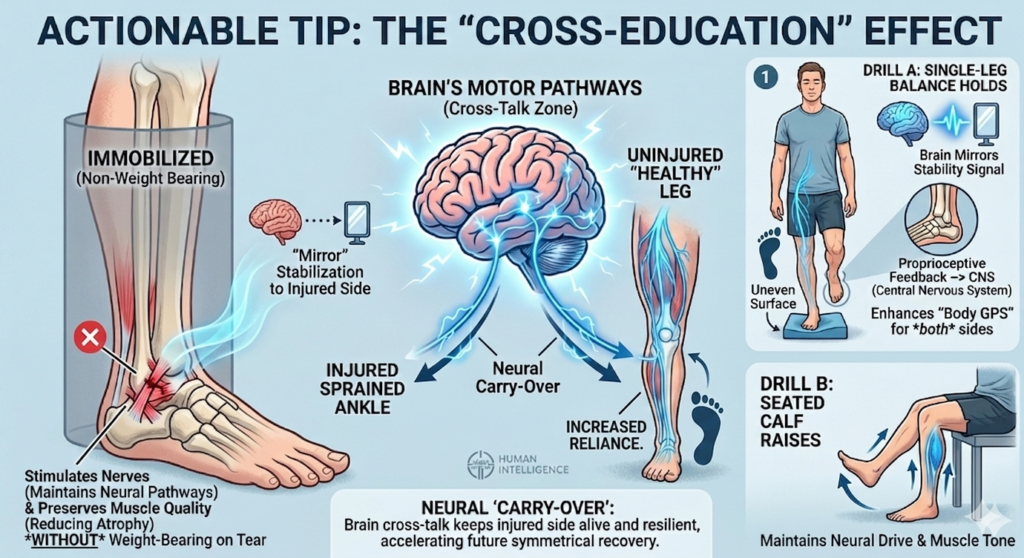
The Drill: While seated or standing (with support), perform calf raises or “single-leg balance holds” with your healthy leg. Your brain will “mirror” some of that stability work to the sprained side, keeping the neural pathways alive without putting weight on the tear.
How can you strengthen your ankle after spraining?
Now that we’ve covered the immediate “PEACE” phase, we move into the actual rehabilitation. This is where you actively fight the overcompensation of the healthy leg.
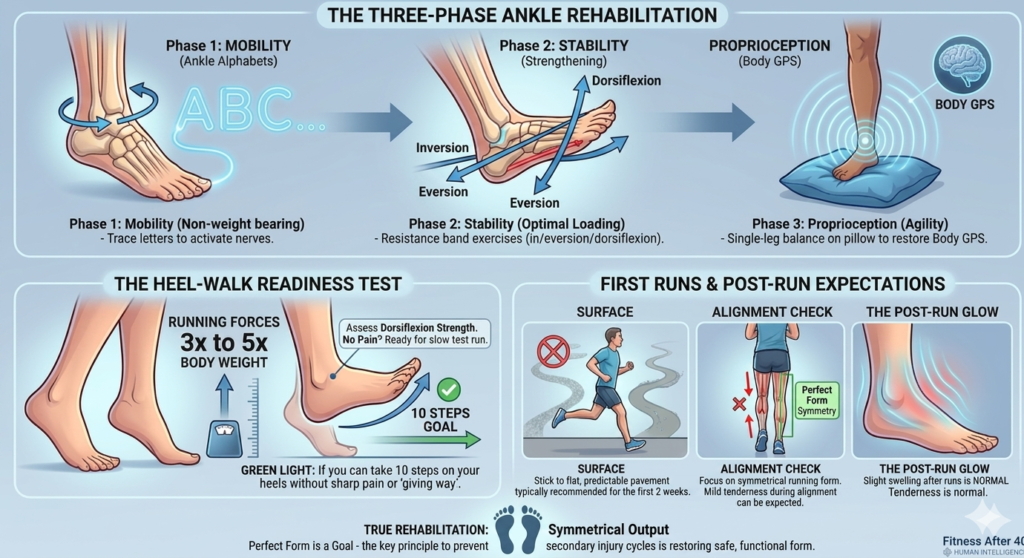
The Three-Phase Approach
- Phase 1: The Range of Motion (Mobility): Once the sharp pain subsides, start with non-weight-bearing movements like “Ankle Alphabets” (writing the alphabet with your toes). This re-activates the nerves without stressing the tear.
- Phase 2: The Strengthening (Stability): Progress to resistance-band work (inversion, eversion, and dorsiflexion). This is where you teach the injured ankle to “carry its own weight” again so the healthy leg can stop overworking.
- Phase 3: The Agility (Proprioception): This is the “Body GPS” restoration phase. Exercises like single-leg balance on an uneven surface (like a pillow) are essential.
When Can You Start Running Again?
You should be able to walk without pain within 3-4 days, but a “pain-free walk” does not mean your ankle is ready for the dynamic load of a run. Running generates forces 3 to 5 times your body weight; your ligaments need to be structurally ready for that impact.
The “Heel-Walk” Readiness Test
One of the best ways to gauge your readiness is the Heel-Walk Test. Try to walk on your heels with your toes elevated and your ankles “locked.”
- The Goal: If you can take 10 steady steps without sharp pain or the ankle “giving way,” your dorsiflexion strength is returning.
- The Green Light: This is a good indication that you can begin a very slow, flat-surface “test jog.”
What to Expect During the First Runs
- The Surface Matters: You will likely still feel discomfort on uneven trails, slopes, or while turning around the corners. Stick to flat, predictable pavement for the first 14 days.
- The Alignment Check: You may not feel pain while walking, but you will feel “tenderness” when focusing on your ankle alignment. This is your nervous system relearning how to stabilize the joint.
- The Post-Run Glow (Swelling): It is normal to see slight swelling a few hours after your first few runs. This is the “Optimal Loading” process in action – your body is remodeling the tissue in response to the stress.
Critical Rule: You must focus on perfect form. If you find yourself “limping” to avoid a small amount of pain, stop immediately. Running with a limp is a guarantee that you will overstress the healthy leg and create a secondary injury cycle.
It may take 2 to 3 months before you are truly “pain-free” on technical trails or steep hills. Patience in this phase is what separates a successful recovery from a chronic instability issue.
Awareness of Overcompensation: Protecting the Healthy Side
We have spent decades relying on the symmetry of two legs. When one ankle is compromised, your “movement software” (the brain) automatically shifts the burden to the healthy side. While this is a brilliant short-term survival mechanism for walking, it is a high-risk strategy for running.
You must be acutely aware of how much you are favoring your “good” leg. Overworking the healthy side doesn’t just lead to fatigue; it changes your foot strike. You may notice new hotspots or blisters on your healthy foot due to this unnatural weight transfer. In more severe cases of overcompensation, you risk a secondary injury – such as a sprain or Achilles strain – on the leg that was originally fine.
The Strategy for Balance:
- Gradual Loading: Focus on incrementally shifting weight back to the injured side as the “PEACE & LOVE” protocol progresses.
- Assistive Support: If the pain is forcing a significant limp, use a compression sleeve or ankle support sock. These provide proprioceptive feedback, reminding your brain that the injured ankle can still participate in the movement.
- The Goal of Form: True rehabilitation is only complete when your “running footprint” is symmetrical again. Combined with strength and mobility exercises, your injured ankle will eventually resume 50% of the workload, allowing for a sustainable, pain-free run.
Note – The Myth of 50/50 Symmetry
Let’s be realistic: unless you are a rare outlier, a perfect bilateral symmetry is a myth. We all have a dominant side – a “lead” leg that drives, and a “stability” leg that supports. Because of this lateral dominance, one side will naturally have slightly different muscle development. While a perfect 50:50 balance isn’t technically the goal, for runners, functional symmetry is everything. We strive to get as close to that balance as possible, not just for the sake of the numbers, but to eliminate “energy leaks”, and ensure that one leg isn’t doing 60% of the work while the other lags behind.
Pro tip for runners: While the ankle is a frequent pain point, understanding the full spectrum of common running injuries after 40 can help you spot the early warning signs of overcompensation before they sideline you.
Frequently Asked Questions on Ankle Pain Rehab
For a Grade 2 ligament tear (partial tearing), most runners can return to light activity in 4 to 6 weeks. However, full functional stability and peak power output often take 8 to 12 weeks. Recovery for runners over 40 may lean toward the longer end of this spectrum due to slower collagen synthesis and cellular repair cycles.
While RICE is the traditional standard, modern sports physiotherapy now advocates for PEACE & LOVE. This newer protocol prioritizes Optimal Loading and Vascularization over total immobilization. Unlike RICE, it discourages the long-term use of anti-inflammatory drugs (NSAIDs), which can potentially interfere with the natural tissue-remodeling phase of healing.
This is due to Contralateral Overuse or compensatory gait shift. Your brain subconsciously offloads weight to the uninjured side to protect the site of pain. This asymmetrical loading puts excessive stress on the healthy leg’s Achilles tendon, knee joint, and plantar fascia, often leading to a secondary overuse injury if bilateral symmetry isn’t restored quickly.
An ankle compression sleeve is excellent for enhancing proprioception (your body’s “spatial awareness”), which helps prevent the healthy leg from overcompensating. However, a rigid brace should only be used as a temporary stabilizer. Over-reliance on a brace can lead to muscle atrophy and joint stiffness, making the ankle less resilient in the long run.
Clinicians use the Ottawa Ankle Rules to determine if an X-ray is necessary. If you cannot bear weight (take four steps) immediately after the injury or during an exam, or if you feel sharp pain when pressing on the malleolus (the bony bumps on the ankle), you should consult an orthopedic specialist to rule out a bone fracture.
Focus on Proprioceptive Training and Eccentric Strengthening. Exercises like single-leg balance holds (on a foam pad or BOSU ball) and resistance band eversions help “re-wire” the neural pathways. Strengthening the peroneal muscles on the side of the leg is the “missing link” in preventing the foot from rolling inward during future runs.
Ankle Sprain – Final Words
As we’ve explored, an ankle sprain is more than just a local injury; it is a full-body recalibration. For runners over 40, these setbacks can be frustratingly slow to resolve, often tempting people to hang up their running shoes for good.
While there is no foolproof way to prevent ankle pain entirely when leading an active lifestyle, you can minimize the risk by staying present. A single wrong step on a trail or a momentary lapse in focus during a workout can lead to an injury that takes months for recovery.
The takeaway: Don’t just focus on the pain – focus on restoration of your symmetry. By protecting your healthy leg from overcompensation and following a modern recovery protocol like PEACE & LOVE, you aren’t just healing an ankle; you are protecting your long-term mobility.
Stay focused, maintain your form, and don’t let your guard down. Your future runs depend on the patience you show today while dealing with your ankle sprain.
Want professional content writing services to turn your ideas into engaging blog posts that your readers love?
 Chat with Nady on WhatsApp
Let’s build your authority in the fitness and health niche together.