
- Introduction – Ankle Pain in Runners
- Ankle Pain – First things first
- Common causes of Ankle Pain when running?
- Overuse injury
- Ankle strain or sprain
- Ankle stress fracture
- Ankle Tendonitis
- Ankle Arthritis
- Ankle Instability
- Flat Footedness
- Poor Running Technique
- Ankle Pain Healing and Rehabilitation
- Ankle Pain Can Be Avoided
- Final Thoughts: Resilience Over Perfection
Introduction – Ankle Pain in Runners
Post-running ankle pain can signal issues, from minor tweaks to more severe injuries. Ankle pain indicates potential strains, sprains, or stress fractures, and it shows up with typical symptoms like inflammation, swelling, and compromised running ability. You must identify it quickly and carefully address the underlying cause. It will help you prevent further complications, particularly if you want to maintain your fitness after 40.
Ankle Pain – First things first
If you have been struggling with severe ankle pain for more than 4-5 days, please stop reading this post and visit a doctor immediately. Ankle pain could be due to many different reasons. Some pains will heal with proper rest, elevation, cold packs, flexibility stretches, massages, and strength training, whereas you will need help from an orthopedic or podiatric physician for complex issues.
Muscles, tendons, and ligaments help with ankle stability. They may swell or feel tender when the ankle is injured. Sore or painful ankles hinder your running performance and cause a lot of discomfort in your daily activities like walking and getting up from a seated position.
Ankle pain can be tricky because you will involuntarily overcompensate it with the other healthy leg. That can cause excessive strain on your healthy ankle. Even if your ankle pain stops after a few days, you may take a month or more to rehabilitate and return to your former performance.
Certain pains may signal more serious issues where you need professional help. Let’s now talk about some causes of ankle pain and ways to get relief.
Common causes of Ankle Pain when running?
If your ankles hurt when you run, there can be any of the following possibilities.
- Overuse injury
- Ankle strain or sprain
- Ankle stress fracture
- Ankle tendonitis
- Ankle instability
- Flat footedness
- Poor running technique
Overuse injury
Overuse is a prevalent cause of ankle pain, mainly if you have been using the wrong techniques for an extended period. It is marked by
- Inflammation
- Swelling
- Redness
- Bruising
- Reduced mobility
- Warmness
It would help if you allowed adequate recovery time between workouts to reduce the chances of injuring your ankles. Even a sudden increase in speed or distance can make runners prone to overuse injuries. Follow a progression plan where you give time for your body to lift the intensity gradually. Besides rest and recovery, you must work on your running form to reduce the chances of overuse injury.
Ankle strain or sprain
The primary culprits for running-induced ankle pain are usually strains and sprains. Ankle strains result from overstretched or torn muscles or tendons, while sprains involve rupturing of ligaments.
Unlike overuse-related pains, strains and sprains often result from a singular traumatic injury. For example, you could snap the connective tissues or muscles around your ankles when you abruptly change direction while running at a good speed. Runners also tend to sprain their ankles while playing other sports or cross-training. You could step on some other player’s feet and twist your ankle.
You can prevent sprains and strains by improving your running form and gait. Besides the technique, you need a keen eye to read even the small changes in your running track and manage the weight transfer accordingly. An ankle sprain is usually caused by an unexpected change on the track or by making a sudden awkward movement.

You can prevent injury even when you take awkward steps, provided you have complete control of the load. You will need good leg strength and mobility to reach that level. Calf and ankle exercises help to manage your body weight with less effort.
Ankle stress fracture
Stress fractures develop when muscles weaken and cannot absorb the repetitive impact shock, causing tiny cracks in the bones that eventually give way under stress. It is a prolonged injury that you might be unable to identify in the early stages. You may wake up to the realization only when the pain becomes unbearable.
Your doctor will ask you to rest your ankles to heal from this injury, and you should do just that. Physical activity will only aggravate it further. It may put you out of action for about a month or 2. Your doctor will give you the green signal to resume your physical activities after confirming your healing with an X-ray or CT scan. It is advisable to go for a gradual return and work on rehabilitation.
Ankle Tendonitis
Tendinitis refers to the inflammation of a tendon caused due to fraying, tearing, or swelling. Various types of tendinitis in the foot region can contribute to ankle pain during running, such as:
- Tibialis anterior tendonitis
- Achilles tendonitis
- Posterior tibial tendonitis
- Peroneal tendonitis.
It is also a type of overuse injury triggered by poor running technique. Achilles tendinitis can happen when your heels are overstretched while running for some time. It is common among runners, especially those who run on slopes. You might not know how it started because the injury keeps progressing until the pain becomes intense. After that, you will feel the tenderness even while walking.
If the injury is minor, you could continue running as long as you do it with a proper form. Hard massaging is not recommended here. A soft massage around the tendons will help remove the scar tissues. Calves stretching exercises with heel-rises can help in rehabilitation after the healing.
Ankle Arthritis
Arthritis is often linked with old-age athletes but can impact runners of any age. Three types of foot arthritis can induce ankle pain during running, emphasizing the diverse nature of this condition:
- Osteoarthritis
- Rheumatoid arthritis
- Post-traumatic arthritis.
It would be best to work on your arthritis healing and rehabilitation plan with your doctor. It may be a prolonged treatment, where you may even need medication.
Ankle Instability
Weak ankles can lead to instability, causing biomechanics to falter under your weight. It could result in chronic pain and recurrent injuries during running. Strength and flexibility training of your hips, legs and ankles will help.
Flat Footedness
Flat feet lead to arch collapse and inward ankle rolling, known as overpronation. It can be genetic, contributing to posterior tibial tendon dysfunction (PTTD), or acquired in adulthood due to PTTD. Flat-footed people will still be able to run with proper footwear and by ensuring proper strides. It is advisable to stay away from uneven surfaces while running. Walking or running barefoot on soft surfaces like sand or grass can help in improving the toes engagement in your gait. You could also use custom orthotics on shoe soles to increase shock absorption.
Poor Running Technique
Poor running technique, such as excessively long strides leading to repetitive over-flexing, can result in ankle pain. Also, many runners lose focus after feeling tired but continue running with a compromised form. Weak or imbalanced ankle muscles will lead to some injury or the other. You can work on your balance and alignment with strength and flexibility training.
Ankle Pain Healing and Rehabilitation
This checklist is a textbook example of a structured return-to-play protocol for soft tissue injuries. In the initial phase, the focus is on mitigating secondary damage through unloading and basic mechanical support: limiting weight-bearing, using compression to manage swelling, and elevating the limb.
However, the modern rehabilitation approach to rehab has shifted; we no longer just wait for pain to disappear. We use gentle ankle movements early on to maintain that “Body GPS” (proprioception) you’ve been working on, ensuring the brain doesn’t lose track of the joint’s position during the healing process.
As you move out of the acute phase, the checklist emphasizes Calf Strengthening and a Gradual Return to Activities. This is where biomechanics truly matter. For a long-term runner, rebuilding the strength of the gastrocnemius and soleus is vital because these muscles act as the primary shock absorbers for the ankle. Without this progressive loading, you risk “gluing” the fascia in a restricted pattern, which can lead to the chronic stiffness often seen in the over-40 demographic.
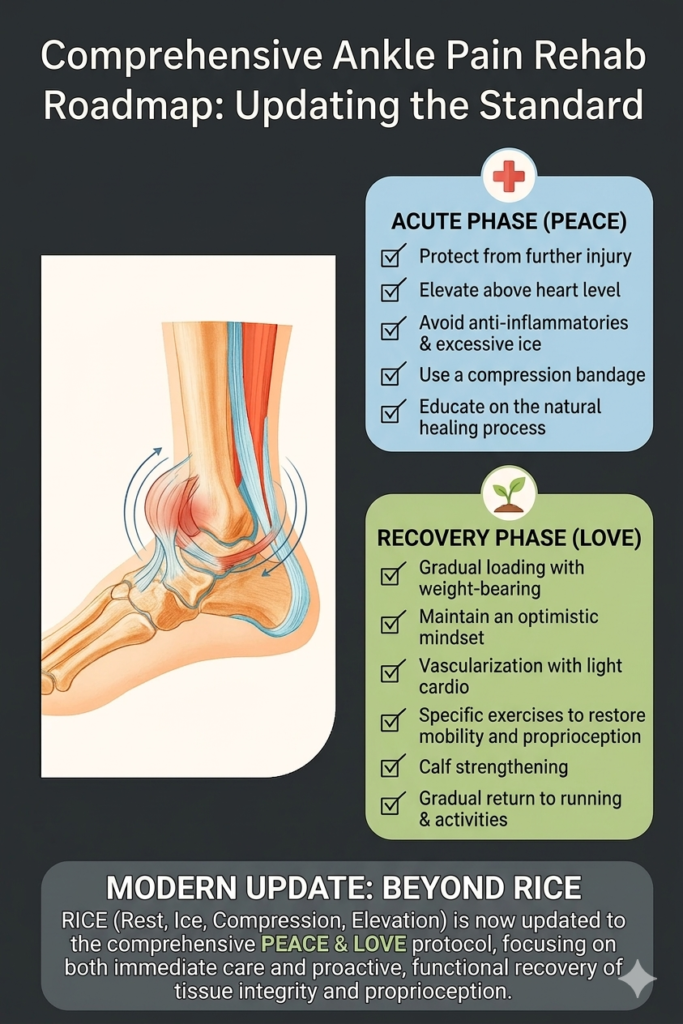
Ankle Pain Rehabilitation – From RICE to PEACE & LOVE
For decades, RICE (Rest, Ice, Compression, Elevation) was the undisputed gold standard. It focused primarily on “shutting down” the inflammatory response. While effective for immediate pain relief, many experts now believe that over-icing and total rest can actually delay long-term tissue repair by restricted blood flow and natural healing signals.
The sports medicine community has largely updated this to the PEACE & LOVE protocol, which offers a more comprehensive roadmap for both immediate care and long-term recovery:
PEACE (Immediate Care):
- Protect: Avoid activities that increase pain for the first few days.
- Elevate: Keep the limb higher than the heart.
- Avoid Anti-inflammatories: Natural inflammation helps tissue heal; don’t suppress it entirely with meds or excessive ice.
- Compress: Use bandages to reduce swelling.
- Educate: Listen to your body and avoid unnecessary passive treatments.
LOVE (Long-term Recovery):
- Load: Gradually add weight-bearing to strengthen the tissue.
- Optimism: Maintain a positive mindset (crucial for the nervous system).
- Vascularization: Choose pain-free aerobic activity to boost blood flow.
- Exercise: Restore mobility, strength, and proprioception through active movement.
By following this updated approach, you aren’t just “fixing” an injury; you are actively rehabilitating the structural integrity of your fascia and the communication of your nervous system to ensure a resilient return to your daily runs.
While many are familiar with the traditional RICE (Rest, Ice, Compression, Elevation) method, modern sports science has evolved. RICE was primarily designed to “shut down” inflammation. However, we now understand that inflammation is a vital part of the natural healing process. Over-icing or total immobilization can actually delay tissue repair and lead to fascial “gluing,” which restricts your range of motion as you age.
The updated PEACE & LOVE protocol offers a more holistic roadmap for the over-40 athlete. The PEACE phase (Protect, Elevate, Avoid anti-inflammatories/ice, Compress, Educate) handles the immediate acute injury, while the LOVE phase (Load, Optimism, Vascularization, Exercise) focuses on active recovery. By gradually Loading the joint and encouraging Vascularization through light activity, you ensure that the fascia remains hydrated and the nervous system stays sharp, leading to a much more resilient return to running.
Pro Tip: The Heel-Walk Self-Diagnostic
When dealing with an ankle sprain, the transition from rest to activity is the most critical phase. I’ve found that a simple “Heel-Walk” test serves as a reliable benchmark for readiness. By walking on your heels with your midfoot and toes lifted, you are engaging in a functional assessment of your ankle’s dorsiflexion and the integrity of the surrounding stabilizer muscles. If you can maintain this position for 10 steady steps without sharp pain or instability, it signals that your joint is regaining the necessary control for the demands of slow running.
However, this test isn’t just about the ankle; it’s about the entire kinetic chain. To pass this 10-step benchmark, I focused heavily on Calf and Ankle Strengthening. Your gastrocnemius and soleus act as the body’s natural shock absorbers, and rebuilding their capacity is what allows the “Body GPS” (proprioception) to function accurately again. Without this foundation, returning to the road can lead to compensatory movements that risk further injury.
Ankle Pain Can Be Avoided
Avoiding ankle pain is always a better option to healing and rehabilitation. Our ankles bear a lot of body weight throughout the day, whether you are playing or doing normal daily activities. If you are leading an active lifestyle, there are possibilities of ankle injuries, but we can do our best to prevent that from happening. Here are few good ways to go about it.
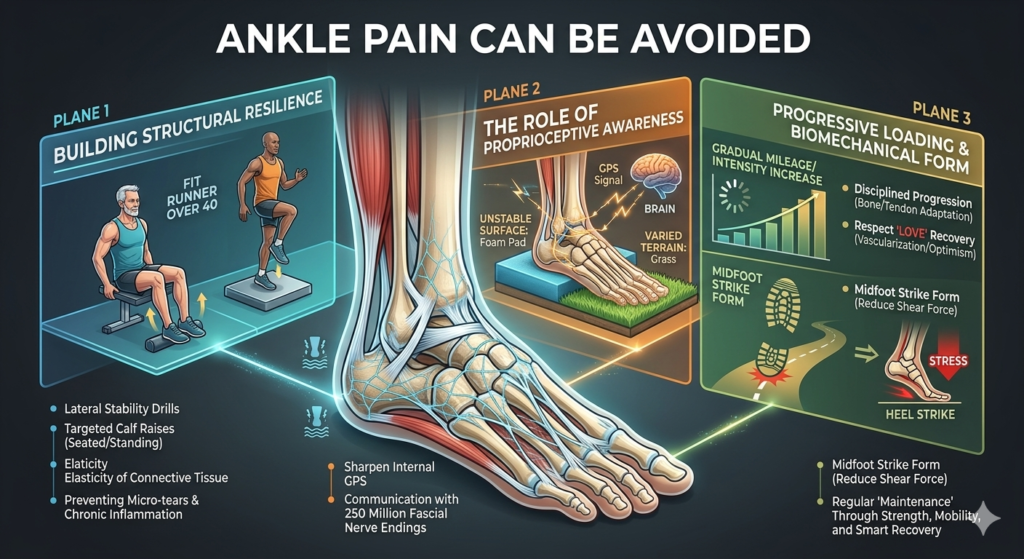
Building Structural Resilience
Avoiding ankle pain begins with moving beyond a “cardio-only” mindset and focusing on the structural resilience of the joint. For runners over 40, this means prioritizing the lateral stability of the ankle and the elasticity of the surrounding connective tissue. Incorporating single-leg balance drills and targeted calf raises—performing both seated and standing variations—ensures that the gastrocnemius and soleus muscles can effectively manage the repetitive impact forces of daily running. When these muscles are strong and the fascia is well-hydrated through varied movement, they act as a natural suspension system, preventing the micro-tears that lead to chronic inflammation.
The Role of Proprioceptive Awareness
Many ankle injuries occur not because of a lack of strength, but because of a “lag” in the body’s internal GPS – its proprioception. Enhancing your nervous system’s ability to sense joint position is your primary defense against unexpected slips or uneven terrain. By practicing stability exercises on different surfaces, such as grass or a foam pad, you sharpen the communication between your 250 million fascial nerve endings and your brain. This heightened awareness allows your body to make split-second micro-adjustments during a run, effectively “correcting” a potential sprain before it happens.
Progressive Loading and Recovery
Overtraining is the most common path to ankle pain, especially when the desire to maintain a daily streak outpaces the body’s rate of repair. Avoiding pain requires a disciplined approach to progressive loading; your mileage and intensity should increase gradually to allow both bone density and tendon thickness to adapt. Furthermore, respecting the “LOVE” phase of recovery even when you aren’t injured—prioritizing vascularization through light movement and maintaining an optimistic, patient mindset—ensures that minor tightness doesn’t evolve into a compensatory injury.
Biomechanical Alignment and Form
Finally, your attention to running form plays a critical role in ankle longevity. Focusing on a midfoot strike rather than a heavy heel strike can significantly reduce the sheer force placed on the ankle joint. When you treat your ankles as high-performance equipment that requires regular “maintenance” through strength, mobility, and smart recovery, you keep the “post-run ache” at bay. By addressing these biomechanical gaps, you ensure that you can enjoy your fitness journey well after 40 without the setback of preventable pain.
Final Thoughts: Resilience Over Perfection
While avoiding ankle pain through structural resilience and proprioceptive training is always the superior strategy, it is important to remember that the life of an active runner is rarely a straight line. Sometimes, despite our best efforts, disciplined routines, and focus on biomechanical form, injuries can still occur due to unpredictable terrain or sheer accumulated fatigue.
The defining characteristic of ankle pain, however, is that it is not a permanent roadblock. Because the ankle is such a highly sensory and adaptable joint, it is remarkably capable of being healed and rehabilitated when given the right stimulus. By transitioning from the immediate “PEACE” phase to the active “LOVE” phase of recovery, you can hydrate stiff fascia, recalibrate your nervous system’s internal GPS, and return to your daily runs with even greater joint intelligence than before.
Ultimately, your fitness journey after 40 isn’t about avoiding every single bump in the road; it’s about having the expert-led tools and the “Human Intelligence” to navigate those bumps when they happen. Stay proactive with your strengthening, listen to your body’s signals, and keep moving forward with confidence.