
⚠️ IMPORTANT MEDICAL & SAFETY DISCLAIMER
Read before applying any information in this blog category on exercise for special populations. The content provided under Adaptive Fitness is for educational and informational purposes only and does not constitute medical advice, diagnosis, or clinical treatment.
- Doctor Guidance Is Mandatory: All specific exercise variables, including allowable movements, resistance, repetition ranges, intensity levels, and training frequency, must be determined, cleared, and approved by your primary care physician or medical specialist.
- The Role of the CPT: A Certified Personal Trainer (CPT) does not diagnose conditions, prescribe medical interventions, or override clinical directives. The CPT’s role is strictly to conduct a baseline functional screening, evaluate your current movement capacity, and formulate a safe continuum plan that operates entirely within the boundaries set by your medical team.
Never disregard professional medical advice or delay seeking it because of something you have read on this website. If you experience pain, dizziness, palpitations, shortness of breath, or chest discomfort (Angina) during any physical activity, stop immediately and consult your physician.
Welcome to Adaptive Fitness: Bridging the Gap Between Medical Care and Physical Activity
If you are over 40 and living with an underlying chronic health condition, standard fitness advice that you often see online feels completely disconnected from your reality. Most generic workouts are built for uninjured bodies with zero medical friction.
When you are managing chronic ailments like hypertension, joint degeneration, type 2 diabetes, or an autoimmune condition, you need a fundamentally different strategy for exercise. “Just pushing through it” isn’t just bad advice – it is outright dangerous. Exercise for special populations cannot follow a cookie-cutter workout plan: it must be personalized based on a thorough physiological assessment and physical screening.
Fitness after 40 isn’t about setting personal records or chasing the body you had in your twenties. It is about improving everyday function, building longevity, and preserving independence. Most importantly, your training must adapt to where your body is today, so it becomes a safe, sustainable part of your lifestyle.
The Reality of Exercise for Special Populations
Asking someone managing ongoing health challenges to simply “get active” isn’t as straightforward as tying up running shoes and hitting the pavement. Exercise introduces complex physiological variables that demand careful, professional adaptation:
- Absolute & Relative Contraindications: Clinical signs, such as unstable angina, unmanaged hypertension, acute inflammatory flare-ups, or severe joint damage. are strict red flags where standard exercise can be unsafe. Identifying these limits ensures movement is halted or adapted before harm occurs.
- Extreme Fatigue & Autonomic Conditions: Managing Chronic Fatigue Syndrome (CFS/ME), Long COVID, or Fibromyalgia means traditional exertion can trigger severe symptom flares or Post-Exertional Malaise (PEM). Movement must be strictly paced within safe energy envelopes—often starting with gentle floor mobility or restorative breathing rather than conventional workouts.
- Metabolic Syndrome & Blood Sugar Dysregulation: Managing insulin resistance, type 2 diabetes, or elevated blood pressure means exercise timing, fueling, and intensity must be calibrated to prevent sudden hypoglycemic events or dangerous blood pressure spikes.
- Gut Health & Digestive Conditions: Living with IBS, inflammatory bowel disease (IBD), or chronic gut inflammation requires exercise that respects the digestive system. High-stress, high-intensity workouts can trigger systemic flare-ups or GI distress, whereas low-to-moderate adaptive movement promotes healthy motility without overtaxing the body.
- Medication Interactions: Certain medications, such as beta-blockers for blood pressure, blunt natural heart rate responses, while insulin timing drastically affects energy levels and safety during glucose fluctuations.
- Joint & Connective Tissue Vulnerability: Degenerative joints and aging connective tissues take longer to recover, requiring precise load management to avoid inflammation and overuse injuries.
- Fluctuating Daily Capacity: Managing a chronic condition means physical capacity changes day to day. A safe plan must be flexible enough to accommodate low-energy days without guilt, burnout, or injury.
Ignoring these variables leads to injury, aggravated symptoms, and eventual abandonment of exercise altogether.
The Health Continuum: Physician and CPT Collaboration
Safe physical activity shouldn’t exist in a vacuum separate from your medical treatment. When structuring exercise for special populations, the goal of Adaptive Fitness is to establish a seamless continuum plan where medical monitoring and physical training work together.
Your Physician / Specialist
- Diagnoses medical conditions and underlying pathologies
- Prescribes safe clinical parameters & clearance
- Identifies medical contraindications & red flags
- Sets maximum heart rate caps and joint load limits
- Dictates approved vs. restricted movement types
- Ongoing Medical Review & CPT Collaboration:
- Monitors physiological markers & lab work over time
- Reviews CPT progress reports & movement data
- Adjusts clinical prescriptions based on report card feedback
- Maintains active communication with trainer on care plans
Your Certified Personal Trainer (CPT)
- Does NOT diagnose physiological conditions or medical issues
- Conducts Baseline Screenings:
- Structural balance & postural symmetry
- Sub-maximal VO₂ / aerobic capacity estimation
- Ventilatory thresholds (VT1 & VT2 talk testing)
- Flexibility & dynamic range of motion (ROM)
- Functional mobility & balance assessments
- Translates medical guardrails into specific exercises
- Tracks training metrics to generate CPT progress report cards
- Communicates adaptation metrics to physician for clinical review
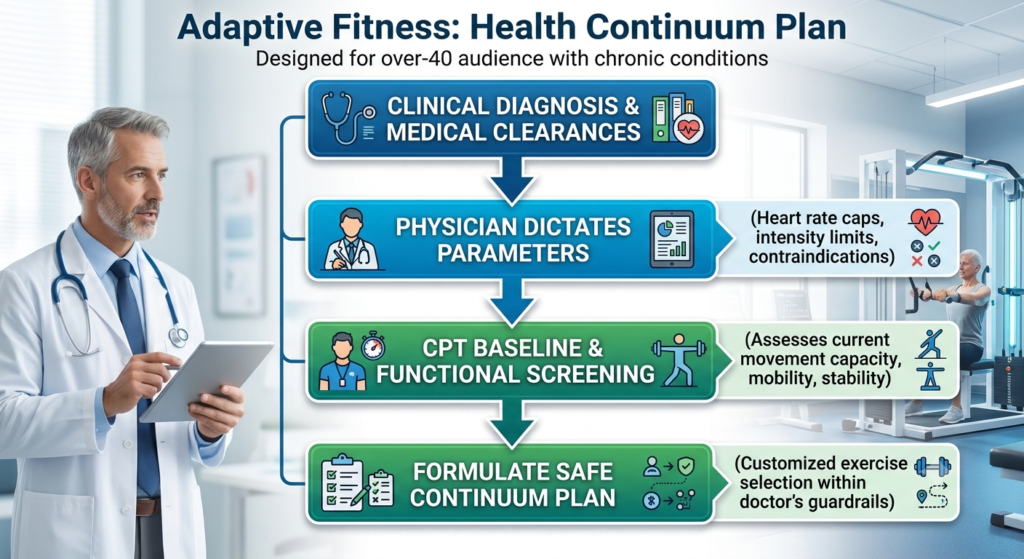
- The Doctor Sets the Guardrails: Your physician defines what is clinically safe based on your diagnostic history, lab work, and medications.
- The CPT Assesses the Baseline: The trainer screens your current functional movement to see how your body handles basic loading, balance, and range of motion.
- Building the Continuum: The CPT takes your doctor’s rules and builds a structured, step-by-step program. They modify exercise selection, volume, loads, frequency, and rest periods so you progress safely while remaining firmly within prescribed medical boundaries.
What You Will Find in This Blog Category
When someone over 40 receives a health diagnosis, whether it is hypertension, joint degeneration, or Chronic Fatigue Syndrome, their immediate question is often: “How do I keep moving without hurting myself?”
Generic advice usually tells you to “ask your doctor,” but standard clinical appointments rarely come with a customized workout plan. On the other end of the spectrum are clinical medical journals that are far too dense, abstract, and technical for everyone to understand and implement.
Adaptive Fitness blog category on this website bridges that exact gap. We translate complex clinical research and medical guidelines into layman’s terms so you can make proactive, informed decisions. Our goal is to provide a clear, actionable plan that is both safe and sustainable.
We translate complex clinical research and medical guidelines into layman’s terms so you can make proactive, informed decisions. Every guide written on exercise for special populations under Adaptive Fitness category in this blog adheres to three non-negotiable principles:
- Safety First: Modifying exercises to protect compromised joints and respect cardiovascular boundaries.
- Consistency Over Intensity: Small, frequent doses of manageable movement always win over sporadic, exhaustive efforts.
- Individual Progression: Everyone starts from a different baseline. Progress is measured by functional gains and physiological safety, not arbitrary benchmarks.
Physical movement does not replace medical care – it supplements it to build resilience and longevity. With proper clinical guidance and a smart approach to exercise for special populations, movement remains one of the most effective tools you have to protect your health, independence, and quality of life.
We will dive deep into recent research to build evidence-based content for anyone eager to move, but unsure how to start safely.
Upcoming Guides on Exercise for Special Populations
Stay tuned as we continue adding evidence-based post-by-post breakdowns on diverse health conditions and practical ways to manage them. Bookmark this category as we continue adding evidence-based post-by-post breakdowns on diverse health conditions and practical ways to manage them. Remember: the purpose is never to break records, but to help you move better and feel stronger than yesterday.
If there is a specific health condition you would like us to explore, don’t hesitate to write to us. We will dig deep into the clinical research to bring you actionable, safe guidance.
For – Brands | Businesses | Coaches
If your brand or website needs top-quality blog content or end-to-end blog management, chat with me today. I create content with the same clarity, science-backed storytelling, and motivational rhythm you just read.
I offer blog management and content writing services across diverse sectors, whether your niche is fitness and health (my favorite), technology, lifestyle, or business – I specialize in turning topic ideas into engaging, SEO-optimized blog posts that your readers will trust and love.
Let’s build your business authority online with content that delivers both value and results.
 Chat With Nady on WhatsApp
✍️ Explore Our Blog Writing Services
Chat With Nady on WhatsApp
✍️ Explore Our Blog Writing Services