

The 17-Year Running Streak: A Journey Beyond Fitness
I have maintained a consistent running habit, six days a week, for more than 17 years now. When I look back at the person I was before this streak began, I realize that running has fundamentally restructured my identity. Frankly, it no longer feels like “exercise” or a “workout” that requires a push of willpower to start. It has transcended the mechanics of fitness to become a non-negotiable pillar of my daily existence. I don’t run because I have to. I run because it is the absolute best part of my day, every day.
To the casual observer, long-distance running can appear monotonous, repetitive, or even tedious. From the outside, it lacks the high-speed thrill of contact sports or the variety of a gym circuit. But for those who have found their rhythm, the experience is internal and profound. We don’t see repetitive miles; we see the nuance of the stride, the meditative flow of easy breathing, and the mental clarity that only comes through sustained physical effort.
Is Running After 40 Sustainable?
This is a question I often encounter. People ask me of it is actually realistic to make running a permanent part of a life journey after 40. The answer is a resounding yes, but with one caveat: you must listen to your body.
Unless you are managing a specific long-term condition where a medical professional has strictly prohibited impact activities, running is entirely accessible. Even for those with physical limitations, working with a physiotherapist to adapt their movement can open doors to high-level health. For the vast majority of people entering midlife, running is a sustainable, high-performance activity that can be carried forward well into your 60s, 70s, and beyond.
Navigating the Midlife Biological Shift
While the door to running is open, we must be honest about the fact that the 40+ body operates on a different “biological budget” than it did at 20. To run safely and avoid the “thin content” traps of generic advice, we must address the specific physiological changes that occur as we age:
- Combatting Sarcopenia: This natural, age-related decline in muscle mass begins to accelerate after 40. For a runner, this means that “just running” isn’t enough. We must integrate strength training to ensure our muscles act as effective shock absorbers for our joints.
- Addressing Fascia Dehydration: Our connective tissue network (fascia) naturally loses moisture and elasticity over time. This “stiffening” is often what people mistake for natural fitness-decline with old age, but with proper fascia training through proper hydration and dynamic mobility work that “re-wets” these tissues, it can be managed.
- Recalibrating Proprioception: Our “body GPS” or the neurological connection that tells us where our limbs are in space, often dims as we age. This increases the risk of trips and falls. Running on varied terrain, such as trails or beaches, helps sharpen these sensors and improves overall balance and proprioception after 40.
- Managing Joint and Tissue Tightness: Years of postural habits or sedentary desk work can lead to tightened hip flexors and ankles. Entering a run with “cold,” tight joints is a recipe for injury.
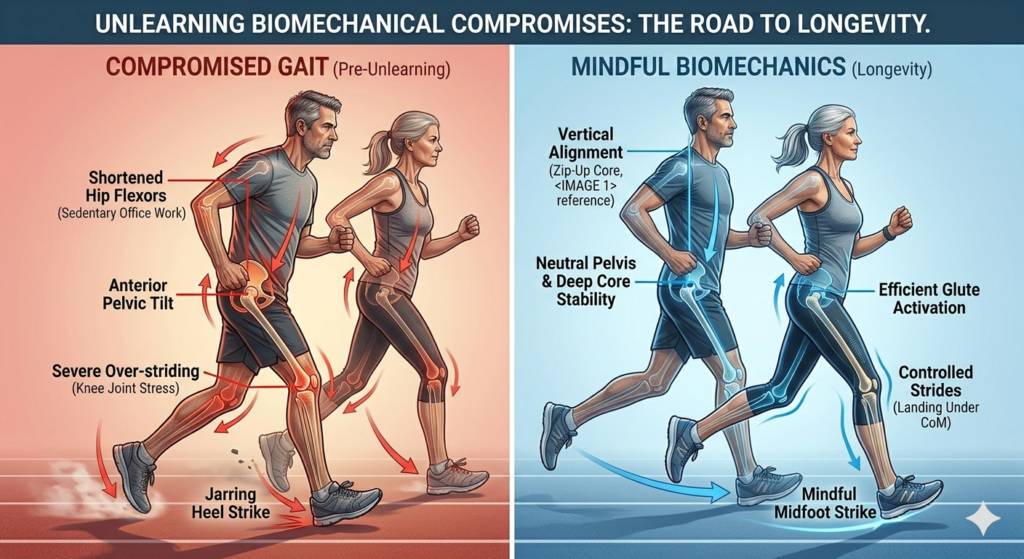
Because of these factors, you cannot simply lace up and sprint or go long distance. You have to understand the biomechanics of longevity. It requires unlearning old habits and adopting a smarter, more mindful approach to how your feet hit the ground. I calls for a total behavior change, where you will have to unlearn some of the biomechanical compromises you picked along the way.
The Art of Unlearning: Embracing the Biomechanics of Longevity
Because of these physiological shifts, the “just do it” mantra can be dangerous for a runner over 40. You cannot simply lace up a new pair of shoes and expect to sprint or tackle long distances without a transition period. Instead, you must adopt what I call the Biomechanics of Longevity. This approach is less about raw speed and more about structural integrity and mindful movement.
Transitioning to running in midlife requires a total behavioral shift. It calls for the “unlearning” of decades-old habits and the biomechanical compromises you’ve likely picked up along the way. Most of us don’t realize that our bodies have spent years compensating for sedentary office work, old sports injuries, or even poor posture.
Common Biomechanical Compromises to Address:
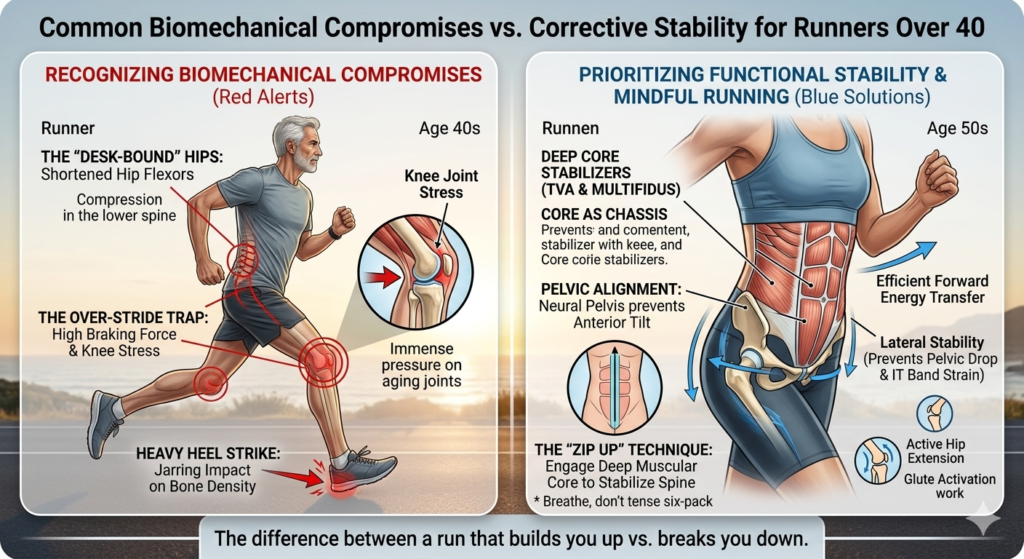
- The “Desk-Bound” Hips: Years of sitting often lead to shortened hip flexors. If you start running with “locked” hips, your lower back takes the brunt of the impact. Unlearning this requires active hip extension and glute activation work before you even hit the pavement.
- The Over-Stride Trap: Many beginners try to run faster by reaching their front foot out too far. In your 40s, this “braking force” puts immense stress on the knee joints. We must learn to keep our feet landing underneath our center of mass to utilize the body’s natural shock absorbers.
- The Heavy Heel Strike: While heel striking isn’t inherently “bad,” a heavy, jarring landing can be brutal on aging bone density. Mindful running teaches you to seek a lighter, quieter footfall, often transitioning toward a midfoot strike that engages the arch of the foot.
The “Silent” Core: Your Natural Shock Absorber
We often mistakenly think of running as an activity powered purely by the legs. In reality, your legs are simply the wheels; your core is the chassis. A “silent” or weak core leads to excessive lateral swaying and pelvic “drop,” which are the primary culprits behind IT band syndrome, lower back strain, and hip impingement.
When I talk about core strength for the 40+ runner, I am not talking about chasing “six-pack abs” for the sake of aesthetics. In fact, superficial abdominal strength is often less important than the activation of your deep stabilizer muscles, such as the Transverse Abdominis (TVA) and the Multifidus.
Why deep core stability is integral to your form
- Pelvic Alignment: A strong core keeps your pelvis neutral, preventing the “anterior pelvic tilt” that puts immense pressure on the lumbar spine during the flight phase of a stride.
- Energy Transfer: A stable trunk ensures that the energy generated by your legs is directed forward, rather than being “leaked” through side-to-side wobbling.
- The “Zip Up” Technique: Learning to “zip up” your core; meaning engaging that deep layer of muscle as if pulling a zipper from your pubic bone to your navel, It provides the internal pressure your spine needs to handle the repetitive loading of long-distance running.
You don’t need a grueling gym routine to achieve this. You simply need to prioritize functional stability. By preparing these stabilizer muscles, you ensure that your form remains crisp even when fatigue sets in during the final miles of your run. This is the difference between a run that builds you up and a run that breaks you down.
The Mindful Approach to Running Impact
Adopting a smarter approach means listening to the “feedback” your body provides. In my 17-year journey, I’ve learned that a “niggle” at age 50 is a communication from your nervous system, not a challenge to your willpower.
To unlearn these compromises, you must become a student of your own gait. This might mean starting with shorter, more frequent “form-focused” runs rather than chasing mileage. By focusing on how your feet hit the ground and how your posture holds up under fatigue, you aren’t just running- you are rebuilding your body’s mechanical foundation for the next several decades.
Your Running Questions: Answered with 17 Years of Experience
When you are starting out, your mind often races faster than your feet. You have practical, everyday questions that don’t necessarily require a deep dive into biomechanics. Here is the “straight talk” on running after 40 without getting too much into its technical aspects.
What is the “Right” age to start running?
Many 40 plus people ask me: “Am I too old to start?” My answer is always the same: The best age to start running is today. While it is true that younger runners have more natural elasticity, people have successfully started their running journeys in their 60s, 70s, and even 80s. I personally started at 36, and now at 52, I am running stronger and more mindfully than I did in my 30s. Age is not a barrier; but you must take it slow in the starting stages to give your body enough time to adapt running. This is important if you have been leading a sedentary life in most of your 30s. Don’t wait for a “perfect” day
How do I actually take the first step to start running?
Getting started doesn’t require a massive financial investment or a complex training manual.
- The Gear: All you truly need is a good pair of running shoes. If you are lucky enough to live near a beach, you might even explore barefoot running on the soft sand to start.
- The Accessories: Eventually, you might want a GPS watch or moisture-wicking gear to organize and track your performance, but for Day One? Just the shoes will do.
- The Approach: Don’t feel pressured to “run” the whole time. The Run-Walk method is the gold standard for those over 40. Alternating between two minutes of jogging and one minute of walking allows your heart rate to stabilize and your tendons to adapt to the new stress.
How do I balance running with a busy social life?
Incorporating fitness into your lifestyle after 40 requires a delicate balance of “The Big Three”: Workouts, Nutrition, and Rest.
To maintain a 6-day-a-week streak, I’ve had to make small, conscious sacrifices. Sometimes that means saying “no” to a late-night party or a social obligation that would compromise my sleep. However, you shouldn’t become a hermit. Your psychological state is vital to your health. If you deny yourself every social joy, your fitness routine will eventually feel like a prison. Find the balance where running fuels your life, rather than draining it.
Is the pain normal?
Let’s be honest: there will be discomfort. You are pushing your body to perform better, and your muscles will respond with soreness (often called DOMS). However, there is a massive difference between “Growth Pain” and “Injury Pain”:
- Growth Pain: A dull ache in the muscles that fades after a good night’s sleep or a light walk.
- Injury Pain: A sharp, localized, or persistent pain in a joint or bone.
Nothing feels better than a fit, capable body in your 50s. It’s an asset you can’t buy online; it’s earned through those moments of pushing through the “good” pain to reach the results on the other side.
Don’t Let the “Someday” Trap Win
Let’s be honest: The biggest obstacle isn’t your knees, your schedule, or your age. It’s the quiet voice of self-doubt that tells you your best physical years are behind you. We spend our 40s and 50s taking care of everyone else – our careers, our families, our obligations – while we let our own vitality sit on the shelf. We tell ourselves we’ll start “someday” by telling ourselves that when the stress settles down or the timing is perfect. But that “someday” is always elusive. It’s a comfortable excuse that keeps you from discovering what your body is actually capable of achieving right now.
The truth is, your body doesn’t come with an expiration date; it comes with a “use it or lose it” policy. When I ask, “Are you up for the challenge?” I’m not asking if you can run a marathon tomorrow. I’m asking if you have the grit to face your own excuses and lace up your shoes anyway. I’m asking if you’re willing to trade the comfort of the couch for the hard-earned clarity that only comes after a few miles.

Claim Your Next Chapter
Fitness after 40 isn’t just about weight loss or heart health – it’s about defiance. It’s a declaration that you aren’t done growing, evolving, or pushing your limits. It is an asset that no one can hand to you and no one can take away. You’ve spent decades building your life; now it’s time to build the body that allows you to enjoy your success to the fullest.
So, stop over-analyzing the biomechanics and stop waiting for the perfect weather. The road is waiting, and the “Live Fitness Laboratory” of your life starts with a single stride. The question isn’t whether you can do it – it’s whether you’re brave enough to begin.
Are you in?
For – Brands | Businesses | Coaches
If your brand or website needs top-quality blog content or end-to-end blog management, chat with me today. I create content with the same clarity, science-backed storytelling, and motivational rhythm you just read.
I offer blog management and content writing services across diverse sectors, whether your niche is fitness and health (my favorite), technology, lifestyle, or business – I specialize in turning topic ideas into engaging, SEO-optimized blog posts that your readers will trust and love.
Let’s build your business authority online with content that delivers both value and results.
 Chat With Nady on WhatsApp
✍️ Explore Our Blog Writing Services
Chat With Nady on WhatsApp
✍️ Explore Our Blog Writing Services