
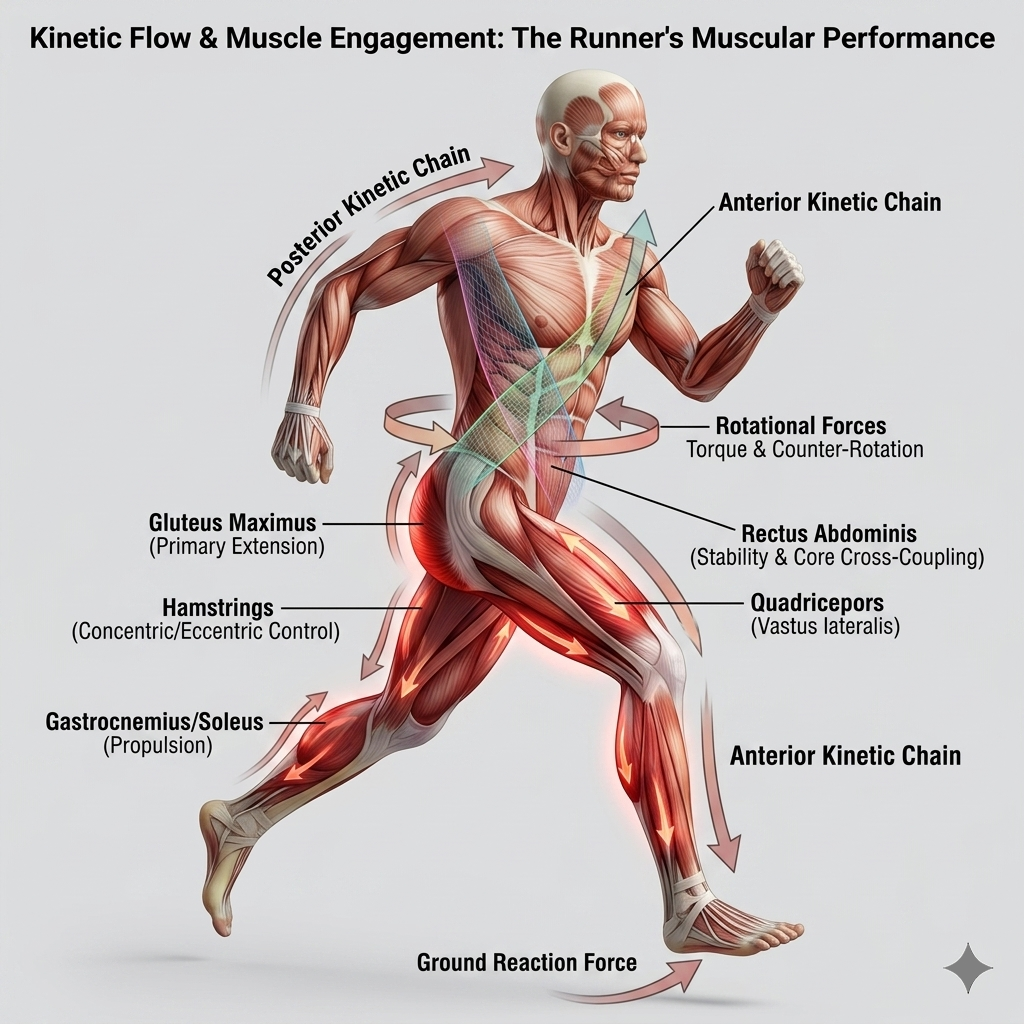
- Lower Body Running Muscles – The Foundation of Every Stride
- Core Running Muscles – Stability, Rotation, and Energy Flow
- The Abs – Rectus Abdominis and Obliques -Rotation, Stability, and Energy Transfer
- Lower Back – Erector Spinae & Multifidus for Alignment and Rotational Control
- Hip Flexors – Iliopsoas & Tensor Fasciae Latae for Lift and Rotational Flow
- Transverse Abdominis & Pelvic Floor – Deep Stability and Injury Prevention
- Upper Body Running Muscles – Rhythm, Balance, and Efficiency
- Supporting Running Muscles and Their Role
- Impact of running form on muscle engagement
- Nady’s Take: Checkpoints for Efficient Running Form
- 🏃♂️ Running Muscle Activation: Sprinting vs. Long‑Distance
- Running Muscles – Conclusion
- Nady's Take
Running isn’t just about strong legs pounding the pavement – it’s a full‑body symphony of muscles working together to create efficiency, rhythm, and flow. Every stride you take is powered by a chain of coordinated movements: your legs drive propulsion, your core stabilizes, your hips and glutes channel rotational forces, and even your shoulders and arms contribute to balance and momentum. When these muscle groups fire in harmony, you unlock what sports scientists call kinetic flow – the seamless transfer of energy across your body that makes running feel lighter, smoother, and more sustainable.
This is especially important for runners over 40. At this stage, muscle imbalances and age‑related strength loss can disrupt that flow, leading to wasted energy, slower recovery, and higher injury risk. Training your entire body, and not just your legs, – restores efficiency and keeps you moving with power and resilience. If you’ve ever wondered why some runners seem to glide effortlessly while others struggle with stiffness or fatigue, the answer lies in how well their muscles coordinate across the body’s diagonal “power slings.”
I’ve explained these concepts in detail – including the kinetic flow and rotational forces of running, and the diagonal power cross of posterior and anterior slings, in my blog post ‘Start Running After 40 – It’s Never Too Late to Begin’. Think of this current guide as the practical follow‑up: here we’ll break down the specific muscles you must train, why they matter, and how they work together to transform running from a leg‑driven workout into a total‑body performance practice.
Lower Body Running Muscles – The Foundation of Every Stride
Your lower body is the engine of running. Every step you take depends on a coordinated effort between the quadriceps, hamstrings, glutes, and calves. These muscles don’t just move you forward; they absorb shock, stabilize your joints, and keep your stride balanced and efficient.
When trained properly, they act like a finely tuned suspension system: quads cushion knee impact, hamstrings generate speed, glutes stabilize the pelvis, and calves provide explosive push‑off power. Together, they create the kinetic flow that makes running feel smooth and sustainable.
For runners over 40, lower‑body strength becomes even more important. Age‑related muscle loss can weaken this foundation, leading to slower recovery and higher injury risk. By deliberately training these muscle groups, you not only improve running performance but also protect your knees, hips, and Achilles tendon for long‑term resilience.
Quadriceps – Power and Shock Absorption
Your quadriceps (the four muscles at the front of your thigh) are the engines of knee extension and forward motion. They activate as your foot pushes off the ground, lifting and extending your leg for both sprinting and endurance running. Beyond propulsion, quads act as natural shock absorbers, reducing stress on the knees during impact.
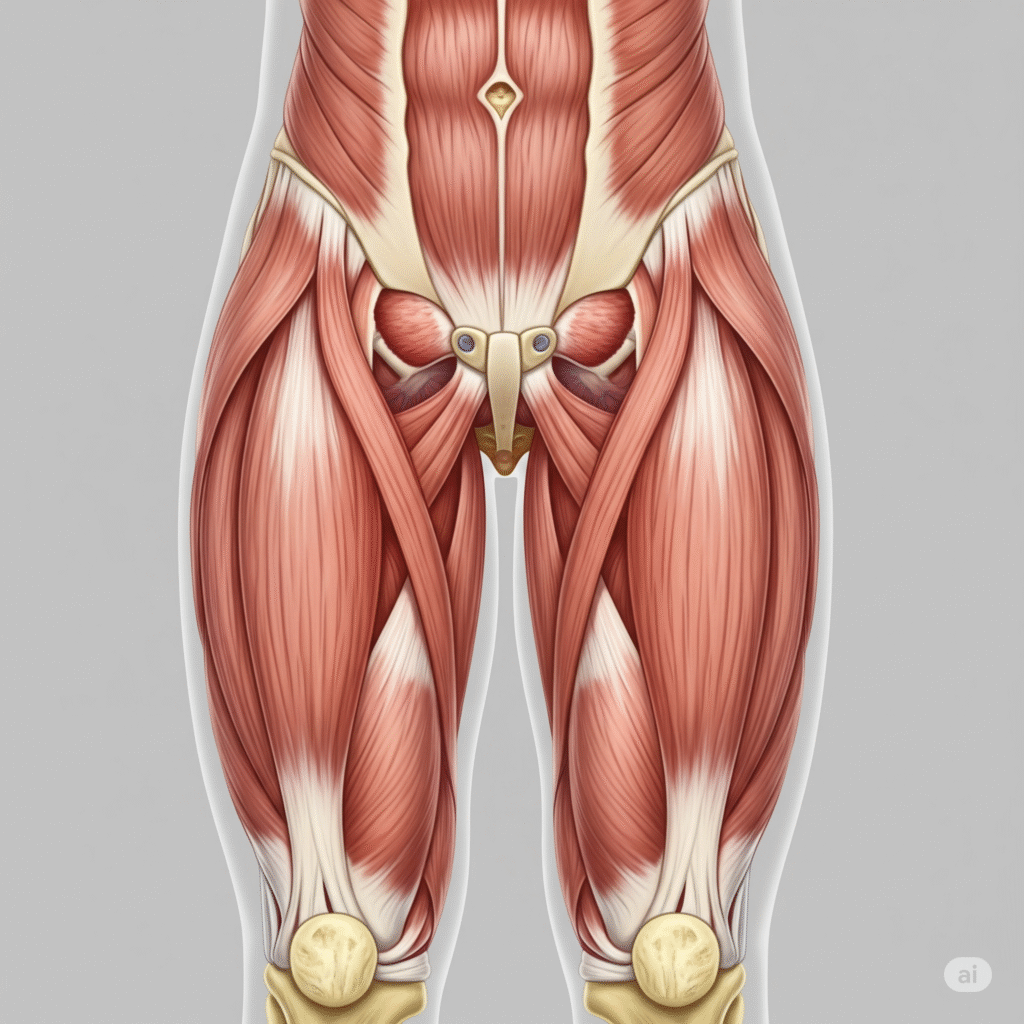
Quick Tip: Strengthen your quads with squats and lunges to improve running efficiency and protect your knees, especially if you’re running after 40.
Hamstrings – Speed, Power, and Injury Prevention
Your hamstrings, located at the back of the thigh, act as the counterbalance to the quadriceps. They drive hip extension and knee flexion, allowing your foot to push back against the ground after each strike. During the stride phase, strong hamstrings generate the force that builds speed and maintains running rhythm.
Weak or tight hamstrings, however, are one of the most common causes of running injuries. Without adequate strength and flexibility, they struggle to absorb impact and can easily strain under repetitive load. For runners over 40, this risk is even higher due to natural muscle elasticity loss. Focused training is essential to keep them resilient and efficient.
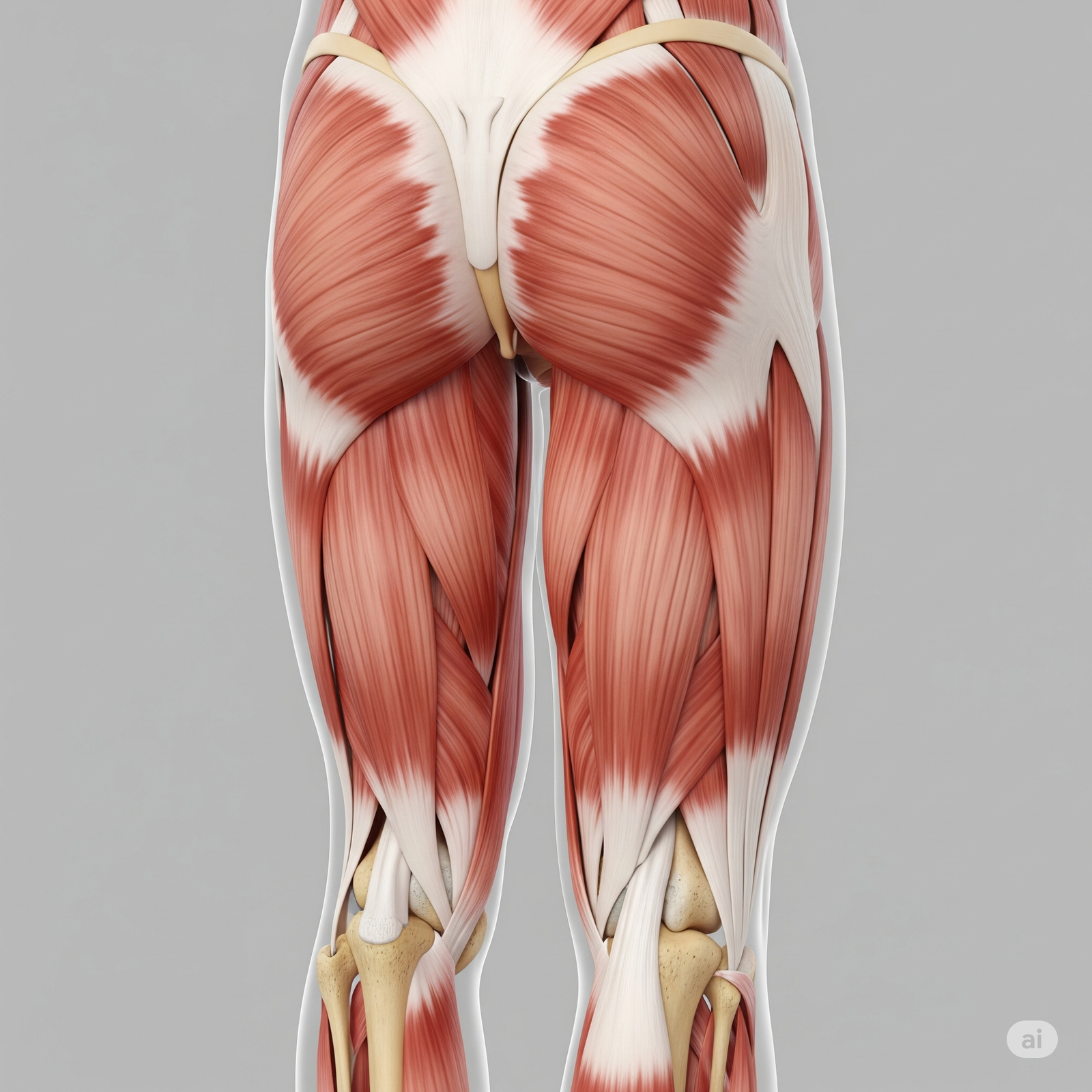
Quick Tip: Add Romanian deadlifts, single‑leg bridges, and dynamic hamstring stretches to your weekly routine. These exercises improve both strength and flexibility, helping you run faster while reducing the risk of strains.
Glutes – Pelvic Stability and Forward Drive
Your glutes (the maximus, medius, and minimus) are the powerhouse muscles that propel you forward with every stride. They generate the pressing forces needed for forward motion while stabilizing the pelvis, ensuring balance and efficient energy transfer across the body. Strong glutes don’t just improve running speed and endurance; they also protect against common issues like runner’s knee and IT band syndrome.
For runners over 40, glute strength becomes even more critical. Age‑related muscle loss can weaken pelvic stability, leading to inefficient stride mechanics and increased injury risk. Targeted glute training restores balance, keeps your hips aligned, and helps you maintain smooth kinetic flow.
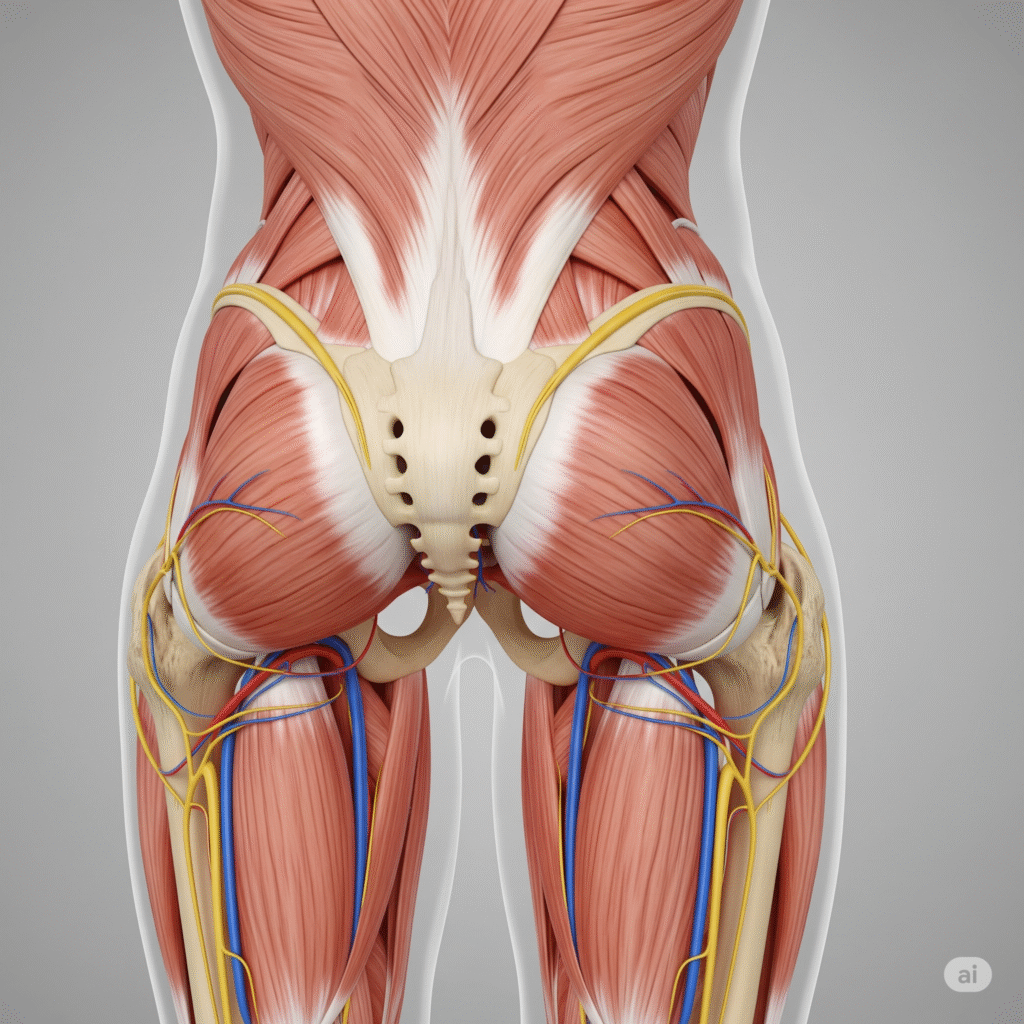
Quick Tip: Add single‑leg squats, hip thrusts, and lateral band walks to your weekly routine. These exercises build glute strength, improve pelvic stability, and reduce the risk of knee and hip injuries.
Calves – Push‑Off Power and Endurance
Your calves (the gastrocnemius and soleus) are the unsung heroes of running. The gastrocnemius, the visible muscle at the back of your lower leg, fuels explosive push‑off power during sprints and uphill climbs. Beneath it, the soleus provides endurance and stability, helping you maintain posture and balance over long distances.
Together, these muscles absorb impact forces with every stride and protect the Achilles tendon from excessive stress. Without strong calves, runners often experience fatigue, reduced stride efficiency, or even Achilles injuries. For runners over 40, calf strength is especially important, as tendon elasticity naturally declines with age.
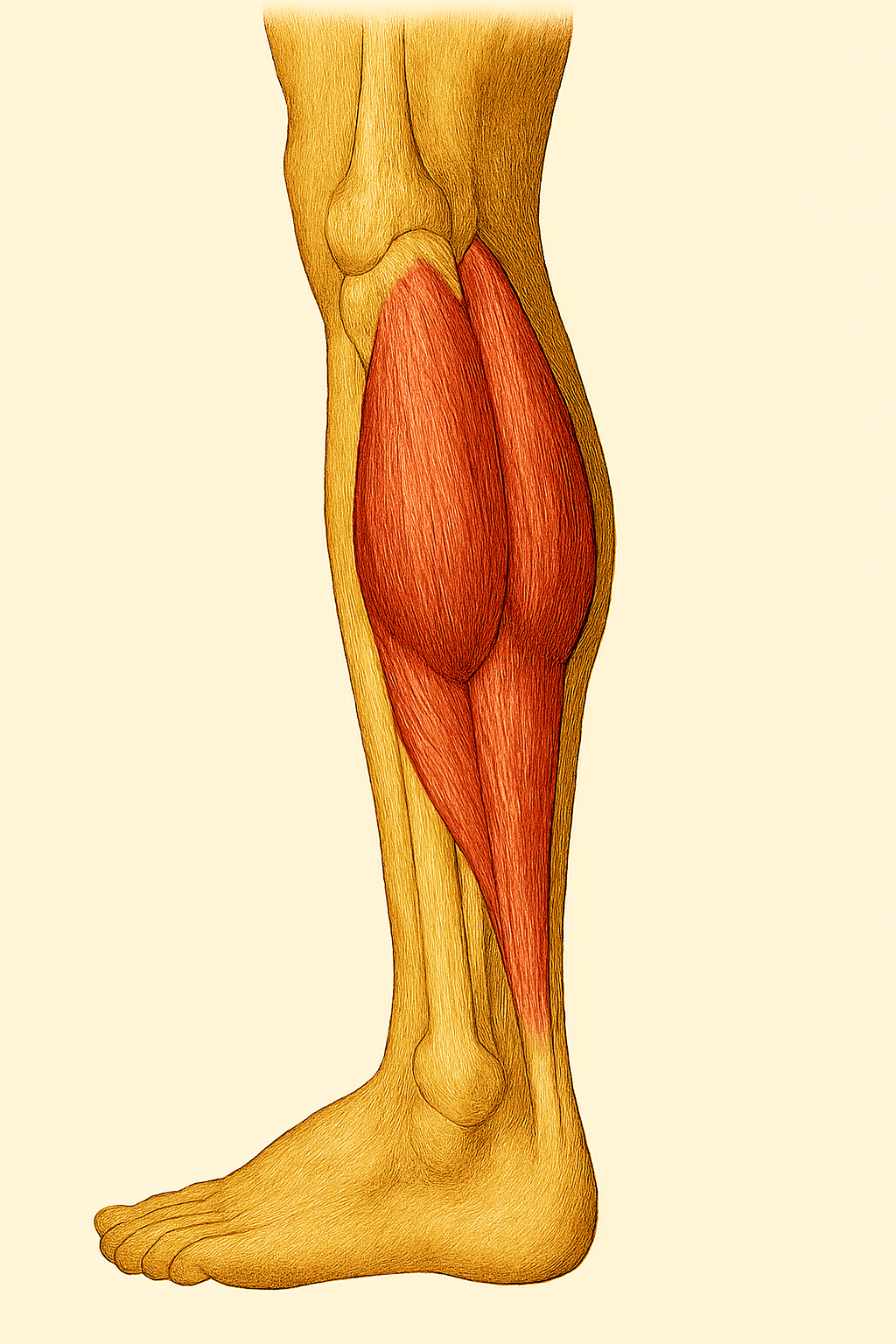
Quick Tip: Strengthen your calves with standing calf raises, seated calf raises, and jump rope drills. These exercises build both explosive power and endurance, keeping your push‑off strong and your Achilles tendon resilient.
Core Running Muscles – Stability, Rotation, and Energy Flow
Your core isn’t just about holding good posture – it’s the engine that stabilizes your stride and channels rotational forces through the body. Every time your leg drives forward, your core muscles transfer energy diagonally across the torso, linking the opposite shoulder and hip. This rotational power is what keeps your stride smooth, balanced, and efficient.
Strong core muscles prevent wasted energy by keeping the pelvis stable, reducing excessive twisting, and ensuring that your arms and legs move in harmony. Without this central control, running becomes inefficient and injury risk rises. For runners over 40, training the core is especially important: age‑related changes in spinal stability and muscle elasticity can weaken rotational flow, making the body more vulnerable to imbalances.
Think of your core as the “control tower” of your run. It stabilizes, rotates, and directs energy so that every stride feels lighter and more connected. With a resilient core, you don’t just run straighter; you run smarter, tapping into the diagonal power slings that make kinetic flow possible.
The Abs – Rectus Abdominis and Obliques -Rotation, Stability, and Energy Transfer
Your rectus abdominis (the familiar “six‑pack” muscles) and the obliques along sides of your trunk do far more than keep your torso upright. Together, they act as the body’s rotational engine, preventing sideways collapse while channeling diagonal forces across the torso. Every stride involves a subtle twist: as one leg drives forward, the opposite shoulder rotates back. This diagonal sling system relies on the rectus abdominis and obliques to transfer energy smoothly between the upper and lower body.
Strong abdominal and oblique muscles ensure that rotational forces are harnessed efficiently rather than wasted through poor alignment. They stabilize the pelvis, protect the spine, and allow your arms and legs to move in harmony. For runners over 40, training these muscles is especially important, because age‑related declines in core elasticity can weaken rotational flow, leading to inefficient movement and higher injury risk.
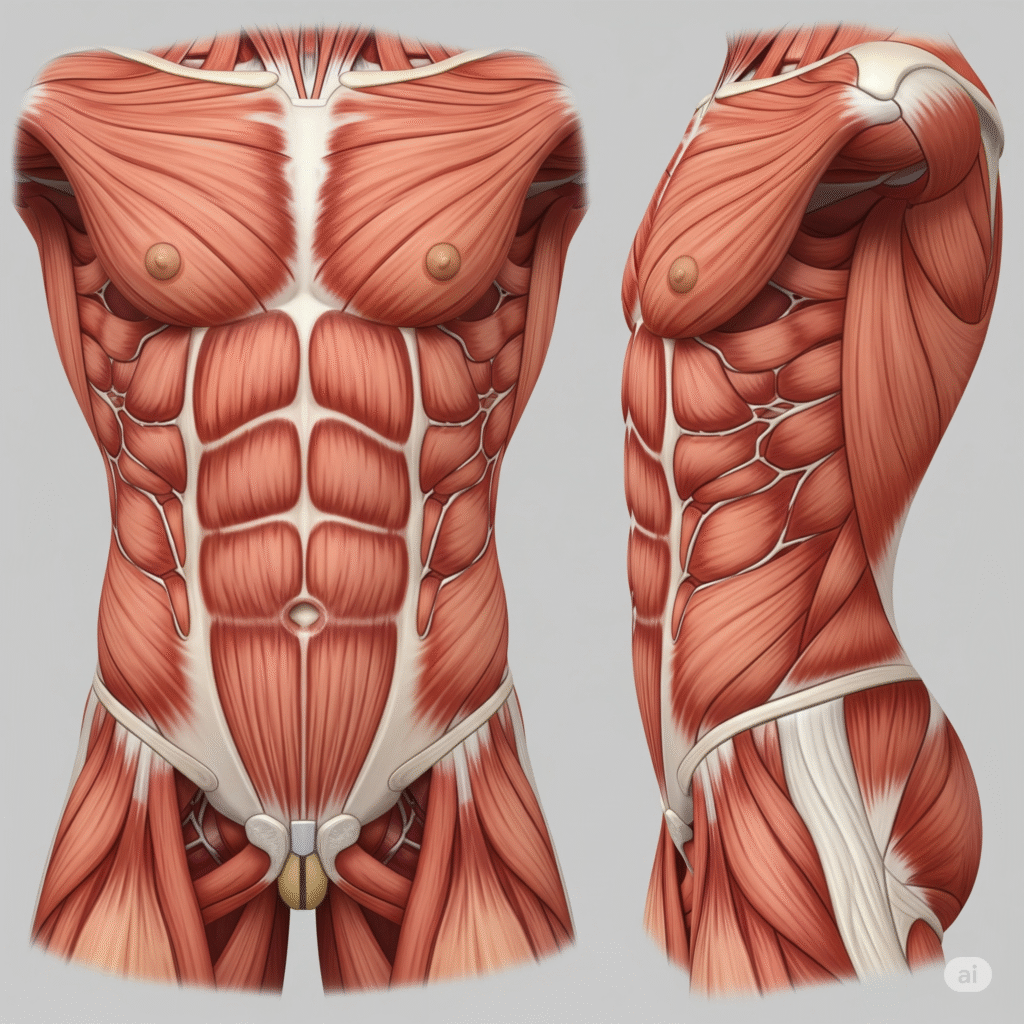
Quick Tip: Incorporate planks, side planks, and Russian twists into your weekly routine. These exercises strengthen both stability and rotational power, helping you maintain balance and kinetic flow with every stride.
Lower Back – Erector Spinae & Multifidus for Alignment and Rotational Control
The erector spinae and multifidus muscles form the stabilizing framework of your spine. Together, they keep your back aligned, prevent excessive forward‑backward sway, and control subtle rotational forces that occur with every stride. These deep stabilizers act like the body’s “shock absorbers and steering cables,” ensuring that energy flows smoothly through the torso without wasted motion.
When the lower back is weak, posture collapses, stride efficiency drops, and back pain often follows, especially during long runs. For runners over 40, strengthening these muscles is critical, as age‑related changes in spinal stability can magnify imbalances and increase injury risk. A resilient lower back not only supports endurance but also enhances rotational flow, keeping your stride powerful and controlled.
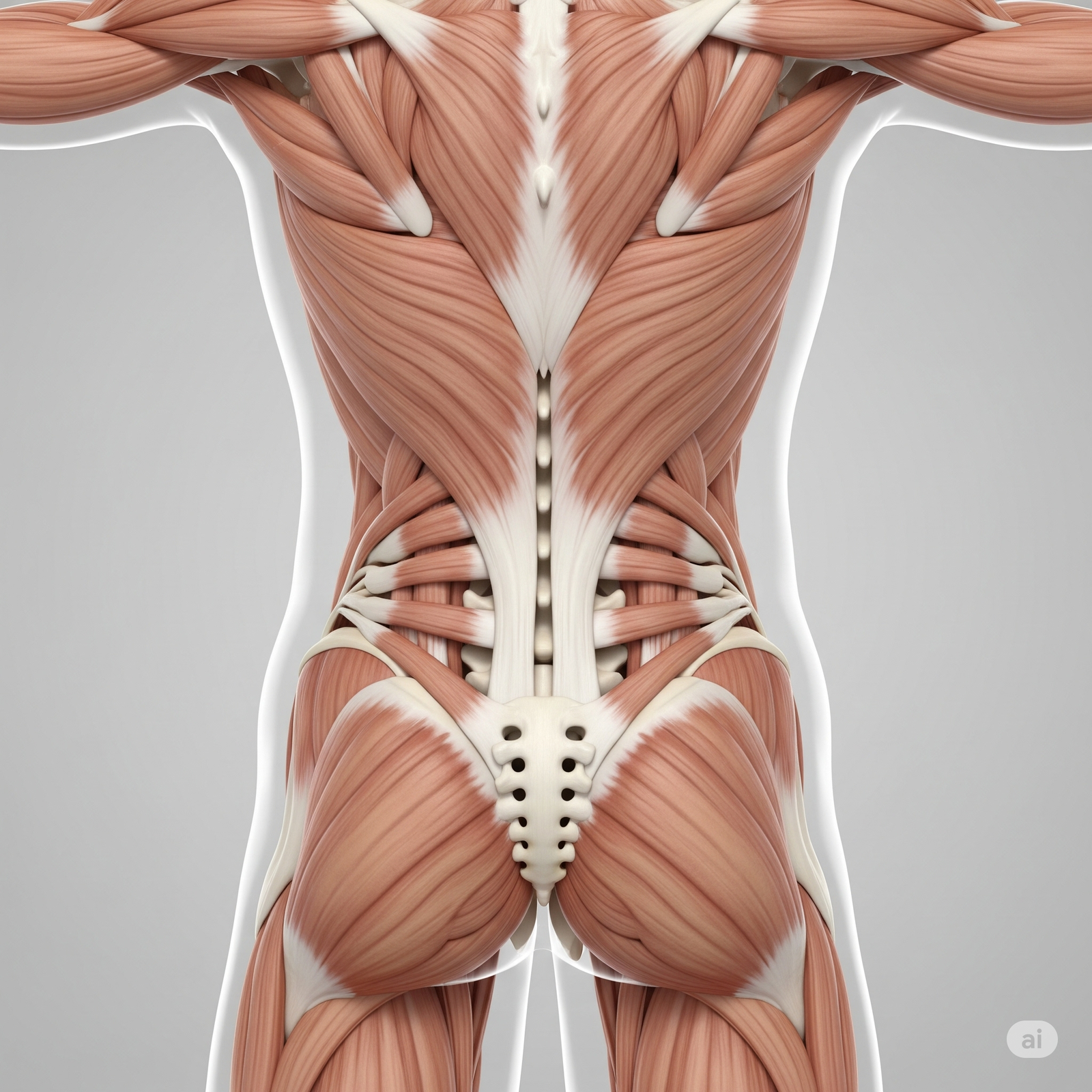
Quick Tip: Add bird‑dogs, supermans, and back extension drills to your weekly workout routine. These exercises strengthen spinal stabilizers, improve posture, and protect against fatigue during long‑distance runs.
Hip Flexors – Iliopsoas & Tensor Fasciae Latae for Lift and Rotational Flow
Your hip flexors, primarily the iliopsoas and the tensor fasciae latae (TFL), are the muscles that lift your knees and drive leg movement forward. They work hardest during explosive actions like sprinting or running uphill, where powerful knee lift is essential. Beyond propulsion, hip flexors also contribute to rotational control, helping your pelvis and torso stay aligned as energy transfers diagonally across the body.
When these muscles become tight from repetitive running or prolonged sitting, hip mobility decreases, stride length shortens, and rotational flow is disrupted. This not only reduces efficiency but also increases the risk of hip and lower‑back injuries. For runners over 40, maintaining hip flexor strength and flexibility is critical to preserving stride mechanics and preventing imbalances.
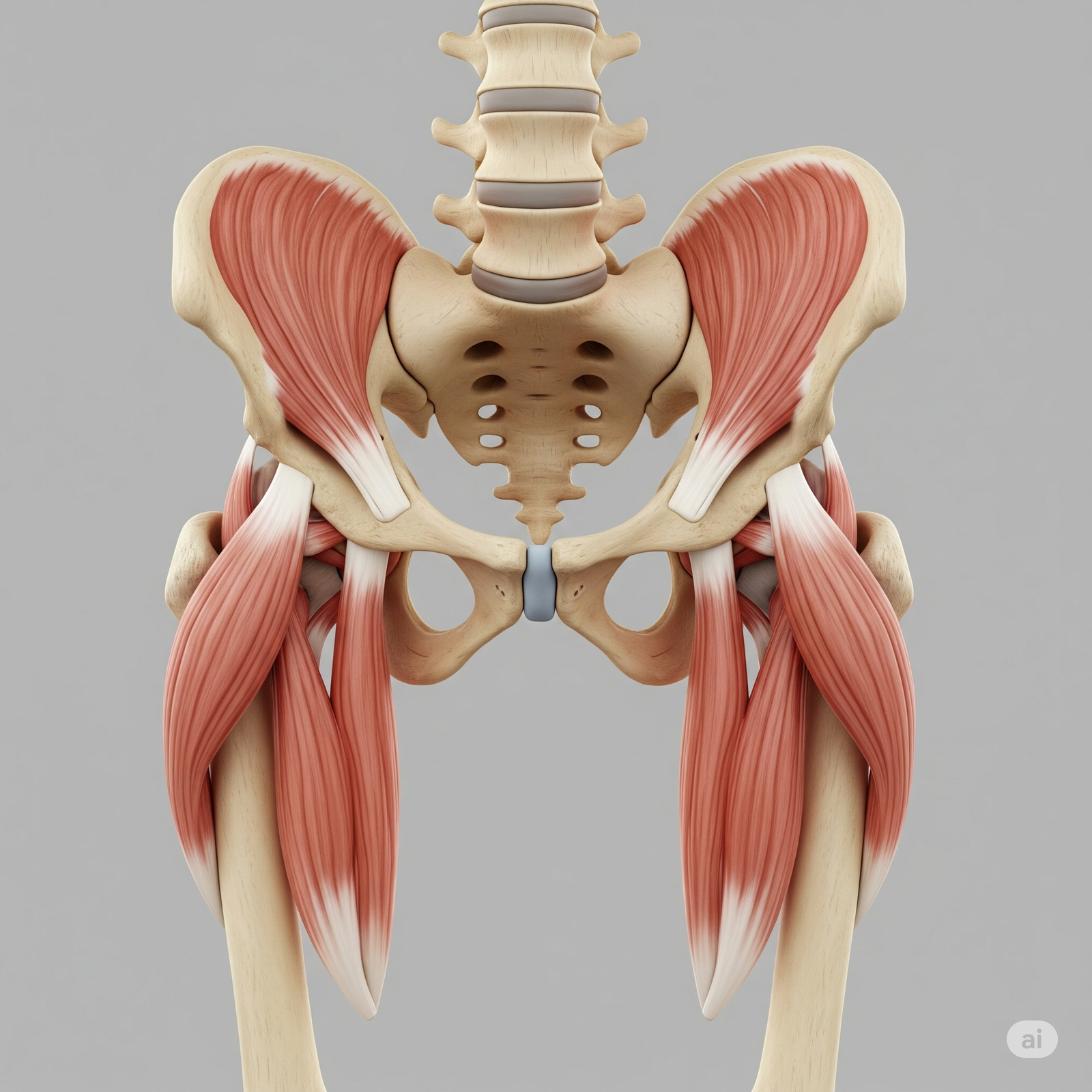
Quick Tip: Add dynamic lunges, high‑knee drills, and hip flexor stretches to your weekly routine. These exercises improve mobility, restore rotational flow, and keep your stride powerful on both flat and uphill terrain.
Transverse Abdominis & Pelvic Floor – Deep Stability and Injury Prevention
Beneath the visible abs lies the transverse abdominis, a deep core muscle that acts like a natural weight belt. It stabilizes the spine and pelvis, preventing excessive rotation and protecting against energy leaks during running. Alongside it, the pelvic floor muscles provide foundational support, helping maintain posture and balance while absorbing impact forces.
These deep stabilizers are often overlooked, yet they are critical for long‑distance efficiency and injury prevention. Weakness here can lead to poor alignment, lower‑back strain, or even hip instability. For runners over 40, training the transverse abdominis and pelvic floor is especially important, as age‑related changes in core control can magnify imbalances.
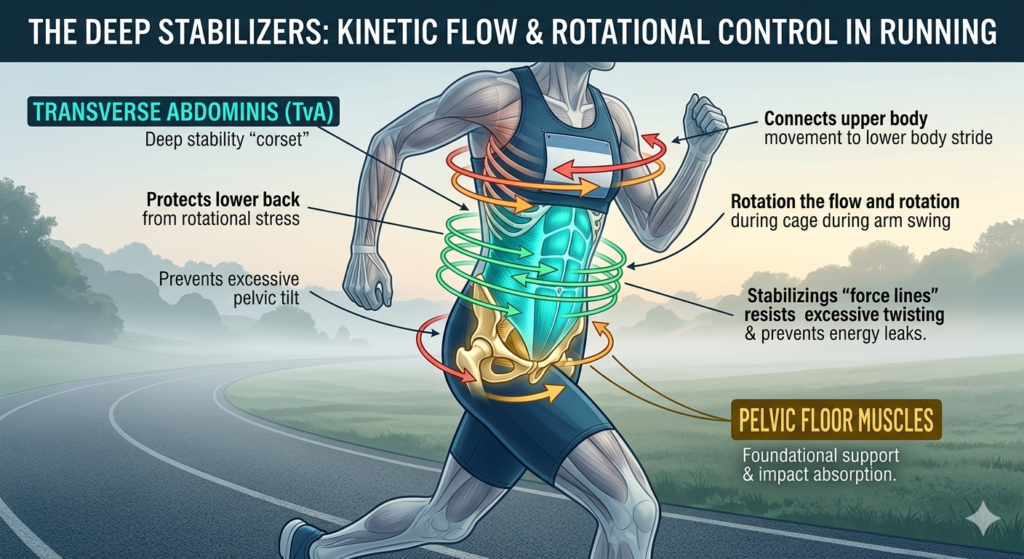
Quick Tip: Incorporate dead bugs, hollow holds, and pelvic floor activation drills into your routine. These exercises build deep stability, protect your spine, and keep your stride smooth and controlled.
Upper Body Running Muscles – Rhythm, Balance, and Efficiency
When we think of running, the spotlight usually falls on the legs. We don’t really notice the job done by the core and upper body while running because their movements don’t seem as aggressive as the legs in action. Yet your upper body plays a crucial supporting role, quietly shaping the rhythm, balance, and technical efficiency. The arms, shoulders, chest, and upper back act as stabilizers and counterweights, ensuring that each stride flows smoothly and that rotational forces are harnessed rather than wasted.
Every arm swing is more than a casual motion – it’s a precise counterbalance to the opposite leg, helping maintain forward momentum and reducing unnecessary torso rotation. Strong shoulders and back muscles keep posture upright, while the chest and arms contribute to breathing rhythm and endurance. Your shoulder blades glide smoothly to initiate and transfer kinetic flow, coordinating with the core to keep energy moving efficiently through the body. Together, these muscles act like a metronome, setting the cadence for your stride and preventing energy leaks.
For runners over 40, upper‑body strength becomes even more vital. Age‑related muscle loss can weaken posture and rhythm, leading to fatigue or imbalance during long runs. By deliberately training these muscles, you not only improve running economy but also protect your spine, enhance breathing efficiency, and sustain resilience mile after mile.
Arms – Deltoids, Biceps & Triceps for Rhythm and Balance
Your arms do far more than swing casually at your sides – they are active stabilizers that balance the powerful movements of your legs. Each arm swing counteracts the opposite leg, keeping your stride smooth and preventing excessive torso rotation.
The deltoids drive the arm swing, providing rhythm and momentum. The biceps and triceps maintain proper arm positioning, ensuring stability and endurance even during long runs. Together, these muscles act like dynamic levers, helping you conserve energy while sustaining speed.
Strong upper‑body mechanics through the arms are especially important for sprinting and uphill running, where explosive rhythm and balance can make the difference between fatigue and flow. This coordinated action also removes pressure from the knees while running uphill, redistributing force through the upper body instead of letting the lower joints absorb it all. Even endurance or long‑distance runners must use their arms efficiently to eliminate power leaks, though not as aggressively as sprinters or uphill runners. For runners over 40, maintaining arm strength supports posture, breathing rhythm, and overall efficiency, reducing the risk of imbalance or wasted motion.
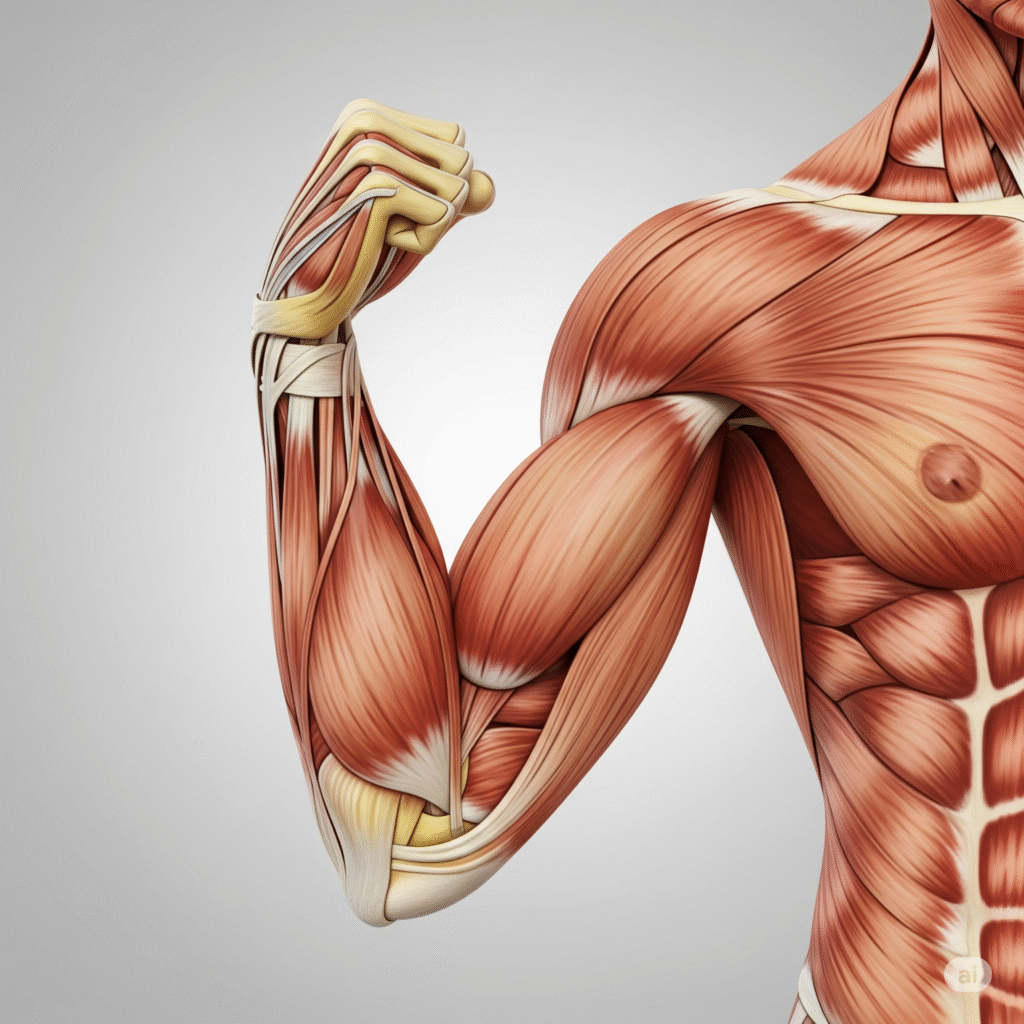
Quick Tip: Incorporate push‑ups, resistance band curls, and triceps dips into your weekly routine. These exercises build strength and endurance in the arms, enhancing both rhythm and speed during runs.
Shoulders & Chest – Pectorals & Trapezius for Posture and Rotational Flow
Your shoulders and chest muscles are constantly engaged while running, even though they don’t demand as much energy as the legs. The pectorals and trapezius work together to keep posture upright, preventing excessive slouching that can restrict breathing and waste energy. Proper posture maximizes lung capacity, reduces fatigue, and helps you sustain rhythm over long distances.
Beyond posture, the shoulders play a vital role in rotational efficiency. As your arms swing, the shoulder blades glide smoothly, initiating and transferring force across the torso in an X‑shaped diagonal pattern – right shoulder to left hip, left shoulder to right hip. This diagonal sling system balances rotational forces, stabilizes the neck, and ensures that energy flows efficiently between the upper and lower body.
For runners over 40, maintaining strong shoulders and chest muscles is essential. Age‑related weakness in these areas can lead to slouching, reduced breathing efficiency, and greater strain on the spine. By strengthening the pectorals and trapezius, you not only improve posture but also enhance rotational control and protect against neck and upper‑back fatigue.
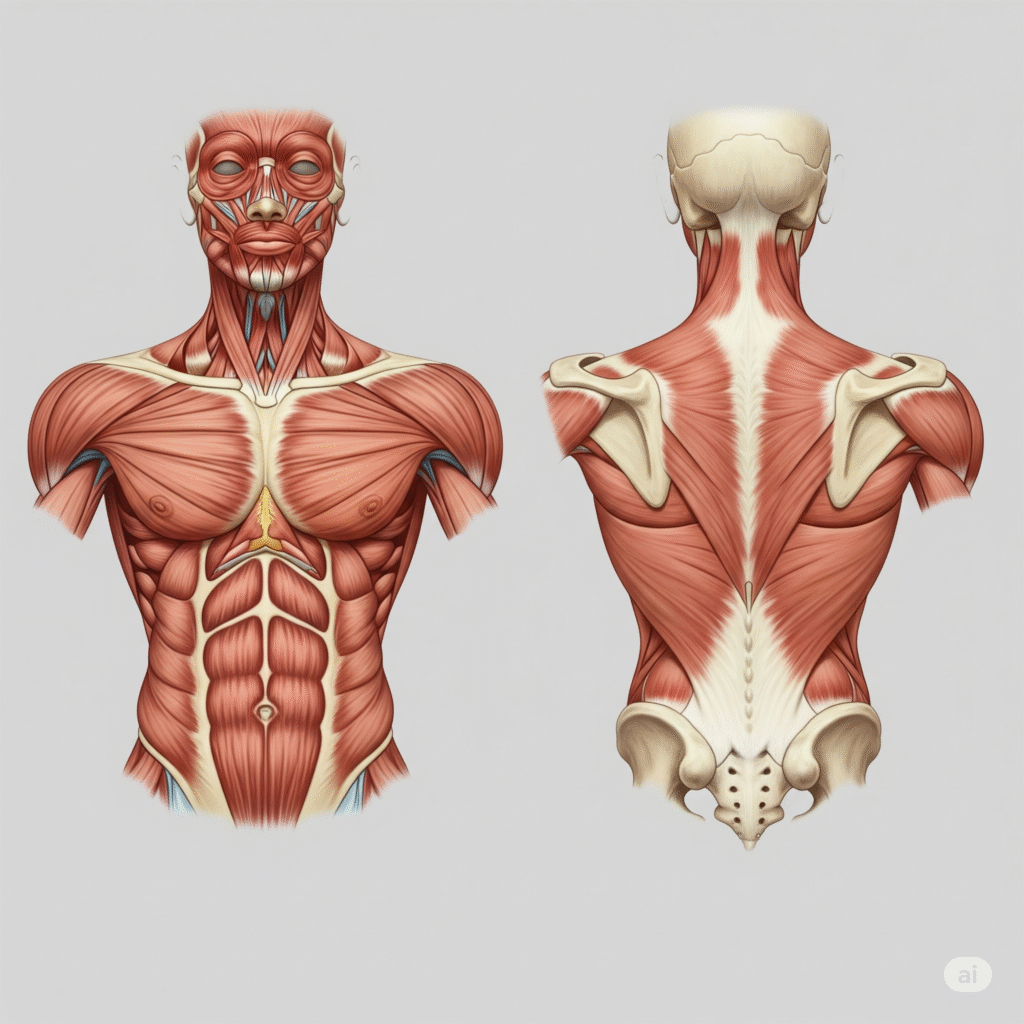
Quick Tip: Add rows, chest presses, and scapular retraction drills to your weekly routine. These exercises strengthen the shoulders and chest, improve posture, and train the shoulder blades to glide efficiently for better rotational flow.
Upper Back – Latissimus Dorsi & Rhomboids for Posture and Rotational Strength
The upper back muscles, primarily the latissimus dorsi and rhomboids, are essential for maintaining upright posture and coordinating rotational flow during running. The lats act as powerful stabilizers, linking the shoulders to the pelvis and helping transfer force diagonally across the body. The rhomboids, positioned between the shoulder blades, keep the scapulae retracted and stable, preventing slouching and ensuring smooth arm swings.
Together, these muscles form the “bridge” between the upper and lower body. They support efficient breathing by keeping the chest open, reduce wasted motion by stabilizing the shoulder blades, and enhance rotational control through the diagonal sling system. This X‑shaped transfer of force (right lat to left hip, left lat to right hip) is what keeps your stride balanced and energy flowing without leaks.
For runners over 40, strengthening the upper back is critical. Weak lats or rhomboids can lead to rounded shoulders, restricted lung capacity, and neck strain. A strong upper back not only improves posture but also protects against fatigue and enhances endurance during long runs.
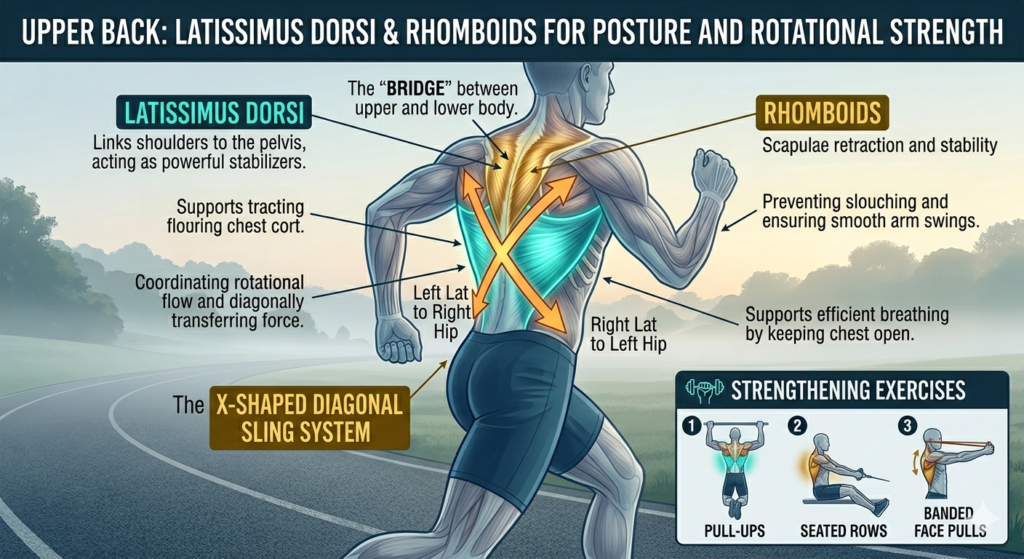
Quick Tip: Add pull‑ups, seated rows, and banded face pulls to your weekly routine. These exercises strengthen the lats and rhomboids, improve scapular stability, and keep your upper back resilient for efficient running mechanics.
Supporting Running Muscles and Their Role
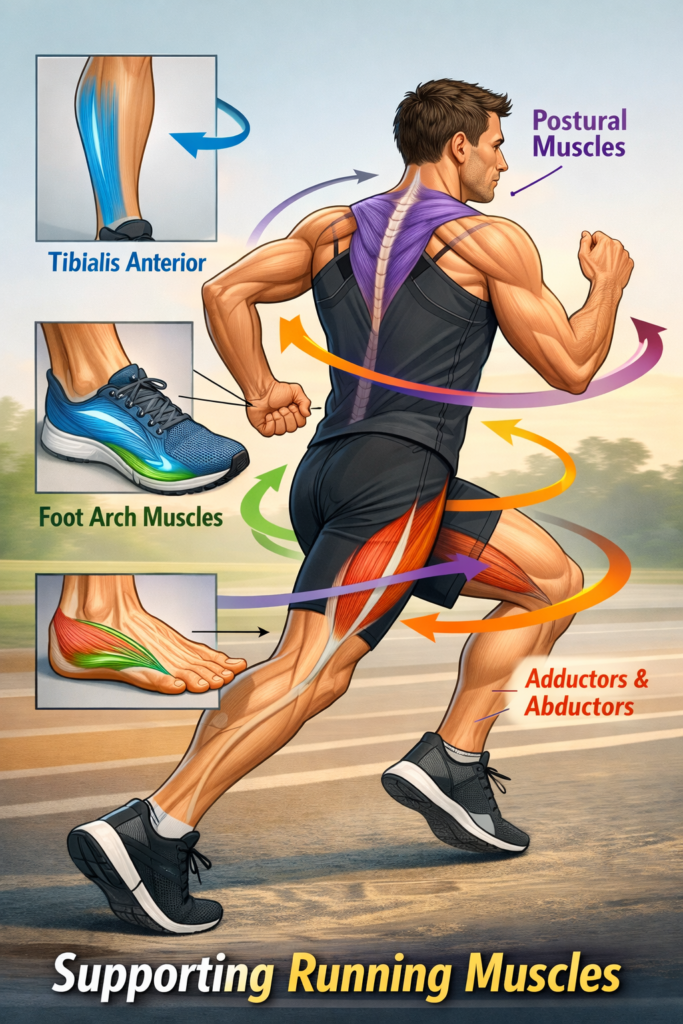
Several smaller muscles act as stabilizers, holding the end range of motion and syncing with the bigger muscles of the legs, core, and upper body. They prevent injuries, maintain balance, and fine‑tune alignment during dynamic movements. While they don’t generate explosive power, they are the unsung heroes of running efficiency.
Stabilizers & Small Muscles
Many runners overlook the essential stabilizing muscle groups that control movement and minimize impact on larger muscles:
- Tibialis Anterior – Located at the front of the shin, it controls dorsiflexion and stabilizes the ankle during foot strike. Weakness here often leads to shin splints.
- Foot Arch Muscles – The intrinsic foot muscles stabilize the arch and absorb shock. Dysfunction can cause overpronation or supination, leading to knee and hip issues.
- Adductors & Abductors – Found inside and outside the thighs, they stabilize side‑to‑side motion. Weakness here can cause joint instability and contribute to IT band syndrome.
Quick Tip: Strengthen your stabilizers with simple, targeted drills.
- Tibialis Anterior: Try heel walks or resisted dorsiflexion with a band to build shin strength and prevent splints.
- Foot Arch Muscles: Practice short‑foot exercises (lifting the arch without curling toes) and barefoot balance drills to improve shock absorption.
- Adductors & Abductors: Side‑lying leg lifts, banded lateral walks, clamshells, and Copenhagen planks enhance thigh stability and protect against IT band issues.
Postural Control
Running demands whole‑body coordination. Strong postural muscles resist gravity, maintain upright form, and reduce wasted energy. Efficient posture not only prevents fatigue but also protects against repetitive strain injuries.
- Neuromuscular Coordination – Continuous running trains the nervous system to coordinate muscle groups more efficiently. Correct form builds muscle memory, improving stride economy.
- Endurance in Supportive Muscles – Stabilizers must contract repeatedly over long distances. Their endurance prevents imbalances and fatigue‑related injuries, keeping the body aligned mile after mile.
Quick Tip: To improve postural control, incorporate planks, bird‑dogs, and wall angels to reinforce upright posture and scapular stability.
Impact of running form on muscle engagement
Your running form is a mirror of how well your muscles engage. When something feels awkward or inefficient in your stride, it often signals that certain muscle groups aren’t activating at the right time. Proper engagement creates harmony, where each muscle contributes just enough force, then releases as the next group takes over.
Learning to engage the right muscles with precise timing transforms your form from effortful to efficient. You should never feel continuous tension from the same muscle group throughout your stride; instead, power should flow rhythmically from one region to another – legs, core, and upper body working in sequence.
Efficient form isn’t just about aesthetics; it’s about energy economy. When your muscles fire in sync, you reduce strain, improve endurance, and maintain better posture even under fatigue.
Quick Tip: Record short clips of your running form or use a mirror during treadmill sessions. Look for signs of imbalances like excessive or absent shoulder rotation, uneven arm swing, excessive forward or backward tilt, hip dipping when the opposite foot strikes, or heavy foot landings. These clues reveal which muscle groups need better activation or mobility work.
Nady’s Take: Checkpoints for Efficient Running Form
Your running form depends on how well you coordinate stride, foot strike, push‑off, knee drive, trunk rotation, shoulder blade glide, and arm movement. These checkpoints help you stay efficient, reduce injury risk, and maintain biomechanical balance:
Stride Length
Keep it natural and sustainable. Over‑striding places excessive stress on the knees and can lead to pain or damage. This doesn’t mean you can’t land with your foot ahead of your body – it means avoid striking too far forward with a straight knee and locked heel. Some coaches and influencers suggest increasing cadence while shortening stride length, while others recommend longer strides to reduce the total number of impacts.
From my 17 years of running six days a week, I’ve found that stride length should adapt to the dynamics of your running surface, the type of run you’re doing that day, and the timing of your full stride cycle. You must adjust stride length dynamically when navigating uneven terrain, slopes, or turns. Your body architecture will differ from others, so you’ll need to figure out the right length as you keep running. One practical cue: listen to the sound of your shoes. It gives you a good idea of how far you can safely stretch your legs without creating braking forces.
Foot Strike
Foot strike patterns will vary, but awareness of which muscle groups are firing helps you maintain efficiency and avoid overload.
- Heel strike: Primarily loads the quadriceps because the knee is extended and the quads absorb the braking forces.
- Midfoot strike: Engages the glutes and calves more with some contribution from hamstrings, because the hip extends and the ankle plantar flexes to push off.
- Forefoot strike: Strongly activates the calves (gastrocnemius and soleus) and also recruits the hamstrings and glutes for propulsion.
I am predominantly a mid‑foot striker, but I use a little bit of heel strike when running downhill. Your foot strike should feel soft on the ankles, knees, and lower back, but without overly bending your knees. When you complete a proper gait cycle and time your muscles to share the load as kinetic energy flows through them, you’ll notice that the foot strike becomes naturally soft. Don’t worry too much about whether it’s heel first or ball first – focus instead on rhythm and smooth energy transfer.
Arm Movement
Proper arm swing enhances rhythm and forward drive, easing tension in the lower body. Long‑distance runners should focus on maintaining form over time rather than explosiveness. Keep elbows hinged and stable without being too tight, and keep your fingers relaxed rather than clenched.
There’s ongoing debate among coaches about whether arms should swing straight forward or diagonally. In my experience, this depends more on individual mobility. Diagonal (but not excessive) arm movements can help runners with limited shoulder mobility in their deltoids. There’s no need to force a change if your running form is stable with respect to shoulder blade glide, trunk rotation, and foot strike efficiency. You must understand and train your running form according to your biomechanics, which is not the same for all.
Breathing Rhythm
Another checkpoint for me is how my breathing feels after a mile or two. When my running rhythm is efficient, breathing doesn’t demand attention – it flows smoothly in the background. If breathing suddenly feels labored or irregular, it’s often a sign that form or muscle engagement has slipped out of sync.
Strengthening the supporting running muscles (tibialis anterior, foot arch stabilizers, adductors, abductors, and postural muscles) helps runners achieve better performance outcomes, reduce injury risk, and improve biomechanical stability.
Quick Tip: Practice short running drills with conscious checkpoints. For example, run 50 meters focusing only on stride length, then repeat focusing on foot strike, then arm swing. Breaking down form into segments trains your body to integrate each element smoothly into a balanced stride.
🏃♂️ Running Muscle Activation: Sprinting vs. Long‑Distance
All muscular groups activate during both sprinting and long‑distance running, but the patterns differ distinctly depending on speed, duration, and intensity levels.
Sprinting Muscles
Sprinters rely on fast‑twitch muscle fibers, which produce intense, rapid bursts of power.
- Glutes, quads, and hamstrings: Explosive forward motion comes from hip extension by the glutes, assisted by the hamstrings and quads generating fast, powerful strides.
- Calves: The gastrocnemius (the main calf muscle) drives acceleration through strong, forceful push‑offs.
- Core & arms: The core stabilizes the torso during rapid motion, while the deltoids, biceps, and triceps coordinate arm swings that amplify momentum.
- Ground reaction force: Sprinting demands high muscle activation to create forceful foot contacts and efficient liftoffs.
- Energy system: Anaerobic – power comes from muscle‑stored energy rather than oxygen, leading to quicker fatigue. Heart rate typically rises into Zone 4 or Zone 5.
Long‑Distance Running Muscles
Long‑distance running relies on oxygen‑driven endurance, characteristic of aerobic exercise.
- Glutes, quads, and hamstrings: These muscles sustain movement at lower intensity, maintaining rhythm and efficiency over time.
- Calves & foot stabilizers: The deeper soleus muscle works harder than the gastrocnemius, absorbing impact and supporting steady motion.
- Core muscles: Postural stabilizers in the abdomen and lower back remain engaged to prevent slouching and fatigue.
- Lower arm involvement: Arm swings remain essential for rhythm but are gentler than in sprinting, conserving energy for long durations.
- Energy system: Aerobic – slow‑twitch muscle fibers dominate, emphasizing endurance and oxygen efficiency.
Nady’s Take
Sprinting feels like a controlled explosion, while long‑distance running feels like energy flow management. Both demand full‑body coordination, but the difference lies in how long each muscle group can sustain its rhythm before fatigue sets in.
❓ Running Muscles FAQ
Q1. Does running activate all muscles in the body?
Yes. Running is a total-body kinetic exercise. While the legs provide propulsion, the core and upper body act as essential stabilizers for posture and balance.
Q2. What muscles are most active during sprinting?
Sprinters rely heavily on the glutes, hamstrings, quads, and calves for explosive power. This is supported by an intense core and arm drive to maximize acceleration.
Q3. Which muscles dominate in long-distance running?
Endurance runners utilize the glutes, quads, and hamstrings, with a heavy reliance on the soleus (deep calf muscle) for sustained shock absorption.
Q4. What are “energy leaks,” and how do stabilizers prevent them?
Energy leaks occur when weak stabilizers—like the transverse abdominis or glute medius—fail to control excessive rotation.
Strengthening these “unsung heroes” ensures force is transferred efficiently through the kinetic chain instead of being wasted.
Q5. Can running replace strength training?
No. Running builds endurance, but strength training is required to preserve muscle mass and support joints, especially after age 30.
Q6. Why is core strength important for runners?
A strong core acts like a natural weight belt, stabilizing the spine and pelvis. This reduces fatigue-related form breakdown and helps maintain upright posture over long distances.
Q7. How does age affect running muscles?
After age 30, muscle mass declines due to sarcopenia. For runners in their 40s and 50s, targeted strength training counters age-related changes in core control and biomechanical imbalances.
Q8. How often should runners do strength training?
At least two to three sessions per week are recommended, focusing on stabilizers (like the tibialis anterior), postural control, and mobility.
Running Muscles – Conclusion
Running is a total‑body exercise. While the lower body carries most of the weight‑bearing work, the upper body and core provide essential stability and balance. Small stabilizing muscles fine‑tune movement, absorb shock, and reduce injury risk.
To achieve both high‑performance benefits and injury protection, runners need:
- Proper alignment of the body
- Coordinated muscle activation across major and stabilizing groups
- Awareness of how activation shifts between sprinting and long‑distance running
When stride, foot strike, posture, and rhythm align, the body moves as a unified system, transforming running from “just cardio” into a kinetic flow of strength, efficiency, and resilience.
Nady’s Take
Now that you know running activates muscles across your entire body, don’t mistake it as a replacement for strength training. The main intention of this article is to highlight that even though your leg muscles do the intensive work, you still need to engage and strengthen the muscles throughout your body. While our legs generate the power during running, the upper body muscles play a vital role in maintaining balance and control throughout dynamic movements. Strong muscles around your bones, joints, and ligaments are essential for maintaining good running form, improving performance, and reducing the risks of injury.
Keep in mind that after the age of 30, muscle mass naturally starts to decline. This is why regular strength training becomes a non‑negotiable part of your routine, especially if you’re engaging in cardio‑intensive activities like running. The only way to counter (or at least slow down) age‑related muscle loss is through disciplined and regular strength training. This commitment will not only help you maintain muscle mass but also keep you in top form for your running activities.
I recommend at least two to three focused strength training sessions per week for runners, along with dedicated work on mobility and flexibility. These sessions should target key stabilizing muscles, postural control, and joint integrity. I cannot stress this enough: running cannot be your only workout. In fact, relying solely on running can lead to accelerated muscle loss and long‑term breakdown. For sustainable progress and injury prevention, your running routine must be complemented with strength and mobility training.
Want professional content writing services to turn your ideas into engaging blog posts that your readers love?
 Chat with Nady on WhatsApp
Let’s build your authority in the fitness and health niche together.